
Turn this into a daily habit — free to start in the MindLift app:
Quick Answer
Why can't I stop thinking about something embarrassing?
Embarrassing memories replay because your brain tagged them as 'social threat unresolved.' Each replay adds a harsher verdict — not more facts — which is why the memory feels worse over time, not better. This is the same mechanism as replaying conversations, triggered by the social fear system.
You're not being dramatic. Your brain is doing something very specific — and once you understand it, you can actually interrupt it.
You said something slightly off.
Or did something awkward.
And now your brain won't let it go.
It keeps replaying: what you said, how it sounded, how people might have reacted. And somehow… it keeps getting worse each time.
"Why did I say that?"
"They probably think I'm weird."
"That was so embarrassing."
If this feels familiar, there's a reason it's happening.
What's Actually Happening in Your Brain
This isn't random. Your brain is trying to protect you from social rejection.
Humans are wired to care deeply about how others see us — it's a survival mechanism. So when something feels "off," your brain flags it as important and tries to analyze it, understand it, "fix" it.
But instead of solving anything, it gets stuck in a loop — replaying the same moment, hoping it will feel better. It doesn't. It just makes it feel more intense.
Why Embarrassing Moments Stick So Much
1. You're focusing on yourself more than others do
You notice every detail of what you said. But most people? They've already moved on.
This is called the spotlight effect — we dramatically overestimate how much others notice and remember our mistakes. In classic experiments, people consistently overestimated how many others had even noticed an embarrassing detail about them.
2. Your brain exaggerates the situation
A small awkward moment becomes: "That was terrible. Everyone noticed."
Even if it wasn't. Your brain in threat-detection mode amplifies, not minimizes.
3. You're being way harsher on yourself than anyone else would be
You're not just remembering the moment. You're judging yourself for it.
That added layer of self-criticism is what keeps it sticky. It's not the memory — it's the verdict you're attaching to it. This connects to a broader pattern of overthinking after social interactions — the same mechanism, just triggered by a specific moment rather than a whole conversation.
Why You Can't Just "Stop Thinking About It"
People often say: "Just forget it. Don't overthink."
But that doesn't work. The more you try to push the thought away, the stronger it comes back — this is called the rebound effect, and it's well-documented in psychology.
You don't need to suppress the thought. You need to change how you respond to it.
What Actually Helps (In the Moment)
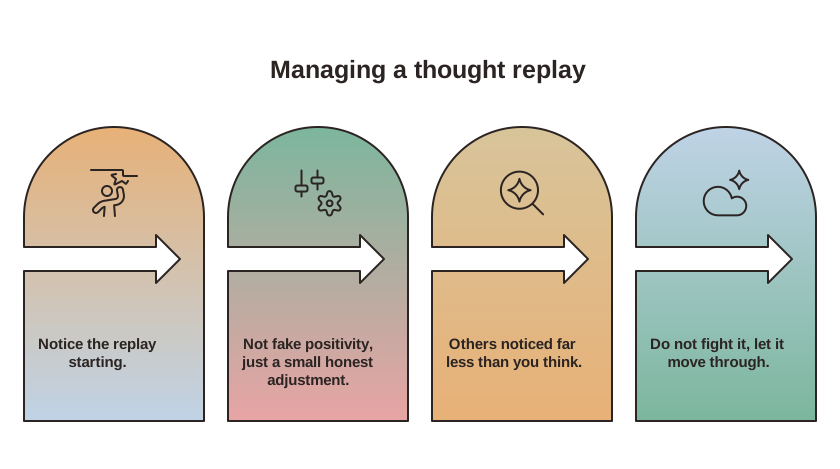
Next time your brain replays something embarrassing, try this 4-step approach:
Step 1: Catch the thought
Notice it clearly — name it as it is: "I'm thinking I sounded stupid."
Naming it creates a small gap between you and the thought.
Step 2: Slightly shift it (not fake positivity)
Don't jump to: "I'm amazing." Your brain rejects the gap as fake.
Instead, go for something believable:
"That moment felt awkward, but it probably wasn't as bad as it feels right now."
Step 3: Add perspective
Remind yourself: "Most people aren't analyzing me the way I am. They have their own worries."
This isn't just a platitude — research on the spotlight effect finds we tend to overestimate how much others notice us.
Step 4: Let it pass (don't fight it)
You don't need to "win" the thought. You just need to loosen its grip.
Notice it, shift it slightly, then redirect your attention. The loop weakens each time you do this.
Why This Works
You're not trying to eliminate the thought. You're reducing its intensity.
Over time, your brain learns: "this isn't a threat." And the loops happen less often. This is the core mechanism behind CBT (cognitive behavioral therapy) — not positive thinking, but more accurate thinking.
The Part Most People Struggle With
In theory, this is simple.
In reality — your mind is overwhelmed, emotions are high, and you can't find the right words in the moment. That's where most people get stuck, not because the approach doesn't work, but because there's nothing there to help in real time.
What Changes Over Time
At first, this just helps you stop spiraling in the moment.
But with repetition:
— your inner voice becomes less harsh
— you recover faster from awkward moments
— you stop overanalyzing everything
The goal isn't to never feel embarrassed. Embarrassment is human.
The goal is to not get stuck there.
Final Thought
If you can't stop thinking about something embarrassing, it doesn't mean you're weak or broken.
It means your brain is trying — badly — to protect you.
When the thought comes back: don't fight it, don't believe it completely either.
Just shift it — slightly.
That's enough to break the loop.
Frequently asked questions
Why can't I stop thinking about something embarrassing?
Your brain replays embarrassing moments because it's wired to protect you from social rejection. It tries to analyze the situation to 'fix' it, but since the moment is over, it gets stuck in a loop — replaying the same thing without reaching a resolution.
How long does embarrassment last in the brain?
The emotional intensity usually peaks within minutes, but the mental replay can last hours or days — especially if you're tired or alone. The loop fades faster when you actively shift your interpretation of the event rather than trying to suppress or ignore it.
Is everyone thinking about my embarrassing moment?
Almost certainly not. This is called the spotlight effect — we overestimate how much others notice and remember our mistakes. In classic experiments, people consistently overestimated how many others had even noticed an embarrassing detail about them.
Why does embarrassment feel worse at night?
At night there are no distractions and you're more tired, which reduces emotional regulation. A thought that was manageable during the day spirals into something much bigger. This is normal and doesn't mean the situation is actually worse than it felt earlier.
What's the best way to let go of an embarrassing memory?
Instead of trying to suppress the thought (which backfires), try shifting your interpretation slightly. Acknowledge it felt awkward, then add a realistic counterweight: 'It felt embarrassing, but most people aren't analyzing me the way I am.' Over time, this teaches your brain the memory is not a threat.
Like what you're reading?
Stop the spiral in real time
MindLift gives you a gentle CBT-based reframe the moment your thoughts start looping.


Free to start · premium optional