
Turn this into a daily habit — free to start in the MindLift app:
The meeting ended at 3:00. It is now 9:40pm and you are still in it — re-running the moment you fumbled the answer, testing alternate takes, checking one more time whether it was as bad as it felt. Everyone else left that room six hours ago. Your brain kept it open. Here's why it does that, what each replay is actually doing to the memory, and how to finally close the door.
Why do I replay conversations in my head?
Because your brain flags possible social missteps as threats worth reviewing — a process psychologists call post-event processing. The replay claims to be extracting a lesson, but studies show it adds no new information; it re-activates the original emotional charge and re-encodes the memory with fresh anxiety attached. It's near-universal after high-stakes interactions and becomes costly at high frequency — a known feature of social anxiety.
Brozovich & Heimberg (2008)
The habit has a name: post-event processing
Replaying social moments is common enough that researchers gave it its own term. Post-event processing is the review your mind conducts after an interaction it cared about — interviews, conflicts, dates, anything where the stakes felt social. The term comes from David Clark and Adrian Wells's 1995 cognitive model of social anxiety, still one of the most widely used in CBT. The review has a stated mission (“figure out how it went”) and an actual behavior (re-living the worst three seconds on loop). It is one of the most studied forms of rumination, and its defining finding is uncomfortable: the replay doesn't do what it claims to do.
Why your brain thinks the rewatch helps
From the inside, replaying feels responsible. You're reviewing the tape, like an athlete. You're making sure you learn the lesson so it never happens again. The loop survives precisely because of this disguise — quitting it feels like choosing to be careless.
But run the athlete comparison honestly. Film review has a structure: watch once, note the correction, done. Your replay has no once. It has no note. It re-runs the same three seconds with mounting dread and produces, on pass after pass, the same conclusion it started with. That's not analysis. That's a fire alarm that keeps ringing after everyone's evacuated.
Reflecting on experience is how people learn. Replaying is something else, and the two lead to very different places:
| Aspect | Reflection | Replay (rumination) |
|---|---|---|
| Question it asks | What happened, and what would I do next time? | Why did I say that? What's wrong with me? |
| New information | Yes, you notice things you missed | No, the same scene on repeat |
| How it ends | A conclusion you can act on | It doesn't end, it fades or restarts |
| How you feel after | Settled, even if a bit uncomfortable | Worse, more certain it went badly |
What each replay actually does
Memory isn't a recording; it's a reconstruction, rebuilt slightly each time you recall it. Which means every anxious replay re-encodes the moment with today's anxiety attached. The conversation isn't getting clearer with review — it's getting heavier. By replay forty, you're no longer remembering the meeting. You're remembering the replays.
Add the curation problem: your brain's negativity bias selects what makes the reel. The one clumsy phrasing is threat-relevant, so it plays forever. The nineteen minutes that went fine were not newsworthy, so they were never filed. The replay presents itself as the honest record of the conversation. It is an edited record, cut by an editor whose only job is finding danger.
That editor also re-shoots the scene from the outside. Socially anxious people often recall a moment as if watching themselves from across the room, and that view is built from how they felt (flushed, stiff, too loud), not from what anyone actually saw. Your friend glanced at her phone; the editor captions it “bored of you.” With every rewatch, the editor's cut feels more like fact.
The thinking traps running the replay
CBT calls these patterns cognitive distortions, or thinking traps. They aren't signs that something is wrong with you; they're shortcuts every brain takes, and anxiety leans on them harder. Four show up in almost every post-conversation replay:
- Mind reading — “She thought I was weird.” You have a glance, a pause and a strong feeling. The feeling is filling in the rest. (More: mind reading, with examples.)
- The spotlight effect — “Everyone noticed I went red.” Thomas Gilovich and colleagues found that people consistently overestimate how much others notice their appearance and slip-ups. You were the main character of your evening. To everyone else, you were one part of theirs.
- Discounting the positive — “She laughed, but she was just being polite.” The awkward pause counts as evidence; the laughter, the follow-up question and the “we should do this again” get an asterisk.
- Catastrophizing — “Now they won't invite me next time.” One long story becomes a damaged friendship by the third replay. (More: catastrophizing, with examples.)
One study is worth keeping in your pocket. Researchers who paired strangers for conversations found what they called the liking gap: afterwards, people consistently underestimated how much their partner liked them and enjoyed the chat. The replay is usually harsher than the person you were talking to. Most people have one or two favorite traps, and a trap you can name loses a lot of its grip.
The social-anxiety connection
Post-event processing shows up in almost everyone occasionally. It shows up reliably and at length in social anxiety — the research literature treats extended post-event review as one of the engines that keeps social fear running, because each distorted replay becomes evidence for the next anticipated disaster. If your replays are frequent, long, and mostly about being judged, it's worth reading our guide to overthinking after talking to someone — and if the pattern is heavy, a licensed therapist can assess what a quiz can't.
How to close a replay loop
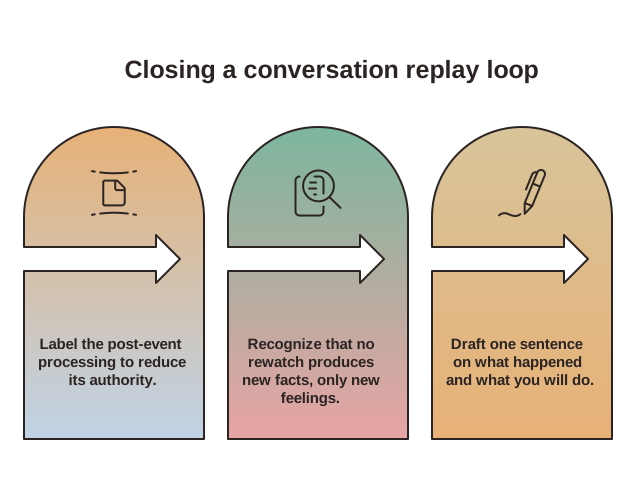
Three moves, in order — the compressed version of our full six-step guide to stopping rumination:
1. Name it. “I'm replaying.” Out loud is better. The label moves you from inside the scene to observing it — and a replay you're observing has lost most of its authority.
2. Run the new-information test. Did the last replay produce a single new fact, or just the same cringe at higher resolution? If it produced something — an actual correction, an apology worth sending — write that down and act on it. If it didn't, the review is complete. It was complete forty passes ago.
3. Check the full tape, then write the closing line. Every replay loop guards one sentence — the thing you're afraid the conversation revealed. “I sounded incompetent.” Write that sentence down and name the trap in it. Then check it against the full tape, not the edit:
- What actually happened, as a camera would have recorded it?
- What happened that doesn't fit my story?
- If a friend told me this exact story about herself, what would I tell her?
The friend question does the most work. Inside your own scene every detail feels loud; thinking about a friend, you naturally step back. Psychologists call this cognitive distancing, and you already have the skill — you use it for everyone except yourself. Now write the most credible (not the most cheerful) reframe next to the original sentence: “One clumsy answer in an otherwise fine meeting is not a reputation event.” Written closure is the receipt the loop has been circling back for.
One replay, worked through in MindLift
Emma, 34, went to a Friday happy hour with three coworkers. Her story about her landlord ran long, and halfway through, Sophie checked her phone. It's 12:40am and Emma has replayed that glance eleven times.
She types the looping sentence into MindLift: “Sophie checked her phone during my story. I was boring everyone and they were waiting for me to stop.” The app names the patterns in it: mind reading (“boring everyone” assumes what three people were thinking) and overgeneralization (one person's glance became “everyone”). Seeing the labels already takes some heat out of it. It's no longer what happened; it's a thought with two traps in it.
Then she picks a tone for the reframe. Realist puts the glance back in proportion — a story ran a bit long, one person looked at her phone, the other two were listening, and one glance isn't a verdict on the evening. Growth would ask what, if anything, she'd actually do differently next time. Compassionate would let her put it down and sleep. Tonight she wants the facts, so she takes the Realist version, saves it to Favorites, and puts the phone down. The thought doesn't vanish. It just stops pulling.
What doesn't work
Two things most people reach for first, and why each one fails:
Distraction. It works — for as long as the distraction lasts. The replay was never waiting on your attention; it comes back the moment the room goes quiet.
Reassurance. "It was fine, nobody noticed." Your brain rejects this, because you're not actually arguing with the memory — you're arguing with a verdict, and a flat denial is not evidence. It reads as someone being nice to you, which is not the same as being right.
Suppression is worse than either. Trying not to think about it hands the thought significance, and significance is what keeps it in the queue. Neither move touches the actual problem: the judgment underneath the memory. Which is why the reframe has to go at the verdict, not the recollection.
Why the replay gets quieter
The first few times you close a loop deliberately, it'll feel effortful and the replay will come back anyway. That's not failure — that's what interrupting a well-worn pattern feels like from the inside.
The research backs the patience. A 2025 meta-analysis found that CBT reduces repetitive negative thinking, the family of loops that includes rumination, worry and the replay. The change comes from repetition, not from one perfect reframe.
Each time you catch the verdict and adjust it, you're teaching your brain something specific: this memory is not an unresolved threat. Over weeks the replays get shorter. The cringe arrives and leaves faster. Eventually they stop registering as emergencies and start registering as things that happened. Not because you got better at conversations — because you stopped re-trying the case.
If this is your signature loop
Replaying the past is one of four distinct rumination styles — some brains rehearse the future instead, some turn events into self-trials, some disguise the loop as problem-solving. Two minutes on our What Kind of Ruminator Are You? quiz tells you which one runs you (no email, instant result — Replayers, this article is your chapter), and the rumination hub has the rest of the series.
Frequently asked questions
Is replaying conversations normal?
Yes — psychologists call it post-event processing, and nearly everyone does it after high-stakes interactions: interviews, conflicts, first meetings. It becomes a problem at the level of frequency and duration, not existence. If most conversations trigger a replay, or a single replay runs for days, the habit is taxing you and worth interrupting deliberately.
Why do I only replay the bad parts?
Negativity bias. Your brain treats possible social missteps as threats worth reviewing and files the parts that went fine as not newsworthy. The result is a systematically unrepresentative highlight reel: one awkward sentence on loop, nineteen unremarkable minutes deleted. The replay feels like an honest record. It is an edited one.
How do I stop replaying a conversation at night?
Night replays run loudest because there's no competing input. Write down the single sentence you're afraid the conversation revealed ('I sounded incompetent'), then write a one-line credible reframe of it ('One clumsy phrasing in an otherwise fine meeting is not a reputation event'). The written form gives the loop the closure receipt it keeps searching for — and gets it off the night shift.
Does replaying conversations mean I have social anxiety?
Frequent post-event review is a well-documented feature of social anxiety, but it isn't proof of it — plenty of people replay conversations without meeting any clinical threshold. A licensed professional can tell the difference. A two-minute pattern check like our rumination-type quiz is a useful starting point for self-understanding, not a diagnosis.
Why do I replay conversations that went fine?
Because the replay isn't really checking whether it went well. It's checking for threat. An anxious brain scans even good conversations for the one moment that could be a problem, and it will usually find a candidate. Research on the liking gap points the same way: after a chat, people tend to underestimate how much the other person liked them.
When should I see a therapist about replaying conversations?
If replaying is affecting your sleep, work or relationships, or you're avoiding social situations because of it, consider seeing a therapist trained in CBT. MindLift is a self-help tool. It isn't a replacement for professional care.
Like what you're reading?
Stop the spiral in real time
MindLift gives you a gentle CBT-based reframe the moment your thoughts start looping.


Free to start · premium optional