Your sleep chronotype isn't just about when you wake up — it predicts how and when you overthink.
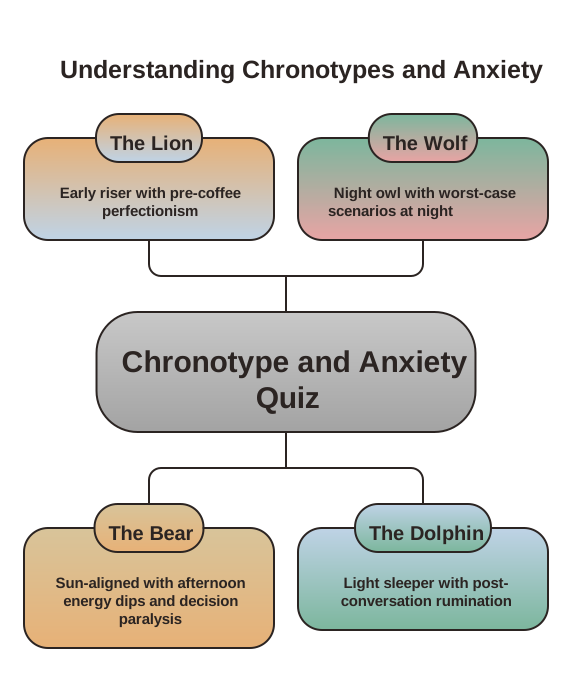
This quiz reveals whether you're a Lion (perfectionism), Bear (decision paralysis), Wolf (2 AM catastrophizing), or Dolphin (constant rumination) — and gives you specific strategies for your type.
The four sleep-linked anxiety patterns — the quiz names your chronotype and its overthinking style.How does this quiz work?
How does this quiz work?
Answer 10 questions about how you usually react, not how you would like to. About 2 minutes is the usual time to finish, there are no right answers, and Chronotype + Anxiety Quiz scores your result on your device — free, no email, no signup.
When do you naturally wake up (without an alarm)?
5–6 AM — I'm up before the sun
7–8 AM — a standard, easy wake-up
8–9 AM or later — mornings are rough
It varies — I have trouble with consistent sleep
When do you feel most alert and focused?
6–9 AM — morning is my prime time
10 AM – 2 PM — mid-morning to midday
12 PM – 6 PM — afternoon and evening
It depends — my energy is all over the place
When do you naturally feel tired?
9–10 PM — I crash early
11 PM – 12 AM — standard bedtime
12 AM – 2 AM — I'm a night owl
I struggle to fall asleep — my mind won't shut off
If you had no obligations, your ideal sleep schedule would be:
Early to bed, early to rise — 9 PM to 5 AM
A natural rhythm — 11 PM to 7 AM
Late nights, late mornings — 2 AM to 10 AM
Unpredictable — I need 8+ hours but never feel rested
How would people describe your energy?
"They're always up before everyone"
"They're reliable and steady all day"
"They're slow to warm up but come alive later"
"They seem tired and wired at unpredictable times"
When do you most struggle with overthinking?
Early morning — I wake up anxious about the day
Afternoon/evening — energy crashes, worry kicks in
Late night (11 PM – 3 AM) — my brain won't shut up
All day — I'm always slightly on edge
Your typical overthinking spiral sounds like:
"I should have done better — I'm not perfect enough"
"I need to make a decision but I can't decide"
"Everything will go wrong — this is a disaster"
"What if people judge me — I can't stop analyzing what I said"
How does poor sleep affect your mental state?
Makes me frustrated with myself and others
I feel sluggish and unmotivated
My mind spirals into worst-case scenarios
I feel anxious and hypervigilant about everything
At 2 AM, you can't sleep because:
Your brain won't stop analyzing something you did
You're going back and forth on a decision
You're catastrophizing about the future
You can't turn off your racing, scanning thoughts
What would most help your overthinking?
Permission to be "good enough" instead of perfect
A framework so I stop second-guessing decisions
A way to interrupt catastrophizing spirals
Tools to calm my anxious mind before bed
What results can you get?
What results can you get?
Your answers sort you into one of 4 results — The Lion, The Bear, The Wolf, The Dolphin. Each result comes with a description of its thinking pattern and one growth move you can practise this week, plus the answer mix that produced it.
Result
Who gets it
What it looks like
The Lion
Majority A answers
Early Riser + Perfectionism
The Bear
Majority B answers
Sun-Aligned + Decision Paralysis
The Wolf
Majority C answers
Night Owl + Catastrophizing
The Dolphin
Majority D answers
Light Sleeper + Rumination
The Lion
Early Riser + Perfectionism
You wake before dawn and hit peak productivity immediately. Your self-critical voice is loudest in the morning — replaying yesterday's performance before you've even had coffee.
You wake before dawn and hit peak productivity immediately. Your strength is discipline and conscientiousness. You thrive on structure and early mornings.
Overthinking pattern: Lions often wake up anxious about yesterday's performance or today's impossibly high standards. The 2 AM spiral sounds like: "Did I do it right? I'm not good enough."
Good enough is still good. One mistake doesn't erase your competence.
The Lion
The 2 AM spiral
The 2 AM spiral sounds like: "Did I do it right? I'm not good enough."
The reframe
Good enough is still good.
One mistake doesn't erase your competence.
Your self-critical voice is loudest in the morning — replaying yesterday's performance before you've even had coffee.
The Bear
Sun-Aligned + Decision Paralysis
You follow the sun's schedule naturally. Bears struggle most during afternoon energy slumps — when "what if I made the wrong choice?" spirals begin.
You follow the sun's schedule naturally. Most of the world is built for your chronotype. Your strength is consistency, adaptability, and steady energy throughout the day.
Overthinking pattern: Bears struggle most during the afternoon energy slump. The 2 AM spiral sounds like: "Did I make the right call? What if I chose wrong? I can't decide, so I do nothing."
No decision is final — most choices are reversible. You have good judgment.
The Bear
The 2 AM spiral
The 2 AM spiral sounds like: "Did I make the right call? What if I chose wrong? I can't decide, so I do nothing."
The reframe
No decision is final — most choices are reversible.
You have good judgment.
Bears struggle most during afternoon energy slumps — when "what if I made the wrong choice?" spirals begin.
The Wolf
Night Owl + Catastrophizing
You come alive as the sun sets. Wolves experience the infamous 2-3 AM spiral: your mind spins worst-case scenarios with full emotional intensity when you're most tired.
You come alive as the sun sets. You're creative, emotionally intense, and forced to fight a 9-to-5 world that wasn't built for you. Your strength is vision and passion.
Overthinking pattern: The 2 AM spiral sounds like: "This one thing will ruin everything. I'm going to fail. This is a disaster." Your brain jumps to the worst possible future and treats it as fact.
Tired thoughts are not accurate thoughts. Your worst-case scenario has almost never happened.
The Wolf
The 2 AM spiral
The 2 AM spiral sounds like: "This one thing will ruin everything. I'm going to fail. This is a disaster."
The reframe
Tired thoughts are not accurate thoughts.
Your brain jumps to the worst possible future and treats it as fact.
The Dolphin
Light Sleeper + Rumination
You're a light, vigilant sleeper — often "wired and tired" at the same time. Your mind replays conversations and scans for threats that aren't there.
You're a light, vigilant sleeper with unpredictable energy. You're often "wired and tired" at the same time. Your strength is sensitivity, awareness, and deep empathy.
Overthinking pattern: Dolphins ruminate endlessly — replaying conversations, analyzing every word, worrying about what people think. Sleep anxiety feeds the rumination cycle, and the cycle feeds the sleep anxiety.
Not every thought is a message. Some are just noise. You can notice a thought without following it for hours.
The Dolphin
The 2 AM spiral
Dolphins ruminate endlessly — replaying conversations, analyzing every word, worrying about what people think.
The reframe
Not every thought is a message. Some are just noise.
You can notice a thought without following it for hours.
Sleep anxiety feeds the rumination cycle, and the cycle feeds the sleep anxiety.Frequently Asked Questions
Frequently Asked Questions
What are the four sleep chronotypes?
The four chronotypes are Lion (early bird, peaks in morning), Bear (follows the sun, most common), Wolf (night owl, peaks in evening), and Dolphin (light/irregular sleeper, often "wired and tired"). Each type has different cognitive and emotional patterns throughout the day.
Why do I overthink more at certain times?
Your chronotype determines when your brain's executive function is weakest. During low-energy windows, cognitive distortions like catastrophizing and rumination intensify because your prefrontal cortex (the "rational brain") has less capacity to regulate anxious thoughts.
Can understanding my chronotype reduce anxiety?
Yes. When you know your vulnerable windows, you can prepare reframes and grounding techniques in advance. A Wolf who knows they catastrophize at 2 AM can keep MindLift ready. A Lion who knows they perfectionism-spiral in the morning can set a compassionate tone before the day starts.
What is a chronotype?
A chronotype is your body's natural tendency toward being a morning person (Lion), standard schedule (Bear), night owl (Wolf), or light/irregular sleeper (Dolphin). It's genetically influenced and affects your energy, mood, and when you're most prone to overthinking.
How does my chronotype affect anxiety?
Your chronotype determines when your brain is most vulnerable to overthinking. Lions tend toward morning perfectionism, Bears hit decision paralysis in the afternoon, Wolves catastrophize at 2 AM, and Dolphins experience rumination throughout the day.
Can I change my chronotype?
Chronotypes are largely genetic, but you can work with yours instead of against it. Understanding your pattern helps you anticipate when overthinking will hit and prepare reframes in advance.
Keep exploring
If you are in crisis or thinking about harming yourself, call or text 988 (US) or find a local line at findahelpline.com. MindLift is a self-help tool and not a replacement for professional care.