
Turn this into a daily habit — free to start in the MindLift app:
The Problem: You're Waiting Until You Break
It's 2 AM. You're awake again. Your brain won't shut up.
You made a small mistake at work today—nothing major, nothing that actually matters. But your mind has decided that one mistake means you're incompetent. That one awkward comment means people think you're weird. That one unclear email means you're going to lose your job.
You're spiraling. And by now, you know the pattern: the spiral will keep you awake for another two hours. Tomorrow, you'll be exhausted. Your focus will tank. You'll snap at someone. Maybe you'll avoid going to that meeting because you're anxious about what people might say.
One small mistake triggered a cascade that's now affecting your sleep, your relationships, your work, and your mood.
Here's the thing: You didn't wake up today broken. But your emotional fitness was weak, and you didn't have the tools to catch it before it spiraled.
If that sounds familiar, you're not alone. Anxiety and stress are among the most common reasons people seek therapy. But most people don't get to therapy until the problem has become severe—until they're having panic attacks or can't get out of bed.
What if there was a way to build emotional fitness before the crisis happens?
What Is Emotional Fitness? (And Why It's Different From Mental Health)
You probably know about physical fitness. It's not something you achieve once and then forget about. It's something you train.
You go to the gym. You build strength gradually. You get better at handling stress on your body. And when you stay consistent, you become more resilient.
Emotional fitness works the same way.
Emotional fitness is your ability to:
- Recognize emotional strain early (before it becomes a crisis)
- Understand what's actually happening (is this thought true? Am I catastrophizing?)
- Respond with skill and compassion (not by spiraling, avoiding, or beating yourself up)
It's not about being positive all the time. It's not about suppressing negative thoughts. It's about building the skill to handle difficult emotions before they hijack your entire life.
The idea is catching on because people increasingly understand that mental health isn't just about treating crisis—it's about building strength for the everyday.
The Three Components of Emotional Fitness
1. Awareness (The Catch)
Emotional fitness starts with catching the problem early. Right now, you might not realize you're spiraling until you've been awake at 2 AM for two hours. Real emotional fitness means recognizing the thought at minute one, not hour two.
This is the difference between:
- ❌ Spinning into a crisis, then trying to fix it
- ✅ Noticing the pattern starting, then addressing it before it takes over
2. Understanding (The Reframe)
Once you catch the thought, you need to understand what's actually happening. Your brain is running a thinking pattern—catastrophizing, mind-reading, all-or-nothing thinking.
The mistake was real. The thought “I'm incompetent” is not.
Emotionally fit people can distinguish between facts and interpretations. They can ask: “Is this thought true? What would a kind, realistic response look like?”
This is where most people get stuck. They either fight the thought (“No, that's not true!”) which creates internal conflict, or they believe it completely (“I AM a failure”).
Emotional fitness teaches a third way: acknowledge the thought, understand the pattern, then shift to a more accurate perspective.
3. Response (The Compassion)
Here's where emotional fitness separates from regular therapy or self-help.
The emotionally fit response to “I made a mistake and I'm incompetent” isn't to pretend everything's fine. It's to respond to yourself with competence and kindness.
Instead of: “I'm so stupid. I always screw things up.”
You learn to say: “I made a mistake. That's human. I've handled hard things before. What can I learn?”
Notice the difference? The second response is firm, realistic, and kind. It's the response you'd give a friend.
Why Emotional Fitness Is Trending Now (And Why 2026 Is Different)
For decades, mental health was treated like physical health after you get sick.
You wait until you have a heart attack, then you go to the cardiologist. You wait until you have severe anxiety, then you go to a therapist.
But that's backwards.
Physical fitness culture understood something: it's way easier and cheaper to build strength before the crisis than to recover after it. That's why gyms exist. That's why people do preventive checkups.
Mental health is finally catching up.
Interest in “emotional fitness” reflects a cultural shift toward preventive mental health. People are tired of waiting until they break to get help.
And the results speak for themselves: research shows that mindfulness-based interventions and emotional regulation practices can meaningfully reduce anxiety and depression and improve overall well-being.
This isn't wishful thinking. This is science.
The Four Pillars of Building Emotional Fitness
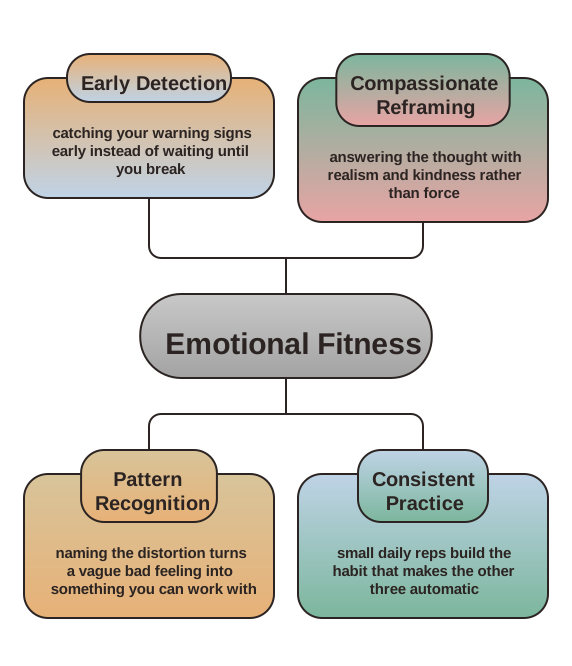
Pillar 1: Early Detection (Know Your Warning Signs)
Emotional fitness starts with noticing the first sign of strain.
For some people, it's a racing heart. For others, it's a tight chest. Some notice they can't focus. Others notice they're suddenly irritable.
🔍 Exercise: Know Your Warning Signs
Over the next week, notice: What's your first sign that your emotions are getting strained? Write it down. Know your warning signs so you can catch them before they spiral.
Pillar 2: Pattern Recognition (Name the Distortion)
Once you catch the strain, you need to understand what thinking pattern you're running.
Common ones:
- Catastrophizing: “One mistake means everything will fall apart”
- Mind-reading: “People think I'm incompetent” (with no evidence)
- All-or-nothing thinking: “I'm either perfect or I'm a failure”
- Overgeneralization: “This one bad thing proves I always fail”
- Should statements: “I should have known better” (with impossible expectations)
When you can name the pattern, it loses power. Instead of “I'm broken,” it becomes “I'm catastrophizing. My brain is trying to protect me from a threat that isn't real.”
That's a massive difference.
Pillar 3: Compassionate Reframing (The Response)
This is where the magic happens.
Instead of fighting the thought or believing it, emotionally fit people respond to it with a balanced, compassionate perspective.
The harsh inner voice says: “You're incompetent. You'll never succeed.”
The emotionally fit response: “I made one mistake. I've succeeded many times before. I'm capable. What can I learn from this?”
Notice: It's not toxic positivity (“Everything's fine!”). It's realistic and kind. It acknowledges the pain while offering perspective.
Pillar 4: Consistent Practice (Build the Habit)
Here's where most people stumble.
You can't build physical fitness by going to the gym once. You have to do it consistently.
Emotional fitness is the same.
The people who see the biggest shifts are the ones who practice daily. Even 5-10 minutes of catching a thought, naming the distortion, and shifting to a compassionate response builds the neural pathway.
After a few weeks, your brain starts defaulting to the compassionate response automatically. That's neuroplasticity. That's real change.
The Real-World Impact: What Changes When You Build Emotional Fitness
Scenario 1: The Work Mistake
❌ Without Emotional Fitness
- Make small mistake at work
- Spiral for 2 hours (catastrophizing, shame)
- Can't sleep
- Exhausted tomorrow
- Avoid going to meeting
- Anxiety persists for days
✅ With Emotional Fitness
- Make small mistake at work
- Notice the harsh inner voice
- Recognize the catastrophizing pattern
- Shift to: “Mistakes happen. What's next?”
- Sleep normally
- Anxiety passes in 30 minutes
Pillar Impact: Better sleep, better work performance, less shame, faster recovery. One skill compounds into multiple life improvements.
Scenario 2: Social Anxiety
❌ Without Emotional Fitness
- Say something awkward in conversation
- Mind-reading spiral: “Everyone thinks I'm weird”
- Avoid social situations
- Isolation increases anxiety
- Becomes a long-term pattern
✅ With Emotional Fitness
- Say something awkward
- Notice: “I'm mind-reading”
- Compassionate response: “One moment doesn't define me”
- Continue the conversation
- Social confidence builds over time
Pillar Impact: Better relationships, less isolation, increased confidence, reduced anxiety over time.
How to Start Building Emotional Fitness Today
You don't need a therapist (though therapy helps). You don't need to wait for a crisis.
Here are three concrete steps to start today:
Step 1: Catch One Thought This Week (5 minutes)
Notice one moment when you feel strained. Write down what the harsh inner voice is saying.
Example: “I'm never going to be good enough” or “I'll always be alone” or “I made a mistake so I'm incompetent.”
Just write it down. Don't judge it. Don't try to fix it yet.
Step 2: Name the Pattern (2 minutes)
What distortion is happening? Catastrophizing? All-or-nothing thinking? Mind-reading? Overgeneralization?
Naming it separates you from it. Now it's “a thought pattern” instead of “the truth.”
Step 3: Write a Compassionate Response (3 minutes)
What would you tell a friend who just said what you said to yourself?
Write that down. That's your compassionate response.
Example:
Harsh voice: “I'm never going to be good enough”
Compassionate response: “You're struggling right now, and that's real. But struggling doesn't make you ‘not good enough.’ You've overcome hard things before. Be kind to yourself.”
The Tool That Makes Emotional Fitness Practical
Here's the challenge: Knowing about emotional fitness and actually practicing it are two different things.
It's one thing to read this article and think “Yeah, I should do that.” It's another to actually catch yourself at 2 AM, name the pattern, and reframe when you're in the middle of spiraling.
That's where structured practice helps. This is why tools like MindLift exist.
MindLift is designed specifically for people who overthink and struggle with their inner critic. Here's how it makes emotional fitness practical:
- Catch (The Logger): When you notice the harsh thought, you log it in the app instead of letting it spiral.
- Understand (The Pattern Identifier): The app identifies the thinking pattern — catastrophizing, mind-reading, or all-or-nothing thinking.
- Shift (The Reframe): The app generates 2-3 compassionate reframes based on CBT principles — not generic positivity, but actual balanced perspectives.
- Track (The Progress Meter): Instead of wondering “Is this working?”, you see measurable progress over weeks.
This is the emotional fitness equivalent of watching your bench press increase or your mile time improve. You can see yourself getting stronger.
The Bottom Line: Emotional Fitness Is a Skill, Not a Personality Trait
You're not “someone who overthinks” or “someone with anxiety” as a permanent identity.
You're someone with a thinking pattern that can be trained.
And like any skill, the better you practice, the stronger you get.
The people with the highest emotional fitness aren't people who never feel anxious or sad or scared. They're people who:
- Catch those feelings early
- Understand them clearly
- Respond with skill and compassion
That's trainable. That's buildable. That's possible for you.
The question isn't “Can I do this?” The question is “Will I start practicing?”
Next Steps: Your Emotional Fitness Journey
- Week 1: Learn the four thinking distortions you struggle with most.
- Week 2-4: Catch one thought per day. Name the pattern. Write a compassionate response.
- Month 2: Add daily tracking. Notice how your emotional intensity changes week to week.
- Month 3: You'll notice you're catching spirals faster. Your harsh inner voice is quieter.
That's emotional fitness. That's the skill that changes everything.
The Science Behind This
A meta-analysis of randomized trials of self-compassion interventions found real, meaningful benefits compared with control groups:
- Self-criticism: Reduced after structured self-compassion practice
- Anxiety: Reduced compared with control groups
- Depression: Reduced compared with control groups
One leading explanation, from compassion-focused therapy, is that self-compassion engages a soothing, safeness-related emotion system that self-criticism shuts down. It's not weakness. It's a trainable skill.
Frequently asked questions
What is emotional fitness?
Emotional fitness is the capacity to notice, understand, and respond to difficult emotions without being overwhelmed or reactive. Unlike traditional mental health framing (fixing what's broken), emotional fitness treats emotional regulation as a trainable skill — something you can strengthen through consistent practice, the same way physical fitness works.
How do you build emotional fitness?
Through three core practices: (1) emotion labeling — naming what you're feeling precisely, which reduces amygdala activation; (2) thought-catching — noticing cognitive distortions before they spiral; (3) intentional response — choosing a response to a feeling rather than reacting automatically. Apps like MindLift provide daily structure for this practice.
What is the difference between emotional fitness and mental health?
Mental health is the absence of disorder; emotional fitness is the presence of skill. You can have adequate mental health and still have poor emotional fitness (reactive, easily overwhelmed). Building emotional fitness improves mental health outcomes, but the two aren't the same thing.
Can emotional fitness reduce anxiety?
Yes. Anxiety is largely a function of how the nervous system interprets and responds to uncertainty. Higher emotional fitness means faster recovery from stress, better ability to tolerate ambiguity, and fewer catastrophic interpretations — all of which reduce anxiety's frequency and intensity over time.
Like what you're reading?
Take control of your mental wellness
Reframe the thought that started it — personalized CBT reframes in the MindLift app.


Free to start · premium optional