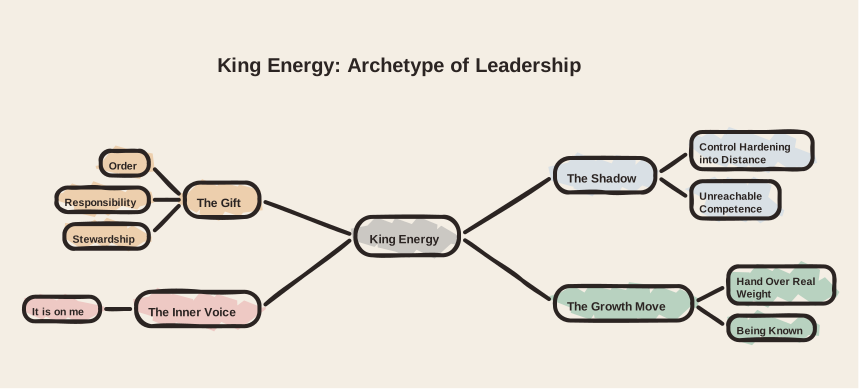
You hold things together — and your inner voice insists, "It's on me." Your growth lives in the space between carrying everything and trusting someone else with a piece of it.
You create order. At work, at home, in your friend group — when things wobble, people look at you, and you've stopped being surprised by that. You make the call, absorb the pressure, and keep the whole thing standing. At your best, you're the reason other people get to feel safe.
Your inner voice runs on responsibility: "It's on me." Often it genuinely is. But repeated long enough, that sentence quietly rewires you — rest starts to feel like negligence, asking for help starts to feel like abdication, and you end up ruling a kingdom nobody can enter.
Your shadow is control that hardens into distance. Under pressure you don't get loud; you get colder and more decisive, handling everything so thoroughly that nobody can reach you. The cost isn't your competence — it's that the people you're providing for stop actually knowing you.
Growth edge: authority and openness aren't opposites. You can stay the steady one and still say "I don't know" out loud, still hand someone a real piece of the weight. When the grip tightens, ask — "Is this mine to carry, or am I carrying it because being needed feels safer than being known?"
here's one thing to try tonight: Delegate one real thing this week — not the scraps, something that matters — and let it be done differently than you'd do it. A king who can't be reached isn't strong; he's alone. Being known is not a threat to being respected.
The group chat stalls on where to stay for the trip. You book something, send the confirmation and quietly absorb the two complaints that follow.
A friend is going through a rough patch and you handle his logistics: the lawyer's number, the ride to the airport. You never mention that your own month is full.
At 2am you run the household like a ledger, rent, school forms, the leak under the sink, and conclude that if you sleep, something slips.
The blind spot
Kings tend to mistake being needed for being close. Because you answer every problem, people bring you problems and keep their own feelings to themselves, and you take that as proof that you must stay on duty. The competence is genuine. What stays out of view is that nobody has seen you unsure, so nobody knows how to help you.
A thought you may know, and a kinder answer
The thought: "If I let go of one thing and it goes wrong, everyone gets hurt and it was my call."
A kinder answer: "Most outcomes have more than one person's hands on them. I can pick one low-stakes task, name what done looks like and let someone else run it. If it comes back different, we adjust."
Often confused with
The Warrior: The Warrior is in the same family but drives at hard things personally and pays in exhaustion. The King mostly arranges the ground so everyone else can act, and pays in distance.
The Protector: The Protector scans for danger and stands in front of it. The King is thinking about the whole structure: who decides, who pays, what happens next quarter.
Other results in this quizFrequently Asked Questions
Frequently Asked Questions
Does The King mean I am controlling?
Not necessarily. Control is the pattern this type slides toward under strain, usually with good intentions. A fair check is whether your grip is protecting people or only quieting your own worry. Many Kings are generous with authority once they trust the person receiving it.
How can a King ask for help without feeling weak?
Start with a request that has a clear edge, such as one errand or one decision, and say it in a plain sentence. Asking for a defined piece is closer to delegating than confessing. Over time people learn that you can receive as well as give.
If you are in crisis or thinking about harming yourself, call or text 988 (US) or find a local line at findahelpline.com. MindLift is a self-help tool and not a replacement for professional care.
The questions and result descriptions in this quiz draw on the studies below. The quiz is a self-reflection tool, not a diagnosis, and none of these papers tested this quiz itself.
Jung CG (1959). The Archetypes and the Collective Unconscious (Collected Works, Vol. 9, Part 1). Princeton University Press (Bollingen Series XX).
Moore R, Gillette D (1990). King, Warrior, Magician, Lover: Rediscovering the Archetypes of the Mature Masculine. HarperSanFrancisco.