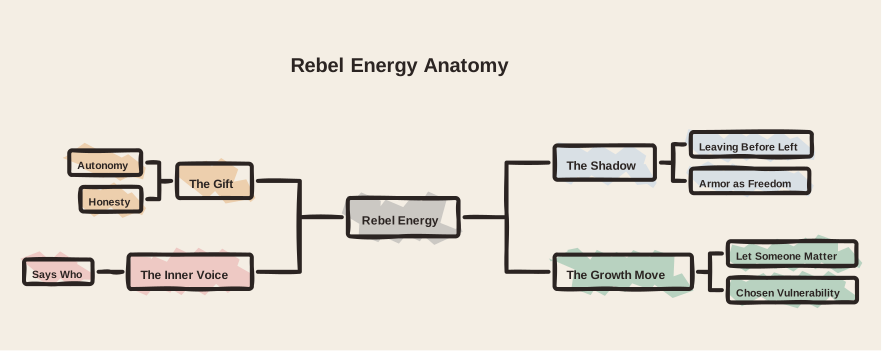
You refuse the script, and your inner voice answers every expectation the same way: "Says who?" Your independence is real — and so is the wall it can build.
You don't run on approval. Where other people see rules, you see suggestions written by someone who isn't living your life — and you've built a self by refusing scripts that didn't fit. People call you difficult until the moment they need someone who'll say the true thing out loud.
Your inner voice answers pressure with "Says who?" It's the question that saved you — from bad advice, dead-end paths, other people's definitions of a good life. It's also the reflex that can fire at things worth keeping.
Your shadow is the lone wolf. Distance becomes proof of strength: you leave before you're left, dismiss before you're disappointed, and call it freedom when some of it is just armor. No one controls you — and lately, no one really reaches you either.
Growth edge: autonomy that allows attachment. Letting someone matter isn't surrendering the self you fought for — it's the harder, braver use of it. Before you pull away next time, ask: "Am I protecting my freedom, or just protecting the wound?"
here's one thing to try tonight: Pick one person and let them in one level deeper than feels comfortable. Independence you can never set down isn't freedom — it's a wall with good branding. Vulnerability, chosen deliberately, is the most rebellious thing left.
Your manager sends a new process and your first thought is who decided that, before you have even read it. You follow it, but resentfully.
A friend gets close and starts to depend on you. You find a reason to be busy for two weeks and call it needing space.
Alone at 2am, you replay an argument you won, and notice that nobody has texted to check whether you are okay.
The blind spot
Rebels often believe their distance is a conclusion, when it began as a defense. Refusing the script protected you from people who wanted to define you, and the reflex still fires when someone merely cares. Because you leave first, you rarely find out which relationships could have held. People admire your honesty and may not notice how seldom you let them back.
A thought you may know, and a kinder answer
The thought: "If I let someone matter, they get a hold on me, and eventually I pay for it."
A kinder answer: "Letting one person closer does not erase my independence, and I can still leave if it stops being right. I will stay one conversation longer than usual and see what actually happens."
Often confused with
The Explorer: The Explorer is not against anything. He is drawn toward the next horizon, and leaving is about curiosity. The Rebel leaves or pushes back to protect himself, and the exit is about autonomy.
Same name, different quiz
The Rebel: The Archetype Test Rebel sits inside the Explorer family and learns to build something it is for. This one is the head of its own family, the lone wolf, and the growth question is whether you are protecting your freedom or protecting a wound.
The Rebel: The Female Archetypes Rebel hears "No one controls me" and works on letting people in. Here the voice is "Says who?" and the shadow is leaving before you are left.
Other results in this quizFrequently Asked Questions
Frequently Asked Questions
Is The Rebel just a difficult person?
Rebels can be inconvenient, but the core is honesty and a refusal to fake agreement. People often call you difficult right up until they need someone who will say the true thing. The pattern becomes costly only when pushing back is the default, whatever the situation.
Can a Rebel be close to people?
Yes, once closeness is something you choose rather than something that happens to you. Letting a trusted person know one real thing, with your exit still available, builds trust gradually. Many Rebels find that being known takes more nerve than leaving.
If you are in crisis or thinking about harming yourself, call or text 988 (US) or find a local line at findahelpline.com. MindLift is a self-help tool and not a replacement for professional care.
The questions and result descriptions in this quiz draw on the studies below. The quiz is a self-reflection tool, not a diagnosis, and none of these papers tested this quiz itself.
Jung CG (1959). The Archetypes and the Collective Unconscious (Collected Works, Vol. 9, Part 1). Princeton University Press (Bollingen Series XX).
Moore R, Gillette D (1990). King, Warrior, Magician, Lover: Rediscovering the Archetypes of the Mature Masculine. HarperSanFrancisco.