Discover your dominant masculine archetype — instant results
About 5 minutes36 questions
Start with question 1 of 36
When something goes wrong in a group, you:
About this quiz
The 12 Male Archetypes Test
Discover your dominant masculine archetype — instant results
The 12 male archetypes are the King, Warrior, Protector, Sage, Magician, Creator, Lover, Caregiver, Jester, Rebel, Explorer and Hero: recurring patterns in how a man leads, thinks, connects and breaks rules. They build on Carl Jung's archetypes and Moore and Gillette's King, Warrior, Magician, Lover model, grouped into four families of three.
Every man carries multiple archetypes. Some lead. Some build. Some protect. Some refuse the script entirely.
This masculine archetype quiz reveals your dominant male archetype, your secondary pattern, your shadow, and the sentence your inner voice repeats under pressure.
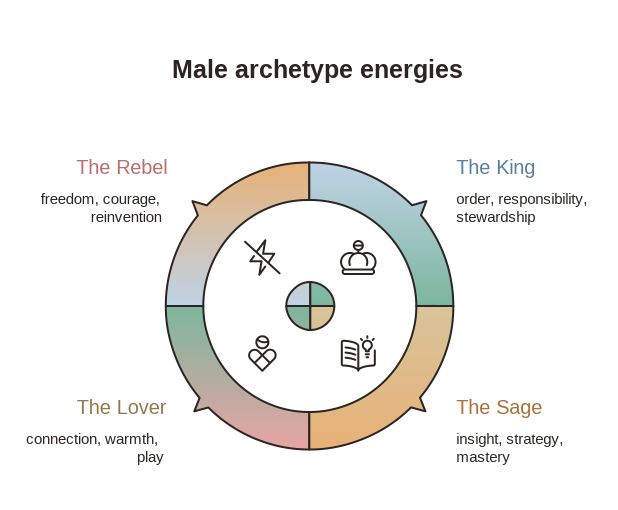
The four energy families the quiz finds first — each holds three of the twelve archetypes, and the final statements pick one.
A reflection model built on Jung's archetypes and Moore and Gillette's four masculine archetypes, grouped into four families — an educational self-discovery tool, not a validated psychometric or clinical assessment.
The 12 male archetypes at a glance
Four energy families, three archetypes each: King, Sage, Lover and Rebel. The first 24 questions find your family; the 12 rated statements pick the archetype inside it. Each name links to its full page.
The 12 Male Archetypes Test has 36 questions and takes about 5 minutes. The first 24 questions place you in one of four energy families: King, Sage, Lover or Rebel. The last 12 are statements you rate from "Not me" to "Exactly me", and the highest-rated statement inside your family names your dominant archetype.
Your result can also name a secondary archetype, the top-rated one inside your runner-up family, plus the shadow pattern your archetype tends to fall into under stress and the sentence your inner voice repeats. There are no right answers, so answer for how you usually react, not how you would like to.
What this quiz is: a free self-reflection tool, scored on your device with no email or signup. What it is not: a clinical test, a diagnosis or a validated personality measure. Archetypes are a reflective lens from Jungian psychology, so use your result to notice a pattern, not to label yourself.
When something goes wrong in a group, you:
Your natural role among friends:
Your biggest strength:
When someone lets you down:
Your ideal environment:
Your inner voice usually says:
You feel most alive when:
Your deepest fear:
Under real stress, you:
People respect your:
You handle a breakup or major loss by:
Your energy in a room:
Your relationship style:
When you feel insecure, you:
The life you actually want includes:
You trust decisions made by:
You value most:
When criticized, you:
Your idea of a great weekend:
Your hidden side:
In friendships, you:
Your shadow shows up as:
You recharge by:
Deep down, you want to be:
I feel steadiest when I'm the one setting direction.
I like finding the hidden mechanism in things, and using it to change the outcome.
I defuse tension with a joke, sometimes before I've felt it myself.
When a rule makes no sense, I'd rather break it than live with it.
I measure myself by how much I can push through.
I feel most like myself when I'm building something from my own ideas.
I feel things deeply, and the people I love can tell they're truly seen by me.
Staying in one place too long makes me restless.
In a crisis my first move is to stand between my people and the problem.
I'd rather understand something fully than act on it quickly.
I show love by looking after people: fixing, providing, turning up.
When everyone else is still talking about the hard thing, I'm already doing it — and proving I can.
What results can you get?
What results can you get?
Your answers sort you into one of 12 results — The King, The Warrior, The Protector, The Sage, The Magician, The Creator, and 6 more. Each result comes with a description of its thinking pattern and one growth move you can practise this week, plus the answer mix that produced it.
Result
Who gets it
What it looks like
The King
King family, top-rated statement
Order, responsibility, stewardship
The Warrior
King family, top-rated statement
King family · Discipline, drive, advancing through resistance
The Protector
King family, top-rated statement
King family · Vigilance, loyalty, holding the line
The Sage
Sage family, top-rated statement
Wisdom, depth, perspective
The Magician
Sage family, top-rated statement
Sage family · Transformation, mastery, making the impossible practical
The Creator
Sage family, top-rated statement
Sage family · Craft, vision, building what you imagine
The Lover
Lover family, top-rated statement
Depth, devotion, presence
The Caregiver
Lover family, top-rated statement
Lover family · Steadiness, generosity, showing up
The Jester
Lover family, top-rated statement
Lover family · Levity, connection, lifting the room
The Rebel
Rebel family, top-rated statement
Autonomy, edge, honesty
The Explorer
Rebel family, top-rated statement
Rebel family · Momentum, curiosity, moving toward the unknown
The Hero
Rebel family, top-rated statement
Rebel family · Courage, proof, rising to the moment
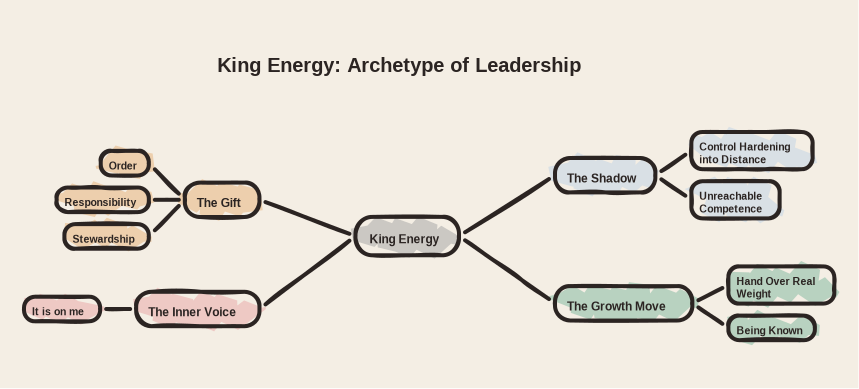
You hold things together — and your inner voice insists, "It's on me." Your growth lives in the space between carrying everything and trusting someone else with a piece of it.
You create order. At work, at home, in your friend group — when things wobble, people look at you, and you've stopped being surprised by that. You make the call, absorb the pressure, and keep the whole thing standing. At your best, you're the reason other people get to feel safe.
Your inner voice runs on responsibility: "It's on me." Often it genuinely is. But repeated long enough, that sentence quietly rewires you — rest starts to feel like negligence, asking for help starts to feel like abdication, and you end up ruling a kingdom nobody can enter.
Your shadow is control that hardens into distance. Under pressure you don't get loud; you get colder and more decisive, handling everything so thoroughly that nobody can reach you. The cost isn't your competence — it's that the people you're providing for stop actually knowing you.
Growth edge: authority and openness aren't opposites. You can stay the steady one and still say "I don't know" out loud, still hand someone a real piece of the weight. When the grip tightens, ask — "Is this mine to carry, or am I carrying it because being needed feels safer than being known?"
here's one thing to try tonight: Delegate one real thing this week — not the scraps, something that matters — and let it be done differently than you'd do it. A king who can't be reached isn't strong; he's alone. Being known is not a threat to being respected.
King family · Discipline, drive, advancing through resistance
You move toward the hard thing while others are still negotiating with themselves — and your inner voice says, "Push through." Your growth lives between proving you can take more and letting yourself stop.
You go at difficulty directly. The early start, the hard set, the conversation nobody else will have, the project that needs one more week of grinding — you'd rather face it than spend energy avoiding it. Where the King holds the ground, you take it. People want you beside them when things get hard, because you don't flinch and you don't quit.
Your inner voice runs on effort: "Push through." It built everything you're proud of. But said on every lap, it quietly rewires you — every finish line turns into a starting line, every warning sign reads as weakness to override, and tired starts to sound like an insult you have to answer.
Your shadow is the grind with no off switch. Exhaustion becomes your proof of effort, as if being depleted were a receipt. And when you feel threatened, your edge can turn into aggression — at other people, or at the "soft" version of yourself you've been trying to outrun.
Growth edge: recovery is training too. A warrior who never rests is just a casualty in progress, and staying with a hard feeling takes the same discipline as staying with a hard set. When the push comes, ask — "Is this the fight that matters, or am I proving something to a voice that is never satisfied?"
here's one thing to try tonight: Schedule one real recovery block this week — on the calendar, like training — and protect it the way you'd protect a session. If "push through" shows up during it, name it — "there's the push" — and keep resting anyway.
King family · Vigilance, loyalty, holding the line
You stand between the people you love and whatever's coming — and your inner voice keeps watch: "Not on my watch." Your growth lives between guarding everyone and letting yourself be guarded too.
You're the one on watch. You notice the loose step, the late text, the shift in the room before anyone names it. You drive at night, track the flight until it lands, and plant yourself between your people and the problem without being asked. Where the King builds the walls, you walk them — and the people around you sleep better because you're awake.
Your inner voice is a vow: "Not on my watch." It's the reason people feel safe around you. But a watch with no end of shift quietly rewires you — calm starts to read as "not yet," rest feels like leaving a post unmanned, and every quiet evening becomes one more perimeter check.
Your shadow is hyper-vigilance. You scan for threats so constantly that you're never actually in the room — at the dinner, but mentally running the what-ifs. And protection can drift into monitoring: checking, restricting, deciding for people what's safe, when what they needed was you beside them.
Growth edge: safety includes yours. You can guard the door and still let yourself be comforted, checked on, looked after. When the scanning starts, ask — "Is there a real threat here, or has my body just forgotten how to stand down?"
here's one thing to try tonight: Once this week, hand the watch to someone else — let them drive, plan the route, or handle the thing you'd usually handle — and stay off duty until it's done, even if they do it differently.
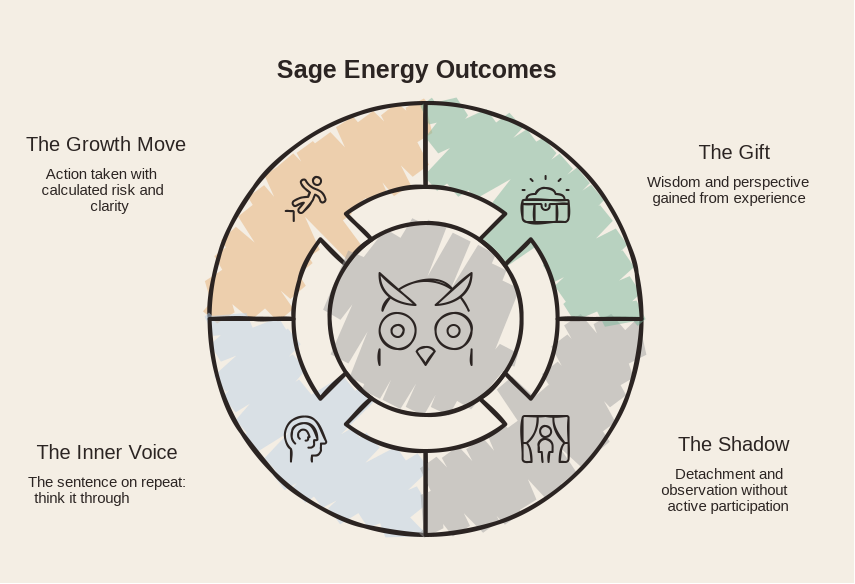
You understand before you act, and your inner voice rarely rests: "Think it through." Insight is your gift — and, sometimes, the room you hide in.
You see the pattern under the noise. While others react, you're already three layers down — reading the incentives, the history, the thing nobody's saying. People bring you their tangled problems because you hand them back untangled, and you're almost never fooled by the surface of things.
Your inner voice says "Think it through" — as if the right amount of analysis could make risk disappear. So you gather one more angle, one more counter-argument, long after you already know enough to move.
Your shadow is detachment. Understanding becomes a substitute for participating: you can explain your own life with stunning accuracy while standing entirely outside it. Feelings get analyzed instead of felt; decisions get studied instead of made.
Growth edge: insight that never becomes action is just sophisticated avoidance. When you catch the loop, name the feeling underneath the analysis — then take one concrete step before you feel fully certain. Clarity usually arrives after the move, not before it.
here's one thing to try tonight: Once a day, act at 80% certainty. Feel, don't just decode: when the analysis loop starts, ask "what am I feeling right now, in one word?" — then move. Your mind is a brilliant advisor and a terrible place to hide.
Sage family · Transformation, mastery, making the impossible practical
You turn knowledge into results other people can't explain — and your inner voice always has an angle: "There's a way." Your growth lives between working the system and letting yourself be seen working.
You find the hidden mechanism. Where the Sage explains how the system works, you operate it — spotting the lever, the workaround, the quiet adjustment that changes the outcome. Problems other people call impossible look to you like puzzles that haven't been solved yet, and you usually solve them.
Your inner voice says "There's a way." On hard problems, it makes you nearly unstoppable. But run on everything, it rewires you — it starts promising you can route around every difficult conversation, every direct request, every moment of being seen mid-struggle.
Your shadow is staying behind the curtain. Operating unseen starts as preference and becomes protection: engineering outcomes instead of risking honest, visible effort, influencing instead of asking, arranging instead of telling. People get the result — and never quite get you.
Growth edge: let people see the work. Being witnessed mid-process is its own kind of mastery, and influence is not the same as intimacy. When you reach for the clever route, ask — "Am I finding a better way, or finding a way not to be seen trying?"
here's one thing to try tonight: This week, ask for one thing directly — in a plain sentence, no setup, no engineering the moment — and let the other person answer however they answer.
Sage family · Craft, vision, building what you imagine
You'd rather build the thing than talk about the thing — and your inner voice keeps raising the bar: "Build it better." Your growth lives between the standard that makes your work good and the finish line it keeps moving.
You make real things. A shelf, a song, a product, a plan that actually ships — you think with your hands and your ideas, and you feel most like yourself when something exists that didn't before. Where the Sage understands and the Magician transforms, you build, and your standards are why the things you make are worth wanting.
Your inner voice says "Build it better." It's the standard behind your best work. But "better" has no end state, and treated as a stop condition instead of a direction, it rewires you — every draft becomes a reason to wait, and every flaw you can see becomes a reason nobody else sees anything.
Your shadow is perfectionism. "Not ready yet" becomes the permanent address of everything you make: the project stuck at 90%, the finished-but-unshown work, the idea kept safe from judgment by never leaving the workshop. Somewhere in there, criticism of the work starts to feel like criticism of you.
Growth edge: ship the imperfect version. Finished and real beats flawless and unmade, and unpolished time with the people you love counts as much as the perfect gesture. When you reach for one more revision, ask — "Is this making the work better, or keeping me from being judged on it?"
here's one thing to try tonight: Pick one thing you've been holding at "almost" and show it to one person this week, as it is. Decide beforehand that their reaction is information about the work, not a verdict on you.
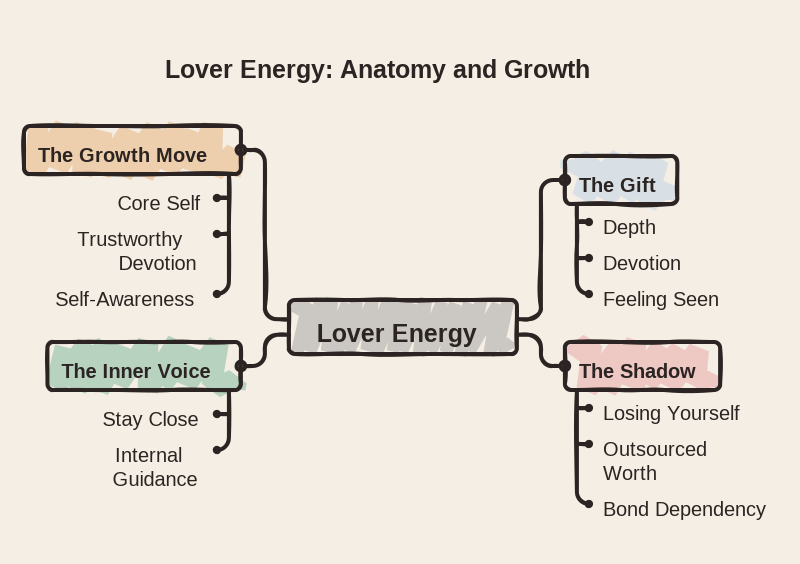
You feel more than you let on, and your inner voice keeps checking the bond: "Stay close." Your depth is a gift — it doesn't have to cost you yourself.
You run deep. You notice the shift in someone's voice before they've admitted anything's wrong; you remember what matters to people; you love with a thoroughness that most men were never taught and most people never forget. Connection isn't a part of your life — it's the engine of it.
Your inner voice scans the bond: "Stay close." You read tone, timing, the pause before a reply — checking that the people you love are still with you. When the connection feels solid, you're unshakeable. When it wavers, everything else goes quiet.
Your shadow is losing yourself in the "us." Your mood, your worth, your sense of okay-ness get outsourced to how the relationship feels today. You can become so tuned to what someone else needs that you genuinely can't say what you want.
Growth edge: devotion with a self in it. The love you give doesn't become smaller when you keep a core that's yours — it becomes trustworthy. Practice letting a quiet moment be just quiet, and answering "what do I want?" before you've checked what anyone else needs first.
here's one thing to try tonight: Once a day, name what you want before checking what anyone else needs. Your depth isn't a liability to manage — but it needs a self at the center of it. A quiet moment is not evidence of distance.
You're the one people call, and you always pick up — and your inner voice keeps the line open: "They need me." Your growth lives between carrying everyone and letting someone carry you.
You show love by showing up. The lift to the airport, the fixed tap, the late-night call, the friend's move you cleared your weekend for — you notice what people need and handle it before they've finished asking. Where the Lover feels deeply, you turn that feeling into action, and the people around you have a steadier life because you're in it.
Your inner voice says "They need me." Often it's true — and that's the trap. It's a sentence with no room for you in it, and repeated long enough it rewires you: every request justifies itself, every boundary feels like abandonment, and rest becomes something you have to earn by being needed harder first.
Your shadow is self-erasure. Being needed becomes your identity, so your own needs don't get suppressed so much as stop registering. You can describe exactly how everyone else is doing and have no idea how you are — and you give people what you quietly wish someone would give you.
Growth edge: let someone carry you for once. Receiving isn't a debt, and needing isn't weakness. Say what you need as a sentence instead of hoping it gets deduced. When the next request comes in, ask — "Do I want to do this, or am I afraid of who I am if I'm not needed?"
here's one thing to try tonight: This week, say one need out loud as a plain sentence — "I could use a hand with this" or "I need a quiet night" — to someone who'd be glad to help, and let them.
Lover family · Levity, connection, lifting the room
You can read a room and lift it in one line — and your inner voice keeps the weight off: "Keep it light." Your growth lives between the joke that connects and the joke that keeps people out.
You're the release valve. You spot the tension a beat before anyone else, find the line that breaks it, and get a tired team or a tense family dinner through the night. Your humor is a way of loving people — you notice what the room needs and give it, fast. Plenty of people have survived a hard stretch partly because you were in it.
Your inner voice says "Keep it light." It may have started as a job — someone needed the mood managed, and you were good at it. But running on its own, it rewires you: depth starts to register as danger, and every approach to your real feelings turns into material before you've felt them yourself.
Your shadow is deflection with perfect timing. The joke arrives precisely when the feeling gets close, every time. Ask how you're really doing and the bit begins — and often the funnier you're being, the further away you are. People love your company and still don't quite know you.
Growth edge: let one serious moment stay serious. The people who love your humor can handle your weight too. When you feel the line coming in a hard conversation, ask — "Is this joke for the room, or is it for getting me out of here?"
here's one thing to try tonight: In one real conversation this week, when you feel the joke loading, hold it for ten seconds and say one true sentence instead. The joke can still come after.
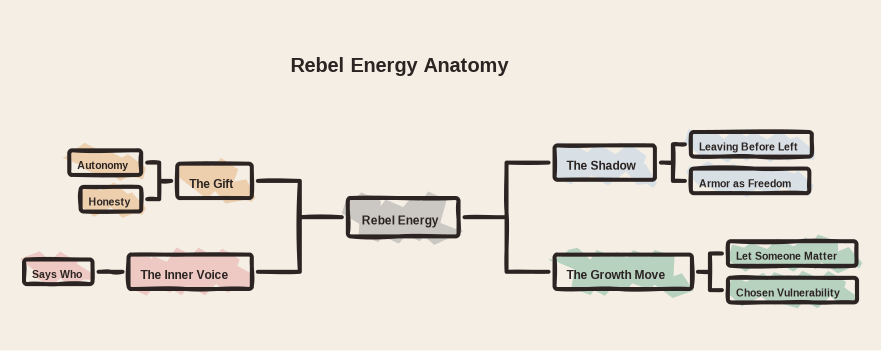
You refuse the script, and your inner voice answers every expectation the same way: "Says who?" Your independence is real — and so is the wall it can build.
You don't run on approval. Where other people see rules, you see suggestions written by someone who isn't living your life — and you've built a self by refusing scripts that didn't fit. People call you difficult until the moment they need someone who'll say the true thing out loud.
Your inner voice answers pressure with "Says who?" It's the question that saved you — from bad advice, dead-end paths, other people's definitions of a good life. It's also the reflex that can fire at things worth keeping.
Your shadow is the lone wolf. Distance becomes proof of strength: you leave before you're left, dismiss before you're disappointed, and call it freedom when some of it is just armor. No one controls you — and lately, no one really reaches you either.
Growth edge: autonomy that allows attachment. Letting someone matter isn't surrendering the self you fought for — it's the harder, braver use of it. Before you pull away next time, ask: "Am I protecting my freedom, or just protecting the wound?"
here's one thing to try tonight: Pick one person and let them in one level deeper than feels comfortable. Independence you can never set down isn't freedom — it's a wall with good branding. Vulnerability, chosen deliberately, is the most rebellious thing left.
Rebel family · Momentum, curiosity, moving toward the unknown
You're most alive at the edge of the map — and your inner voice keeps pointing past it: "What's out there?" Your growth lives between the freedom to go and the courage to stay.
You move toward the unknown. New city, new skill, new market, the trail nobody's taken — the first draft of anything lights you up. Where the Rebel refuses the script, you walk off the edge of it to see what's there. Your range is real, and people come alive around your curiosity because it reminds them the world is bigger than their routine.
Your inner voice asks "What's out there?" It's the question that built your range. But it fires loudest exactly when something here starts to matter — and repeated at every threshold, it rewires you: the familiar starts to feel like shrinking, and staying starts to feel like settling.
Your shadow is never landing. Every commitment feels like a cage the moment it becomes real — the job at month six, the relationship when it deepens, the place once it's familiar. You leave things at their halfway point and call the pattern growth, when some of it is just a well-practiced exit.
Growth edge: stay long enough to be changed by something. Some places only open after the novelty ends, and being fully known by someone may be the one frontier that asks you to stand still. When the itch hits, ask — "Am I moving toward something, or away from something that's starting to matter?"
here's one thing to try tonight: Pick one thing you're tempted to drop because it's gone ordinary — a project, a habit, a conversation — and give it one more deliberate week before you decide.
Rebel family · Courage, proof, rising to the moment
You do the hard thing while others are still discussing it — and your inner voice resets every morning: "Prove it." Your growth lives between what you achieve and who you are without it.
You rise to the moment. When the stakes are high and the room is still talking, you're already moving — taking the risk, taking the blame, taking the impossible quarter. Where the Rebel defies expectations, you set out to beat them. People believe your goals because you've hit enough of them, and in a real crisis you're the one they want.
Your inner voice says "Prove it." It built your track record. But it's a debt that never gets paid off, and repeated long enough it rewires you: yesterday's summit becomes today's baseline, each win buys less relief than the last, and a day without progress starts to feel like losing ground as a person.
Your shadow is worth through achievement. You can't tell the difference between resting and disappearing. Everything becomes a performance for an invisible judge — even love, even rest has to be done impressively — and the ordinary, unwitnessed parts of life start to feel like wasted time.
Growth edge: you were worth something before the last win, and you'll be worth something after. Practice existing unwitnessed — hours, then days, where nothing gets achieved and you're still enough. Before the next big push, ask — "Who is this for? Me, or the judge who is never impressed?"
here's one thing to try tonight: Spend one evening this week doing something you're average at, with nobody watching and nothing to show for it afterward. Notice the urge to make it count — and let it not count.
The questions and result descriptions in this quiz draw on the studies below. The quiz is a self-reflection tool, not a diagnosis, and none of these papers tested this quiz itself.
Jung CG (1959). The Archetypes and the Collective Unconscious (Collected Works, Vol. 9, Part 1). Princeton University Press (Bollingen Series XX).
Moore R, Gillette D (1990). King, Warrior, Magician, Lover: Rediscovering the Archetypes of the Mature Masculine. HarperSanFrancisco.
Now meet the archetype that runs your shadow
Now meet the archetype that runs your shadow
Your dominant archetype is the version of you that leads when life feels safe. A different pattern takes over when you feel cornered, criticized, or exposed. The shadow archetype quiz names that pattern in 12 statements, about 2 minutes, no email.
The 12 male archetypes are: King, Warrior, Protector, Sage, Magician, Creator, Lover, Caregiver, Jester, Rebel, Explorer, and Hero. Each represents a distinct pattern of masculine energy, inner voice, and behavior drawn from Jungian archetype theory.
Is the 12 male archetypes quiz really free?
Yes — free to take, with no email required, no signup, and no paywall on your result. The quiz is 36 questions and takes about 5 minutes. Your results — dominant archetype, shadow pattern, and inner voice — are shown immediately.
Is this the King, Warrior, Magician, Lover test?
It builds on that framework. King, Warrior, Magician, and Lover come from Moore and Gillette's classic model of the mature masculine; this quiz extends it to 12 archetypes organized into four families, each with a gift, a shadow, and an inner voice.
How does this male archetype test work?
36 questions. The first 24 find your energy family (King, Sage, Lover or Rebel). The last 12 are statements you rate; the highest-rated one inside your family is your archetype.
Can I have more than one archetype?
Yes. Most men carry a dominant archetype and a strong secondary one. If two scores are close, you have a dual archetype — which is common and means you draw strength from more than one family.
Is the male archetype test scientifically valid?
No. The male archetypes quiz is not a validated psychological measure, and its results have not been tested for reliability or validity the way a clinical test would be. It is a self-reflection tool built on Carl Jung's idea of archetypes and Moore and Gillette's King, Warrior, Magician and Lover model. Use your result to notice your inner voice under pressure, not as a diagnosis.
Keep exploring
If you are in crisis or thinking about harming yourself, call or text 988 (US) or find a local line at findahelpline.com. MindLift is a self-help tool and not a replacement for professional care.