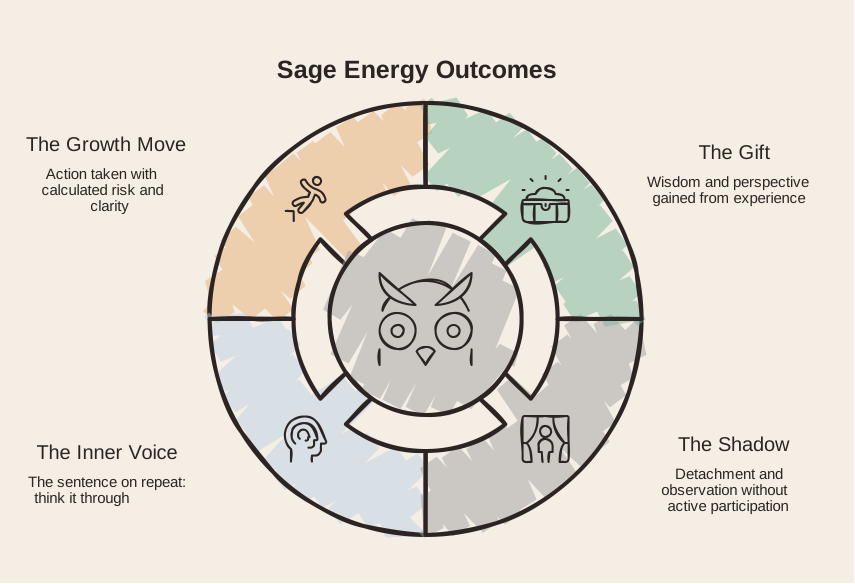
You understand before you act, and your inner voice rarely rests: "Think it through." Insight is your gift — and, sometimes, the room you hide in.
You see the pattern under the noise. While others react, you're already three layers down — reading the incentives, the history, the thing nobody's saying. People bring you their tangled problems because you hand them back untangled, and you're almost never fooled by the surface of things.
Your inner voice says "Think it through" — as if the right amount of analysis could make risk disappear. So you gather one more angle, one more counter-argument, long after you already know enough to move.
Your shadow is detachment. Understanding becomes a substitute for participating: you can explain your own life with stunning accuracy while standing entirely outside it. Feelings get analyzed instead of felt; decisions get studied instead of made.
Growth edge: insight that never becomes action is just sophisticated avoidance. When you catch the loop, name the feeling underneath the analysis — then take one concrete step before you feel fully certain. Clarity usually arrives after the move, not before it.
here's one thing to try tonight: Once a day, act at 80% certainty. Feel, don't just decode: when the analysis loop starts, ask "what am I feeling right now, in one word?" — then move. Your mind is a brilliant advisor and a terrible place to hide.
A friend asks whether he should take the job. You lay out three scenarios and the tradeoffs, and realize later you never said what you would choose.
You read four reviews and a comparison thread before buying a ten-dollar part, then still hold off, because the fifth angle might change everything.
At 2am you give a hard conversation a full forensic review, tone, timing, subtext, and call the result understanding even though nothing has moved.
The blind spot
Sages tend to believe that enough analysis will eventually remove the discomfort of choosing. It rarely does, because the discomfort was never about missing information. Over time this makes you reliable as an adviser and oddly absent as a participant, and your feelings get explained before they are felt. Friends often know your opinions better than your moods.
A thought you may know, and a kinder answer
The thought: "I do not know enough yet, and acting too early would be a mistake I could have avoided."
A kinder answer: "I know enough to take a first step that can be undone. I will decide by Friday, write down why, and treat what I learn as new information rather than a verdict on my judgment."
Often confused with
The Magician: The Magician uses what he understands to change outcomes, often quietly. The Sage mostly keeps understanding and may never reach the lever.
The Creator: Both delay. The Creator holds back a finished thing until it is good enough to show. The Sage holds back a decision until the picture feels complete.
Same name, different quiz
The Sage: In the Archetype Test the Sage hears "Think it through first" and the growth step is acting before certainty.
The Sage: In Female Archetypes the voice is "Think more" and the growth step is to feel rather than process. Here the focus is acting at partial certainty and naming the feeling under the analysis.
Other results in this quizFrequently Asked Questions
Frequently Asked Questions
Is overthinking the same as being a Sage?
Overthinking is the shadow, not the whole type. A Sage who is doing well sees patterns others miss and gives advice people trust. The pattern turns unhelpful when more analysis replaces a decision, so the useful test is whether the extra thinking changes your choice.
What is a practical way to act sooner?
Set a decision deadline before you start researching, and choose a reversible first step. Then ask yourself in one word what you are feeling. Naming it often shows that the real hesitation is emotional, and more data would not have solved it.
If you are in crisis or thinking about harming yourself, call or text 988 (US) or find a local line at findahelpline.com. MindLift is a self-help tool and not a replacement for professional care.
The questions and result descriptions in this quiz draw on the studies below. The quiz is a self-reflection tool, not a diagnosis, and none of these papers tested this quiz itself.
Jung CG (1959). The Archetypes and the Collective Unconscious (Collected Works, Vol. 9, Part 1). Princeton University Press (Bollingen Series XX).
Moore R, Gillette D (1990). King, Warrior, Magician, Lover: Rediscovering the Archetypes of the Mature Masculine. HarperSanFrancisco.