Turn this into a daily habit — free to start in the MindLift app:
Every archetype has one sentence it reaches for when something it cares about feels threatened. Call it the signature thought. It arrives fast, it sounds like common sense, and it quietly starts the same loop every time.
This article gives each of the twelve classic archetypes its signature thought, the four-step loop that thought tends to set off, and one reframe that answers it. The reframes come from cognitive behavioural therapy (CBT), where catching a thought and answering it with a more accurate, believable alternative is a core skill with a strong evidence base[1]. Re-reading a situation in a new way, known as cognitive reappraisal, is also one of the more effective ways people change how they feel[2].
Not sure which archetype leads in you? Take the 12 archetypes test first, then come back to your section. If you want the gentler, everyday version of each archetype’s voice, read the sentence each of the 12 archetypes repeats.
How a signature thought becomes a loop
A signature thought is a prediction. If I say no, they’ll stop needing me. If something goes wrong, it’s on me. Predictions like these push you toward a protective move, such as overgiving, tightening control or avoiding a conversation. The move brings short-term relief, then a cost: exhaustion, distance, a bigger problem. That cost feels like proof the original thought was right, so the next time it arrives it sounds even more convincing.
Each card below shows that loop in four steps, then the reframe. The reframe is not a pep talk or an affirmation you have to force yourself to believe. It answers the specific claim inside the thought, so the loop has something to push against.
A note on the families. This article groups the twelve archetypes into four families by what each one protects most: freedom, connection, stability and mastery. That is this article’s own grouping. Other systems sort the same names differently; the MindLift archetype test, for example, groups them under the Ruler, Sage, Lover and Explorer. The cards also use the name Everywoman for the archetype many lists call the Everyman.
The Freedom family
The Innocent, the Sage and the Explorer each protect a kind of freedom: freedom from conflict, from being wrong, and from being pinned down. Their signature thoughts all point toward escape, whether that means staying quiet, thinking longer or leaving.
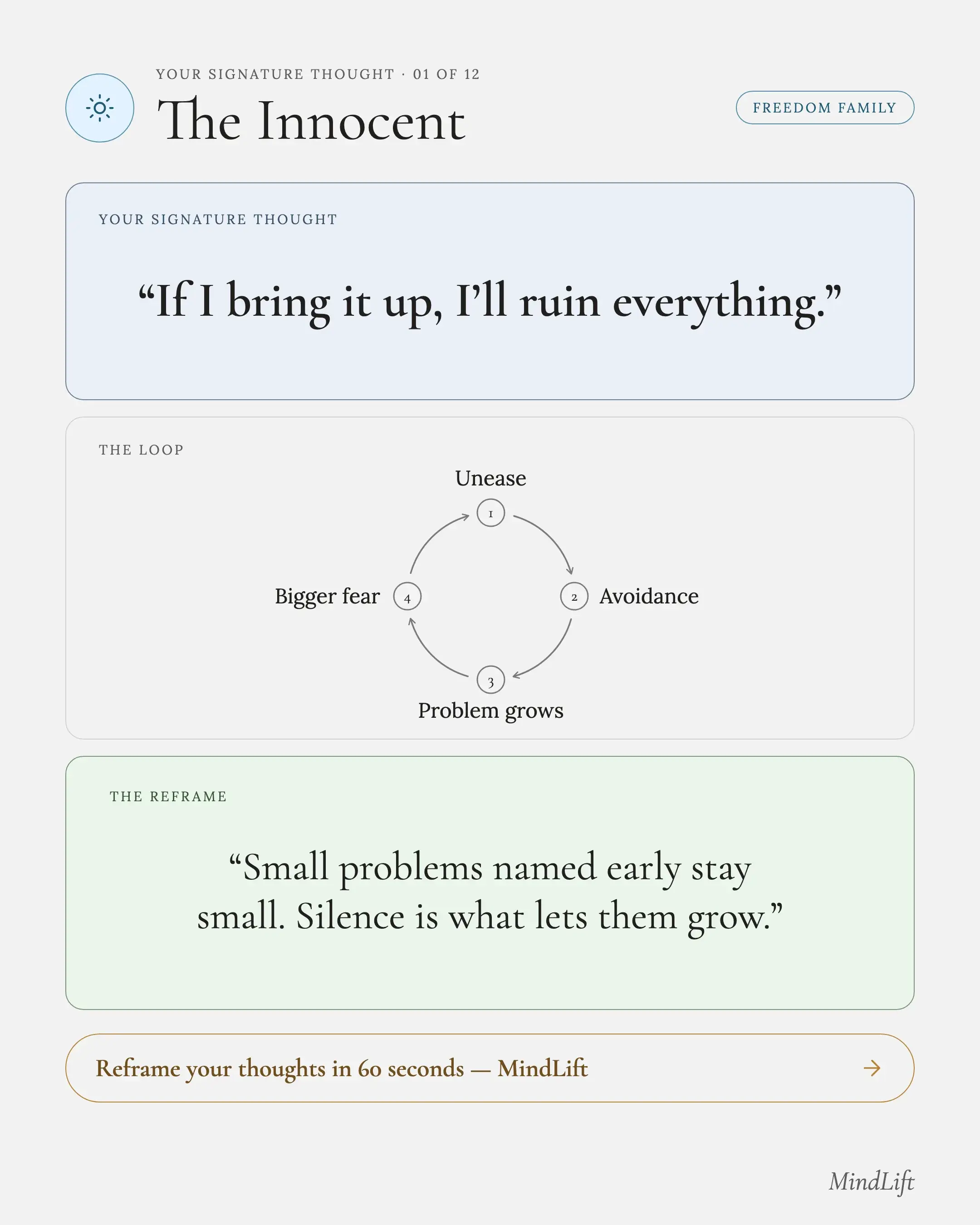
The Innocent: “If I bring it up, I’ll ruin everything.”
The Innocent values peace and trust, so the signature thought predicts that naming a problem will destroy the good thing. In CBT terms this is catastrophising. The loop runs from unease to avoidance, the problem grows in silence, and the bigger fear makes speaking up feel even riskier.
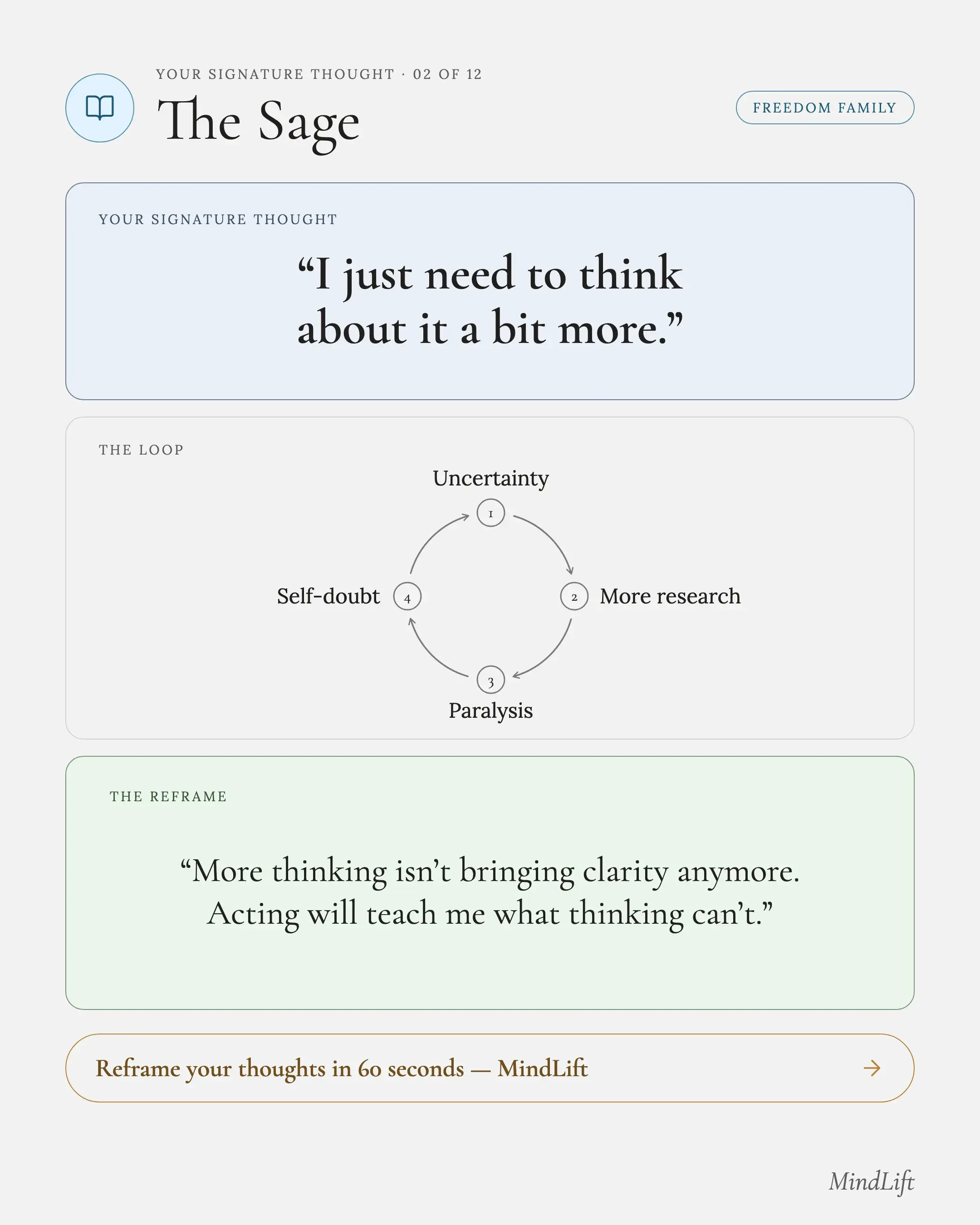
The Sage: “I just need to think about it a bit more.”
The Sage values understanding, so uncertainty feels like a problem that more information will solve. Past a point, it doesn’t. More research turns into paralysis, paralysis turns into self-doubt, and self-doubt creates fresh uncertainty. The reframe accepts that some answers only come from acting.
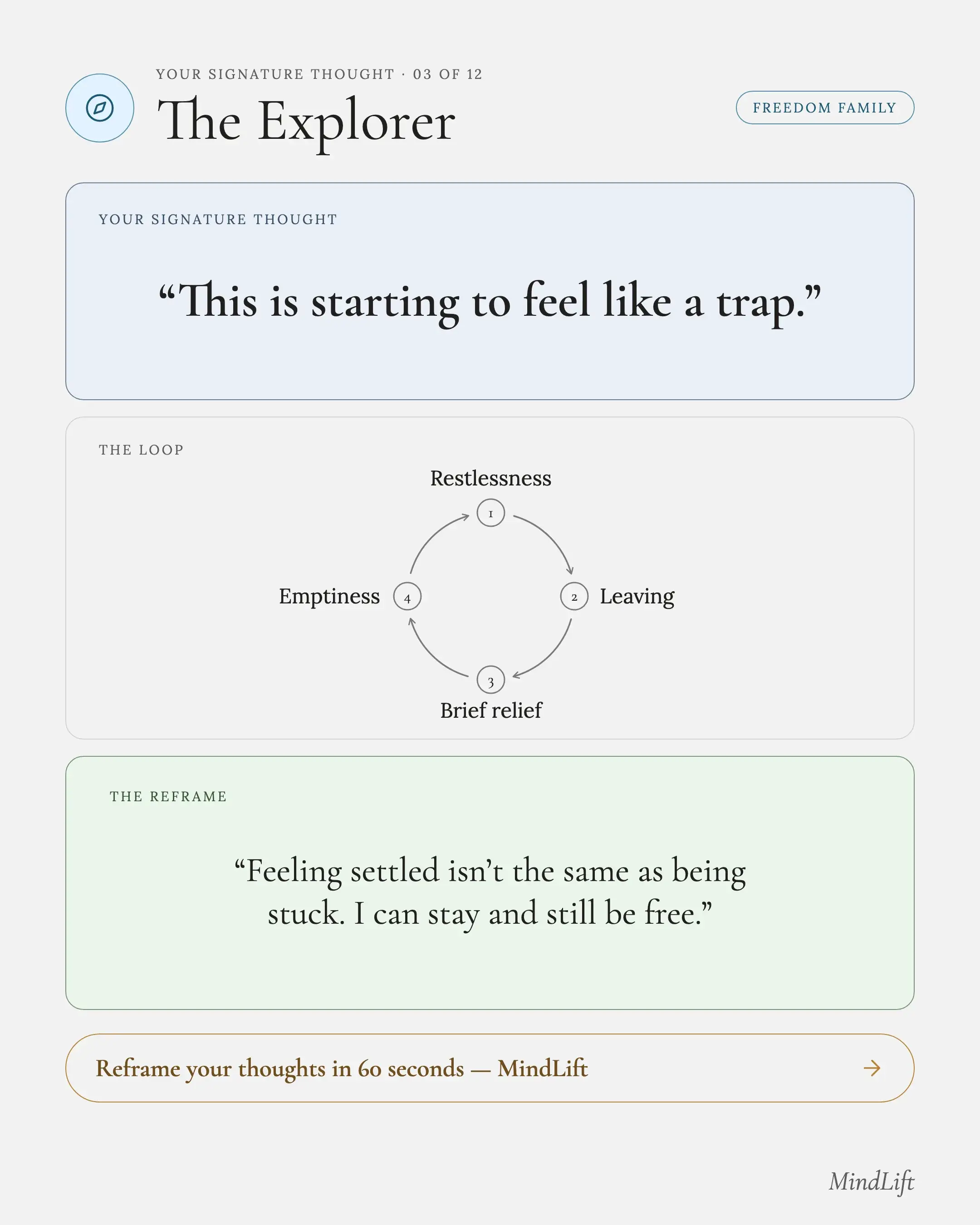
The Explorer: “This is starting to feel like a trap.”
The Explorer values freedom and new experience, so commitment can register as confinement. Feeling restless gets read as evidence of being stuck, which is emotional reasoning. Leaving brings brief relief, then emptiness, and the restlessness returns somewhere new. The reframe separates feeling settled from being trapped.
The Connection family
The Lover, the Jester and the Everywoman each protect closeness and belonging. Their signature thoughts predict that being fully themselves, or wanting too much, will cost them the people they care about.
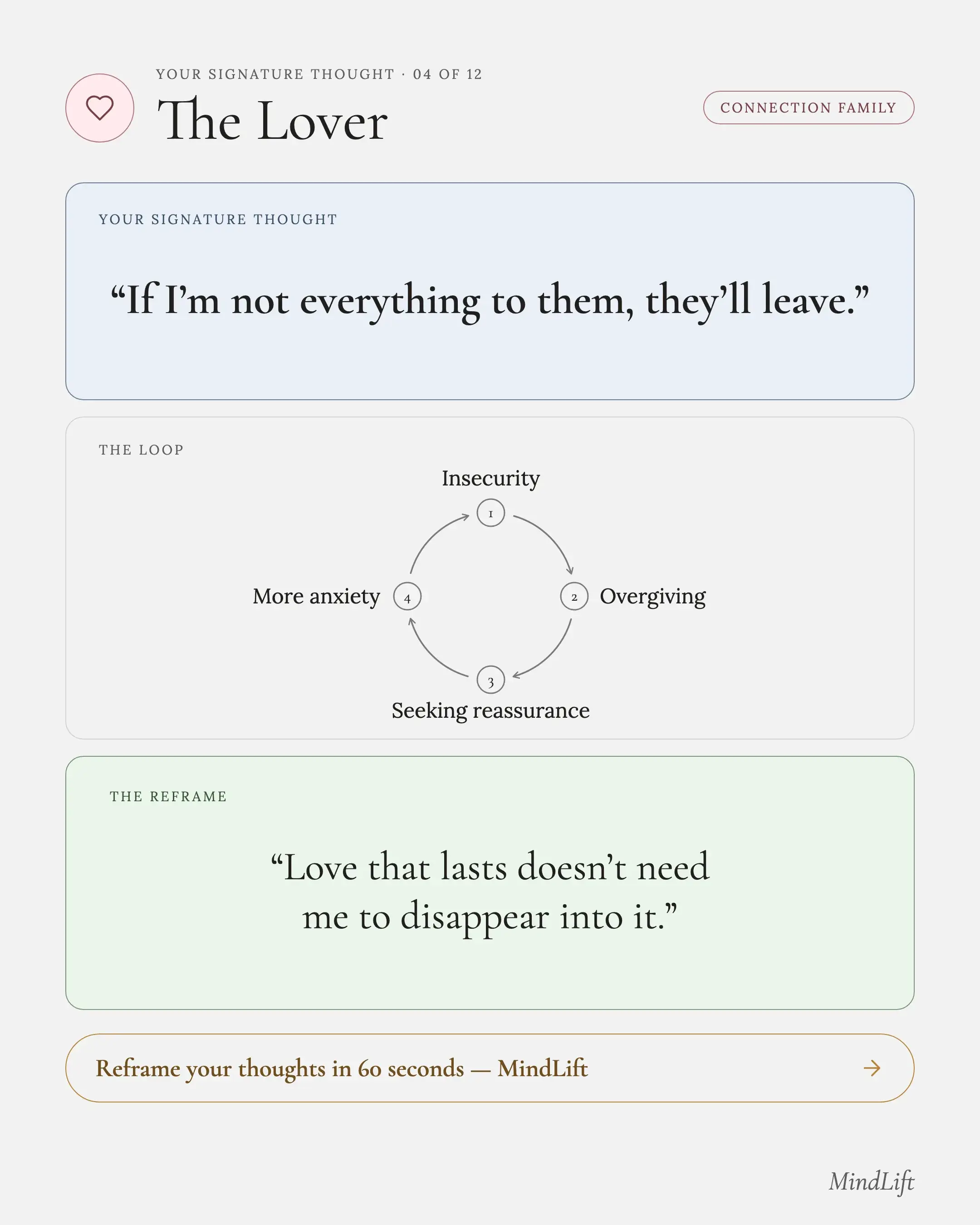
The Lover: “If I’m not everything to them, they’ll leave.”
The Lover values deep connection, so any distance can feel like the start of losing someone. Insecurity leads to overgiving and seeking reassurance, and reassurance only calms the fear for a while, so anxiety climbs again. The reframe treats lasting love as something that has room for two whole people.
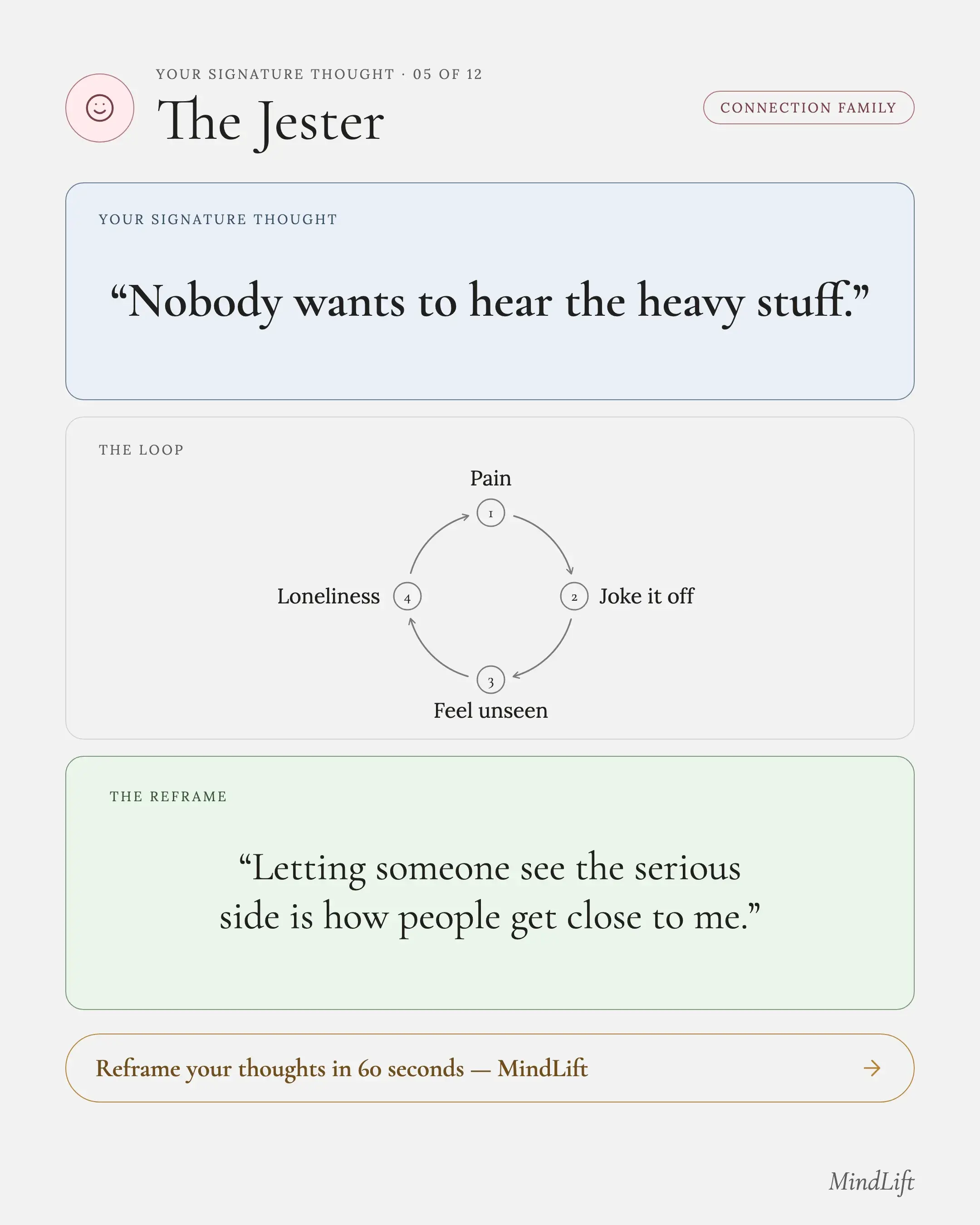
The Jester: “Nobody wants to hear the heavy stuff.”
The Jester values lightness and making others feel good, so the signature thought assumes everyone else would rather not see the pain. That is mind reading. Joking it off keeps the room comfortable but leaves the Jester feeling unseen, and the loneliness that follows hurts more than the original pain.
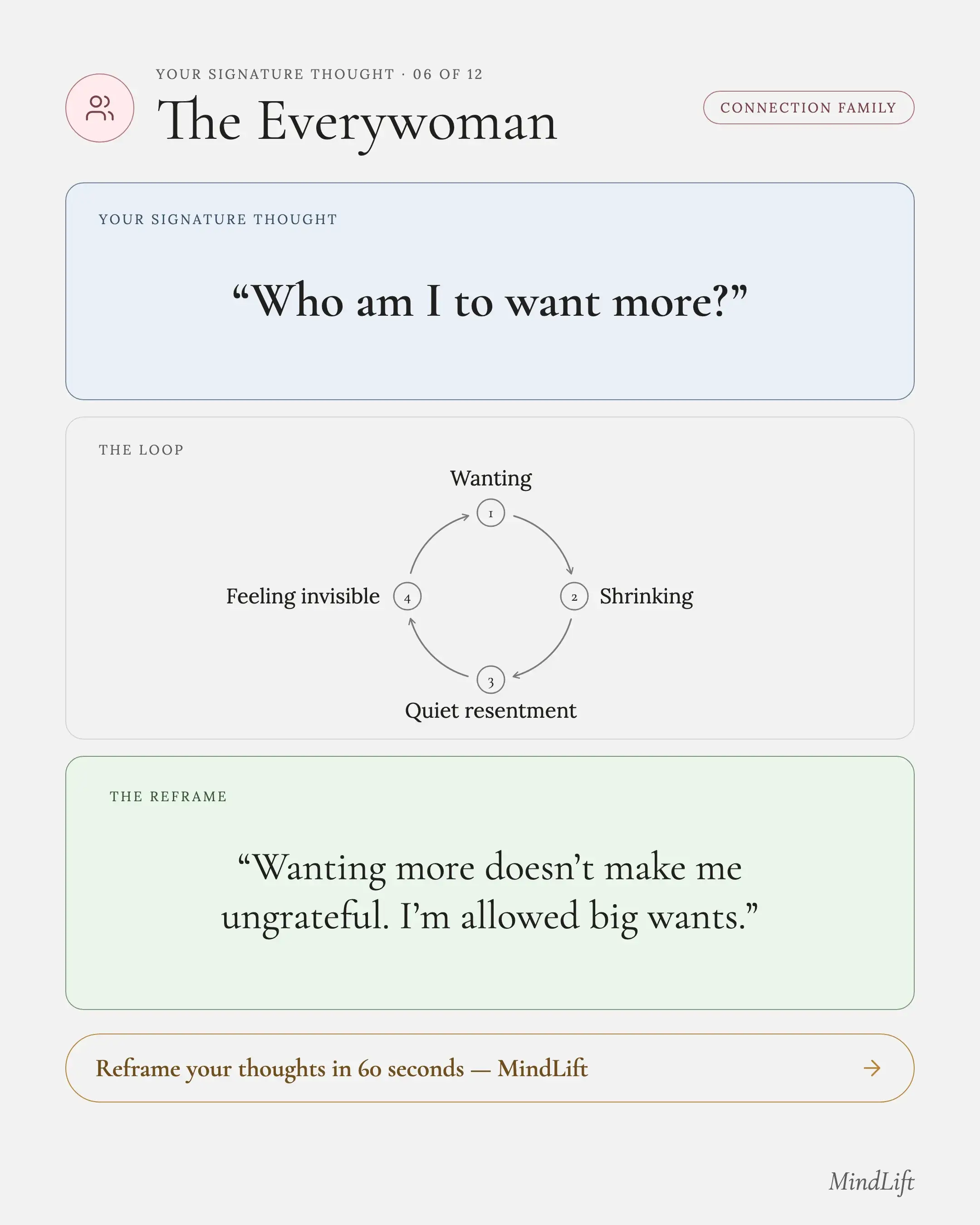
The Everywoman: “Who am I to want more?”
The Everywoman values belonging and fairness, so wanting more than others can feel like breaking an unwritten rule. A wish gets shrunk before anyone hears it. The shrinking turns into quiet resentment and a sense of being invisible. The reframe gives wanting permission to exist without being labelled ungrateful.
The Stability family
The Caregiver, the Ruler and the Creator each protect something steady: being needed, keeping things on track, and being good enough at what they make. Their signature thoughts put the full weight of an outcome on one person.
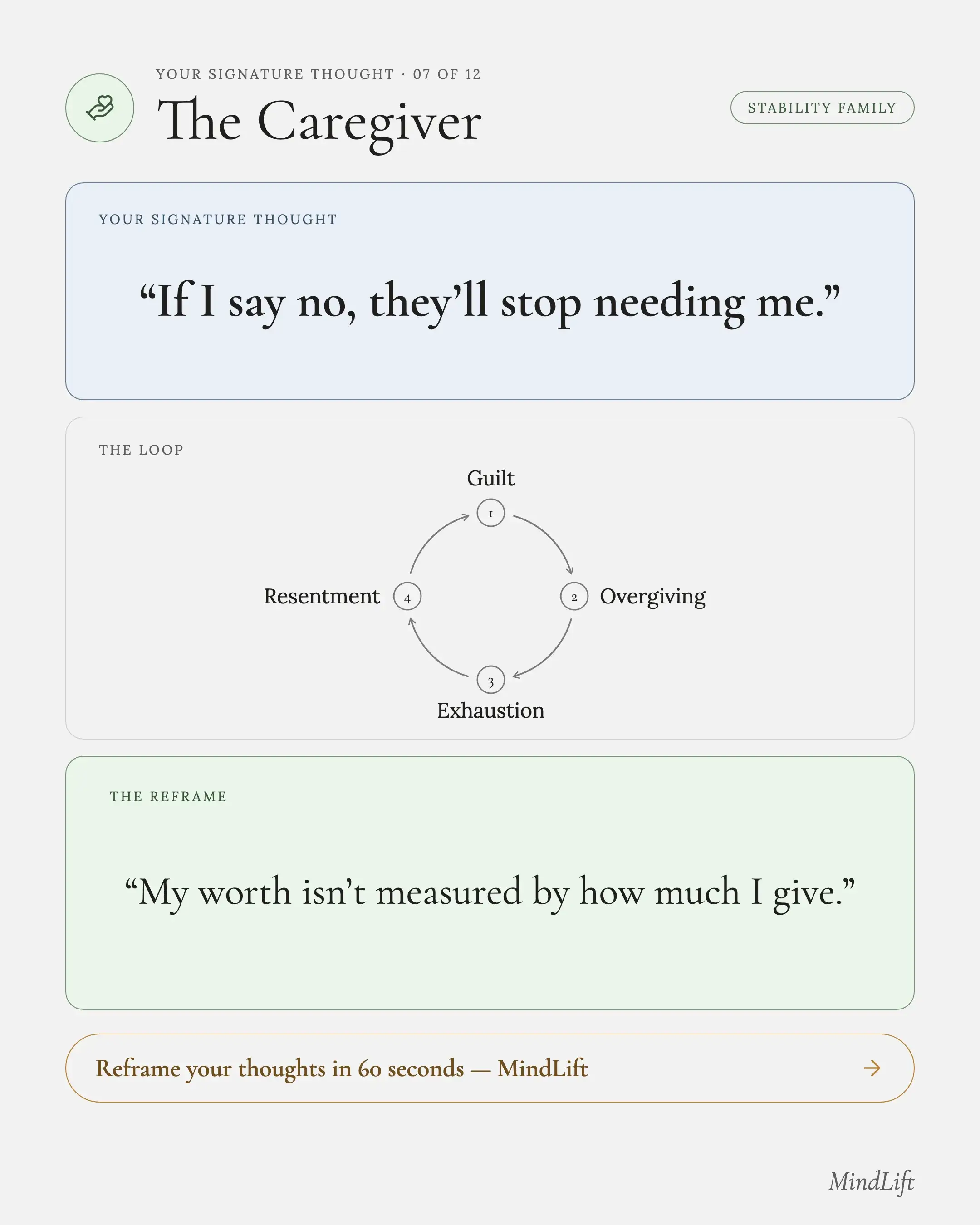
The Caregiver: “If I say no, they’ll stop needing me.”
The Caregiver values being useful to the people they love, so a boundary feels like a threat to the relationship itself. Guilt drives overgiving, overgiving leads to exhaustion, and exhaustion quietly becomes resentment, which brings more guilt. The reframe separates personal worth from the amount given.
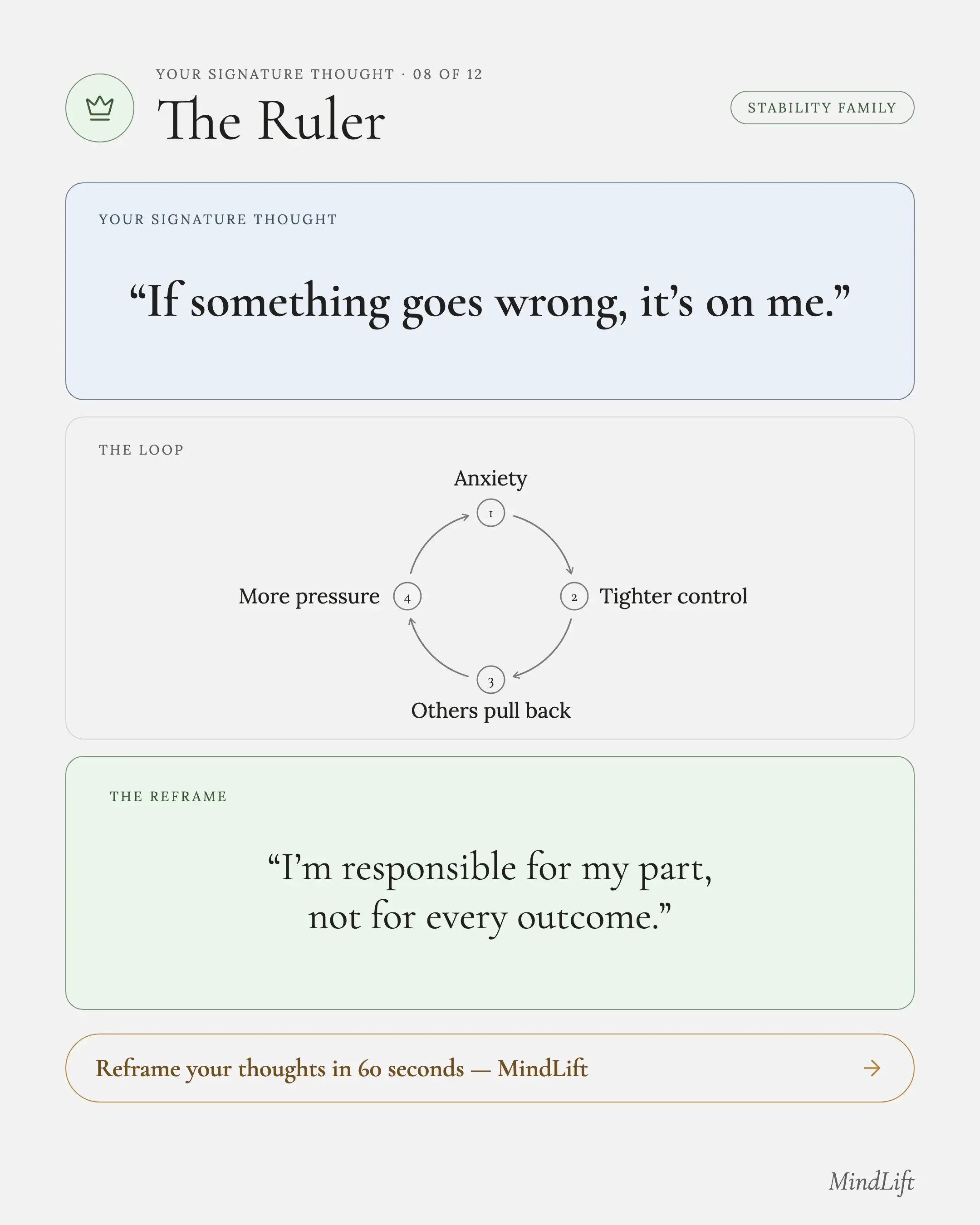
The Ruler: “If something goes wrong, it’s on me.”
The Ruler values order and responsibility, and the signature thought stretches that responsibility to every outcome. CBT calls this personalisation. Anxiety drives tighter control, other people pull back, and the Ruler is left holding even more, which raises the pressure. The reframe draws a line around the Ruler’s actual part.
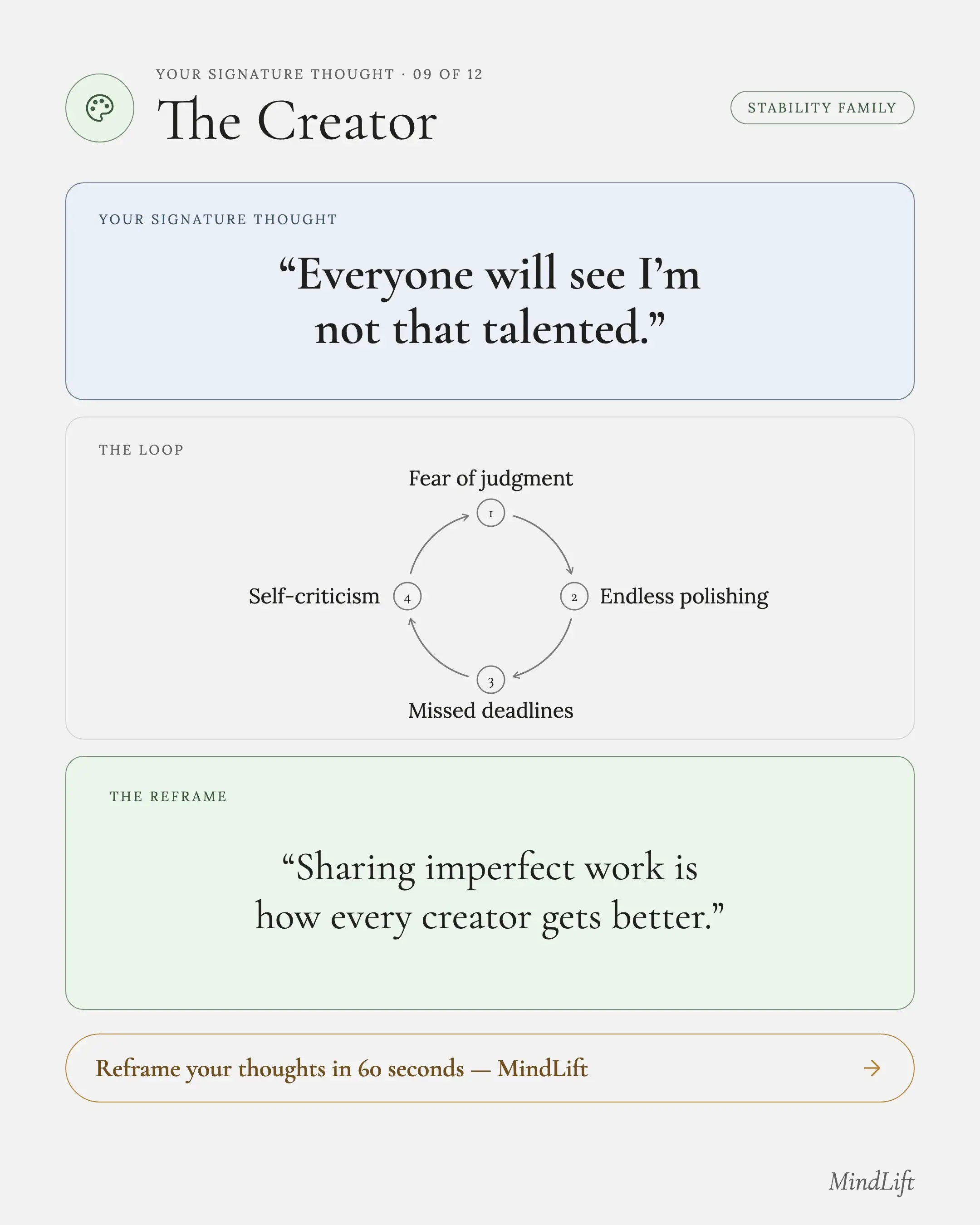
The Creator: “Everyone will see I’m not that talented.”
The Creator values original, well-made work, so sharing it feels like handing over a verdict on their talent. That is fortune telling. Fear of judgment leads to endless polishing, polishing leads to missed deadlines, and missed deadlines fuel self-criticism. The reframe treats imperfect work as the normal route to better work.
The Mastery family
The Hero, the Magician and the Rebel each protect their ability to act on the world: to win, to make change happen, or to stay true to themselves. Their signature thoughts turn effort into a test they can never stop taking.
The Hero: “I’m only as good as my last win.”
The Hero values courage and achievement, and the signature thought makes worth depend on the most recent result. That is all-or-nothing thinking. Pressure leads to overworking, overworking leads to burnout, and slowing down then brings guilt. The reframe lets years of effort count, even during a slower week.
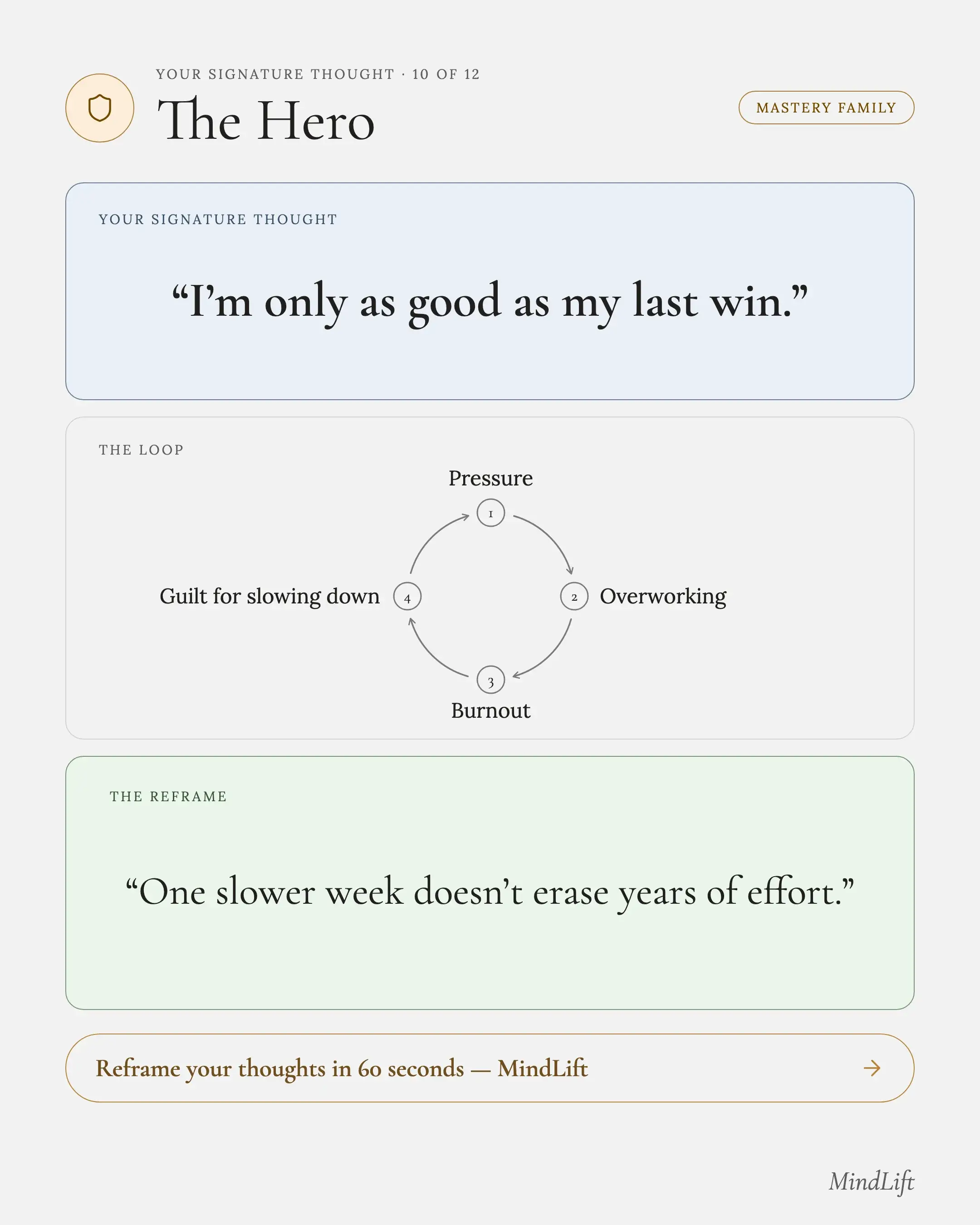
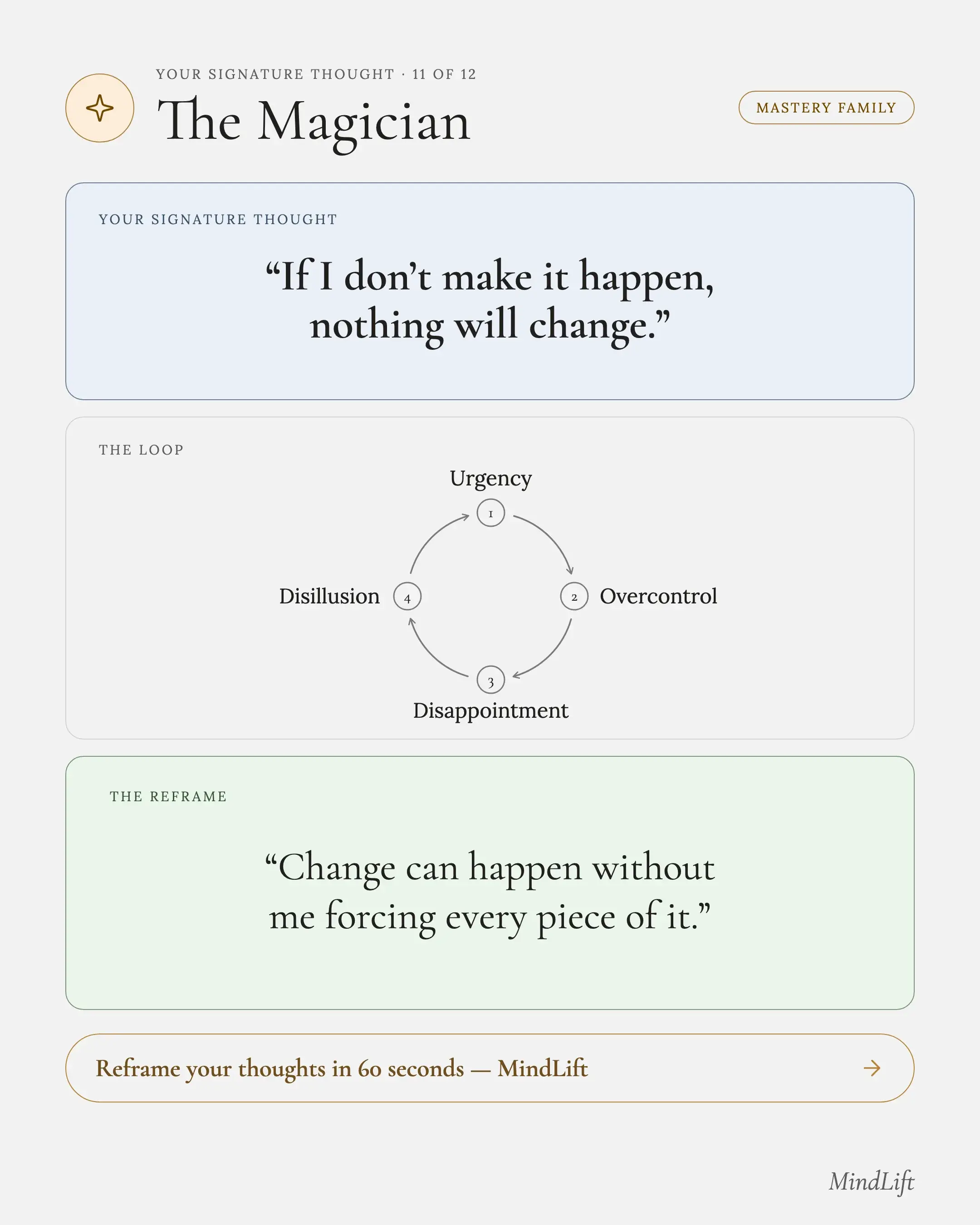
The Magician: “If I don’t make it happen, nothing will change.”
The Magician values transformation, so the signature thought casts them as the only force that can move things. Urgency turns into overcontrol, results disappoint because no one controls every piece, and disappointment slides into disillusion. The reframe allows change to happen with other people and other forces involved.
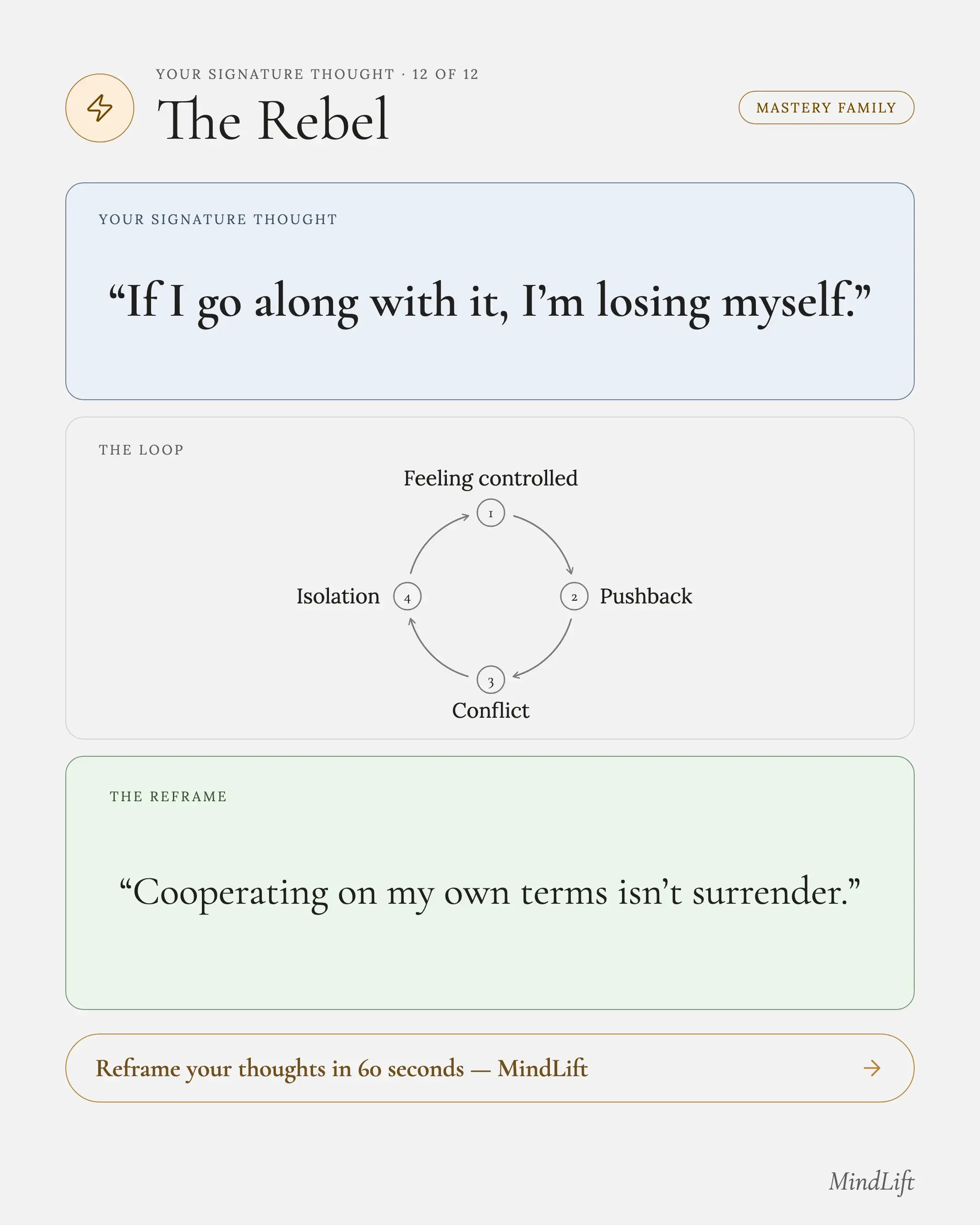
The Rebel: “If I go along with it, I’m losing myself.”
The Rebel values independence, so cooperation can feel like giving up who they are. That is another form of all-or-nothing thinking. Feeling controlled sparks pushback, pushback creates conflict, and conflict leaves the Rebel isolated. The reframe makes room for cooperation that the Rebel chooses on their own terms.
The reframe tone that may land first
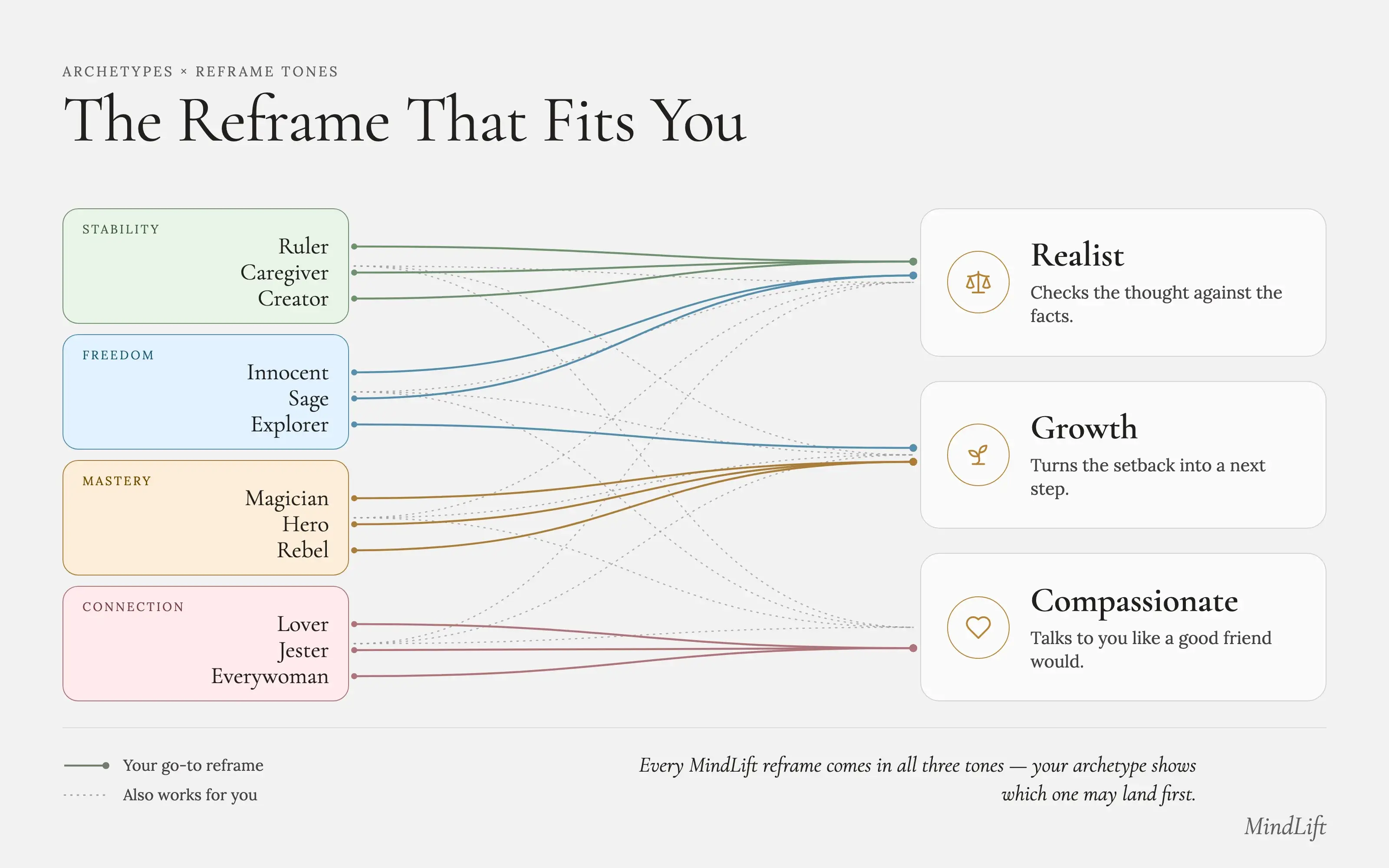
A reframe only helps if you can believe it in the moment. MindLift reframes come in three tones. A Realist reframe checks the thought against the facts. A Growth reframe turns the setback into a next step. A Compassionate reframe talks to you the way a good friend would.
Your archetype may hint at which tone lands first. Archetypes that carry responsibility or crave certainty, such as the Ruler, Caregiver, Creator, Innocent and Sage, often respond to a reality check. Archetypes driven to act, like the Explorer, Magician, Hero and Rebel, often respond to a next step. The Connection family, the Lover, Jester and Everywoman, often respond to warmth. Treat this as a starting guess, not a rule: any of the three tones can work for anyone.
Speaking to yourself with a little distance can also help. In one set of studies, people who used their own name or “you” in self-talk handled a stressful task with less distress than people who used “I”[3]. If your reframe still feels stiff, try saying it in the second person.
In MindLift: write the thought exactly as it sounds in your head. MindLift names the pattern behind it and gives you a reframe. Save the ones that land to your Favorites, so your archetype’s answer is ready the next time the signature thought shows up.
Catch the thought, not the archetype
You don’t need to be sure of your archetype to use this. Read the twelve thoughts and notice which one made you wince. That is the one worth answering. Most people recognise two or three, because most people carry a dominant archetype and a couple of others that take the lead in different parts of life.
The loop rarely breaks in one go. What changes is how quickly you notice the first step. The first few times, you may catch the thought only after the loop has run. Later you catch it halfway through. Eventually you catch it as it arrives, and that is the moment a reframe has the most room to work.
Want to go further? Find your dominant archetype with the 12 archetypes test, read the character archetypes guide for the storytelling side of the same twelve names, or browse the full list of thinking traps behind these loops. If you took the style quiz instead, the same idea applies to your style archetype’s snag thought.
MindLift helps you turn harsh self-talk into a kinder response, in about 60 seconds, at the moment the spiral starts.
Download MindLift and answer your signature thought. Free to start, on iOS 15+, Android 8+ and the web.
Archetypes are a self-reflection framework, not a diagnosis. If a thought loop is affecting your daily life, consider talking to a licensed mental health professional. MindLift is a self-help tool and not a substitute for professional care.
Frequently asked questions
What is a signature thought?
A signature thought is the short sentence your inner voice reaches for when what you care about most feels under threat. For a Caregiver it might be "If I say no, they'll stop needing me." It is a habit of interpretation, not a fact, which is why it can be noticed and answered.
Why do the families in this article differ from the archetype test?
Archetype systems group the same twelve names in different ways. This article groups them by what each one protects: freedom, connection, stability or mastery. The MindLift archetype test uses a different grouping, led by the Ruler, Sage, Lover and Explorer. Neither grouping is more correct; they answer different questions.
Is the Everywoman the same as the Everyman?
Yes. The Everywoman is the same archetype that many lists call the Everyman or the Everyperson: the one who values belonging and being ordinary among others. The cards in this article use the Everywoman name.
Which reframe tone should I use?
Start with whichever tone your archetype points to in the diagram, then try the other two. A Realist reframe checks the thought against the facts, a Growth reframe turns a setback into a next step, and a Compassionate reframe talks to you the way a good friend would. The best tone is the one you can actually believe in the moment.
Are archetypes a diagnosis?
No. Archetypes are a storytelling and self-reflection framework, not a clinical category. If a thought loop is affecting your sleep, work or relationships for weeks at a time, talk to a licensed mental health professional.
Like what you're reading?
Accelerate your growth journey
Reframe the patterns that hold you back — and watch your Top Pattern change over time.


Free to start · no account required
- Hofmann, S. G., Asnaani, A., Vonk, I. J. J., Sawyer, A. T., & Fang, A. (2012). The efficacy of cognitive behavioral therapy: A review of meta-analyses. Cognitive Therapy and Research, 36(5), 427–440. — DOI (opens in a new tab)
- Webb, T. L., Miles, E., & Sheeran, P. (2012). Dealing with feeling: A meta-analysis of the effectiveness of strategies derived from the process model of emotion regulation. Psychological Bulletin, 138(4), 775–808. — DOI (opens in a new tab)
- Kross, E., Bruehlman-Senecal, E., Park, J., Burson, A., Dougherty, A., Shablack, H., Bremner, R., Moser, J., & Ayduk, O. (2014). Self-talk as a regulatory mechanism: How you do it matters. Journal of Personality and Social Psychology, 106(2), 304–324. — DOI (opens in a new tab)
CBT & Self-Talk Researchers
MindLift content is grounded in cognitive behavioral therapy principles and designed to help you shift harsh self-talk in real time. Our guides focus on practical, evidence-based techniques you can use in the moment.
Was this article helpful?