Find which of the classic Jungian 12 leads you, and the shadow that trails it.
About 5 minutes36 questions
Start with question 1 of 36
A group plan hits a snag. Your first move:
About this quiz
12 Archetypes Quiz & Test
Find which of the classic Jungian 12 leads you, and the shadow that trails it.
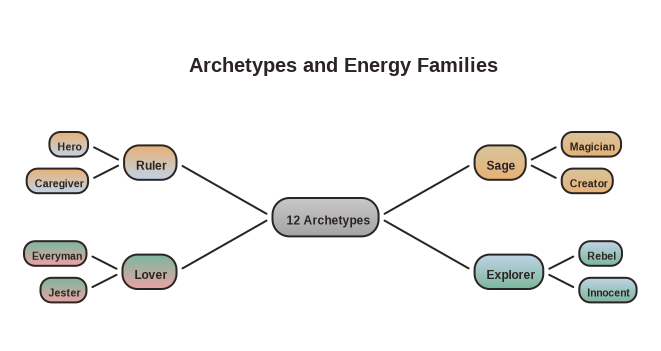
The 12 Jungian archetypes are the Ruler, Hero, Caregiver, Sage, Magician, Creator, Lover, Everyman, Jester, Explorer, Rebel and Innocent, sorted here into four motivation families. Jung described archetypes but never fixed a list of 12; this set comes from Carol S. Pearson and Margaret Mark. Most people recognize themselves in several, and one usually sets the tone.
This test sorts you in two passes. 24 quick picks place you in a family, then 12 statements choose the archetype inside it. You get that archetype, your runner-up, the shadow it slips into, and the line your inner voice falls back on when things get hard.
Four energies, twelve archetypes — the map this quiz sorts you into.
A reflection model built on Jung's archetypes as arranged into twelve by Carol S. Pearson, grouped into four families — an educational self-discovery tool, not a validated psychometric or clinical assessment.
The 12 Jungian archetypes at a glance
Four motivation families, three archetypes each: Ruler, Sage, Lover and Explorer. The first 24 questions find your family; the 12 rated statements pick the archetype inside it. Each name links to its full page.
The 12 Archetypes Test has 36 questions and takes about 5 minutes. The first 24 questions place you in one of four motivation families: Ruler, Sage, Lover or Explorer. The last 12 are statements you rate from "Not me" to "Exactly me", and the highest-rated statement inside your family names your dominant archetype.
Your result can also name a secondary archetype, the top-rated one inside your runner-up family, plus the shadow pattern your archetype tends to fall into under stress and the sentence your inner voice repeats. There are no right answers, so answer for how you usually react, not how you would like to.
What this quiz is: a free self-reflection tool, scored on your device with no email or signup. What it is not: a clinical test, a diagnosis or a validated personality measure. Archetypes are a reflective lens from Jungian psychology, so use your result to notice a pattern, not to label yourself.
A group plan hits a snag. Your first move:
In your friend group, you tend to be:
What others count on you for:
Someone breaks a promise to you. You:
The kind of space you work best in:
The line that runs in your head most days:
You light up most when:
The thing you dread most:
When pressure really builds, you:
Friends seek you out for:
After a big loss, you cope by:
The feel you bring into a room:
In a close relationship, you are:
On days you doubt yourself, you:
The life you are aiming for has:
Your best calls come from:
Above everything else, you prize:
Someone criticizes your work. You:
A weekend that feels well spent:
What few people see in you:
With friends, your role is to:
When you are at your worst, it looks like:
You get your energy back by:
What you most hope to be:
I'm most at ease when the decisions about how things run are mine to make.
Understanding how something works isn't enough for me; I want to change it.
When a moment turns heavy, I reach for humor to carry me and everyone else through it.
If I stay put for too long, I start itching to move on.
Give me a hard task and I'll head straight into it, not around it.
Bringing something new into the world is when I feel most like me.
Very little matters to me as much as a handful of close, deep bonds.
A rule that makes no sense is one I'd sooner break than quietly follow.
I tend to spot what someone needs before they say it, and then I provide it.
I'd take full understanding over a fast decision almost every time.
I do my best where everyone belongs and no one gets looked down on.
Even after things have gone wrong, I still choose to trust they'll turn out fine.
What results can you get?
What results can you get?
Your answers sort you into one of 12 results — The Ruler, The Hero, The Caregiver, The Sage, The Magician, The Creator, and 6 more. Each result comes with a description of its thinking pattern and one growth move you can practise this week, plus the answer mix that produced it.
Result
Who gets it
What it looks like
The Ruler
Ruler family, top-rated statement
Order, responsibility, stewardship
The Hero
Ruler family, top-rated statement
Ruler family · Courage, drive, the hard thing
The Caregiver
Ruler family, top-rated statement
Ruler family · Generosity, protection, showing up
The Sage
Sage family, top-rated statement
Insight, truth, understanding
The Magician
Sage family, top-rated statement
Sage family · Transformation, vision, making it real
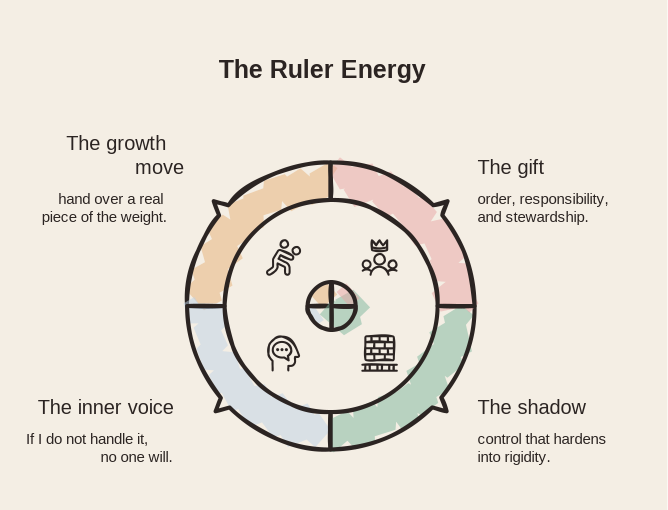
You hold things together — and your inner voice insists, "If I don't handle it, no one will." Your growth lives between keeping everything standing and letting someone else hold a corner of it.
You create order out of chaos. At work, at home, in your group chat — when things wobble, people look at you, and you've stopped being surprised by that. You plan, you decide, you absorb the pressure, and the whole thing stays standing because you're under it.
Your inner voice runs on responsibility: "If I don't handle it, no one will." Often that's even true. But repeated long enough, the sentence rewires you — rest starts to feel like negligence, delegating feels like risk, and being needed quietly replaces being known.
Your shadow is control that hardens into rigidity. Under pressure you don't fall apart; you tighten — more structure, more oversight, less room for anyone (including you) to breathe. The cost isn't your competence. It's that a life that's fully managed stops being fully lived.
Growth edge: order is your gift, not your cage. You can stay the steady one and still say "I don't know," still hand over something that matters and let it be done differently. When the grip tightens, ask — "Am I holding this because it's mine, or because holding things is the only way I know to matter?"
here's one thing to try tonight: Hand over one real thing this week — not the scraps, something that matters — and let it be done differently than you'd do it. Control that can never rest isn't strength; it's fear with a schedule.
You go toward what others back away from — and your inner voice says, "Push through." Your growth lives between proving you can and letting yourself stop.
When something is hard, you move toward it. The difficult conversation, the project nobody wants, the thing that scares you a little — you'd rather face it than live with having avoided it. While others are still negotiating with themselves, you've already started, and people trust you in a crisis because you don't flinch.
Your inner voice runs on effort: "Push through." It got you through things that would have stopped someone else. But said often enough, it rewires you — tired starts to mean weak, rest has to be earned, and every task quietly turns into a test you have to pass.
Your shadow is proving as a lifestyle. Every task becomes a test, and exhaustion becomes evidence of your worth. From the outside it looks like strength, and you rarely notice you're running on empty until something gives.
Growth edge: rest is not surrender — a hero who can't stop competing has made an opponent out of their own life. Recovery is part of the work, not a break from it. When the push comes, ask — "Is this the hard thing that matters, or am I proving something to a voice that's never satisfied?"
here's one thing to try tonight: Pick one day this week with nothing to conquer. If the push shows up, notice it, name it — "there's the push" — and let the day stay small anyway.
You see what people need before they say it — and your inner voice answers, "They need me." Your growth lives between looking after everyone and putting yourself on the list.
You notice. The friend who went quiet in the group chat, the colleague who's drowning politely, the thing someone needed and never asked for — you've clocked it and you're already on your way. People feel safer because you're around, and they're right to.
Your inner voice runs on care: "They need me." It's why you show up first and stay last. But repeated long enough, the sentence rewires you — your own needs start to sound like interruptions, saying no feels like abandoning someone, and being useful quietly becomes the only way you feel allowed to take up space.
Your shadow is self-erasure. Everyone gets looked after except the person doing the looking after. You run on empty and call it love, and resentment tends to arrive before rest does — usually aimed at yourself for feeling it.
Growth edge: care that includes you isn't selfish — you can't pour from a cup you refuse to refill. Letting someone look after you doesn't cancel what you give; it keeps you able to give it. When the "yes" is halfway out, ask — "Am I offering this because I have it to give, or because I don't know who I am if I'm not needed?"
here's one thing to try tonight: Say one kind "no" this week — to a favor you'd normally absorb without thinking — and spend that hour on something that's only for you. Notice that everyone gets through it, including you.
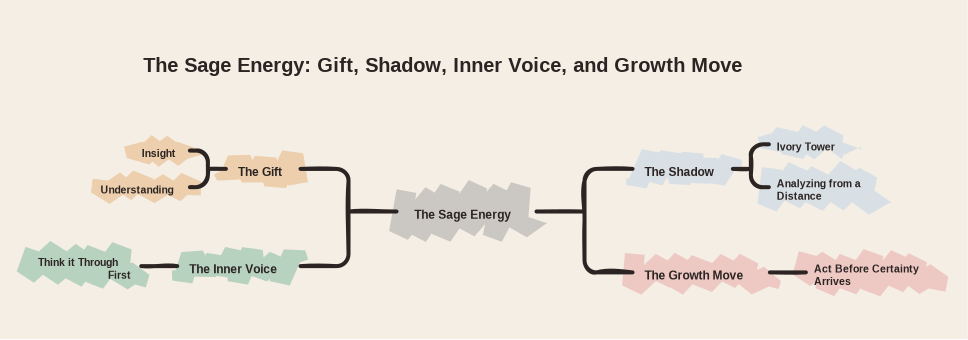
You need to understand things — and your inner voice keeps saying, "Think it through first." Your growth lives between knowing enough and letting yourself act before certainty arrives.
You live a step back from the noise, watching, connecting dots other people don't see. Friends bring you their tangled situations because you untangle them. You'd rather be right slowly than wrong fast, and your judgment has earned that patience.
Your inner voice runs on analysis: "Think it through first." It's why your advice lands and your mistakes are rare. But the same voice can quietly turn thinking into a hiding place — one more angle to consider, one more source to check, while the decision waits and the life around it moves on.
Your shadow is the ivory tower. Under stress you retreat into your head, where everything can be examined and nothing can touch you. Understanding a feeling becomes a substitute for feeling it; analyzing a risk becomes a substitute for taking it.
Growth edge: your mind is the gift — the moat around it is the problem. Insight that never becomes action is just decoration. When you catch yourself researching a decision you've already made, ask: "What am I actually waiting for — information, or permission?"
here's one thing to try tonight: Pick one decision you've been researching for weeks and make it with the information you already have. You knew the answer before the third spreadsheet — the rest was anesthesia.
Sage family · Transformation, vision, making it real
You turn ideas into something real — and your inner voice insists, "There's always a way." Your growth lives between changing things and letting some things be as they are.
Where other people see a dead end, you see a workaround. You take a half-formed idea, a stuck team, a friend who's been circling the same change for years, and you find the move that makes it happen. People around you tend to become more of who they were trying to be — and you often see it before they do.
Your inner voice runs on possibility: "There's always a way." It's why you keep going where others stop. But said often enough, it rewires you — every limit starts to look like a puzzle you failed to solve, and "this can't be fixed" sounds like a personal defeat instead of a fact.
Your shadow is engineering outcomes instead of trusting them. The fixer can't stop fixing: steering conversations, nudging people toward the version of them you've already pictured, editing other people's stories because you can see how they should go. From your side it feels like help; from theirs it can feel like pressure.
Growth edge: not everything needs transforming — some things need witnessing, including your own limits. Staying with a problem you can't solve is a skill too, and sometimes it's the one the moment is asking for. When your mind starts drafting the fix, ask — "Did anyone ask me to change this, or am I uncomfortable just being here with it?"
here's one thing to try tonight: The next time someone tells you about a problem this week, offer no solutions. Ask one question, listen to the whole answer, and let the conversation end with nothing fixed.
You make things that didn't exist before — and your inner voice keeps saying, "It could be better." Your growth lives between the vision in your head and the draft you let the world see.
You process the world by making something out of it. A song, a spreadsheet, a meal, a garden, a business — the medium matters less than the act. You can see what could exist before it does, and you have the craft to close some of that distance with your own hands.
Your inner voice runs on standards: "It could be better." It's what makes your work good. But repeated long enough, the sentence rewires you — finishing starts to feel like giving up, feedback lands as a verdict on you instead of the work, and every draft gets measured against a vision it was never going to match.
Your shadow is perfectionism. The gap between the vision and the draft becomes a reason to ship nothing. Projects wait at 80% in folders, you restart instead of finishing, and the thing you were built to do — make — quietly becomes the thing you avoid.
Growth edge: done at 80% exists in the world; perfect at 100% exists in your drafts folder. Finishing is a craft skill too, not a betrayal of the others. When you reach for one more pass, ask — "Is this making the work better, or keeping it safe from being seen?"
here's one thing to try tonight: Pick one unfinished thing this week and share it at the stage it's in now — with one person, or publicly. Set a timer for the last pass, and when it rings, send it.
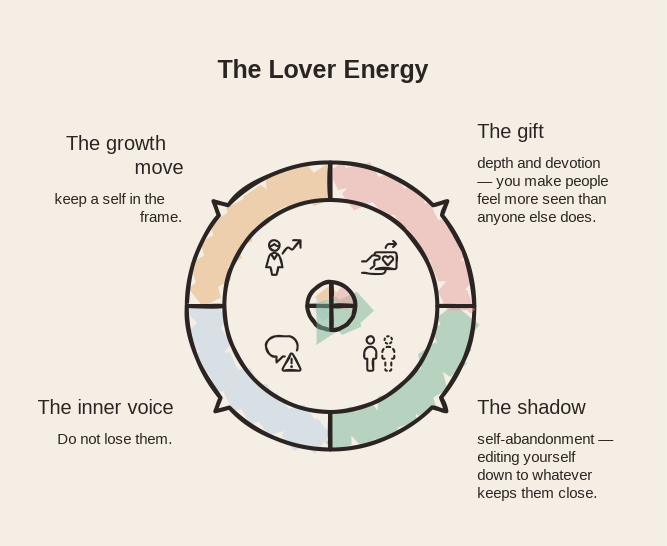
You feel everything at full volume — and your inner voice whispers, "Don't lose them." Your growth lives between loving deeply and remembering you exist when no one is looking at you.
You experience life at a depth most people only visit. When you care about someone — a partner, a friend, a project — you care completely, and the people you love feel more seen by you than by anyone else in their lives.
Your inner voice runs on connection: "Don't lose them." It's what makes you devoted, loyal, unforgettable. But the same voice can turn closeness into surveillance — rereading messages, replaying tones of voice, scanning for the first sign of someone pulling away.
Your shadow is self-abandonment. In the name of keeping people close, you edit yourself — swallowing needs, forgiving too fast, shape-shifting into whoever the room wants. The love stays real; the person offering it slowly disappears from inside it.
Growth edge: your depth is not too much — it's your signal strength. The work isn't to feel less; it's to keep a self in the frame. When the scanning starts, ask: "Am I reading them, or am I abandoning me?"
here's one thing to try tonight: Next time you catch yourself rereading a message for tone, put the phone down and name one thing you need tonight that has nothing to do with them. Connection counts double when you're still in it.
You make every room easier to be in — and your inner voice warns, "Don't make it weird." Your growth lives between keeping everyone comfortable and letting yourself be seen.
You make rooms feel human. The new person gets pulled into the conversation, nobody's question sounds stupid, and nobody feels judged around you. You're unpretentious in a world full of performance, and people relax near you without quite knowing why.
Your inner voice runs on belonging: "Don't make it weird." It keeps things smooth and keeps you easy to be around. But said often enough, it rewires you — your opinions start to feel like disruptions, disagreeing feels like breaking something, and you go along with plans that were never yours.
Your shadow is blending in so well that your own edges disappear. Agreeable on the outside, unseen on the inside — the friend everyone likes and nobody quite knows, because you've never given them the chance.
Growth edge: being liked by everyone and known by no one is a bad trade. A room that can hold everyone else can hold your real opinion too. When you feel yourself nodding along, ask — "Do I actually agree, or am I just trying not to be noticed?"
here's one thing to try tonight: Let one real opinion out this week — the restaurant you'd actually pick, the view you'd usually keep to yourself. Say it plainly, without a joke or an apology attached, and see what happens.
You find the funny angle that lets everyone breathe — and your inner voice says, "Keep it light." Your growth lives between lifting the room and letting yourself be serious for a minute.
You find the joke that lets everyone finally exhale. A tense meeting, a bad week, a hospital waiting room — you're the one who makes it bearable. Joy is a skill and you have it; people remember how they felt around you long after they've forgotten what was said.
Your inner voice runs on lightness: "Keep it light." It's carried you and the people around you through hard moments. But repeated long enough, it rewires you — silence starts to feel dangerous, sincerity feels exposing, and the moment anything gets real, the reflex reaches for a punchline.
Your shadow is the joke as a bodyguard. Humor shows up precisely where honesty was about to happen — a compliment you deflect, a "how are you really?" you laugh off, a feeling that's getting too close. People laugh, and the thing you actually needed to say leaves the room with them.
Growth edge: you're allowed to be the serious one for a minute — the room can hold it, and so can you. Lightness is a gift when it's a choice, not an escape hatch. When the joke is already on its way, ask — "Am I making this easier for them, or making myself harder to reach?"
here's one thing to try tonight: When someone asks how you are this week, give one honest answer with no joke attached. Let the pause after it happen, and don't rush to fill it.
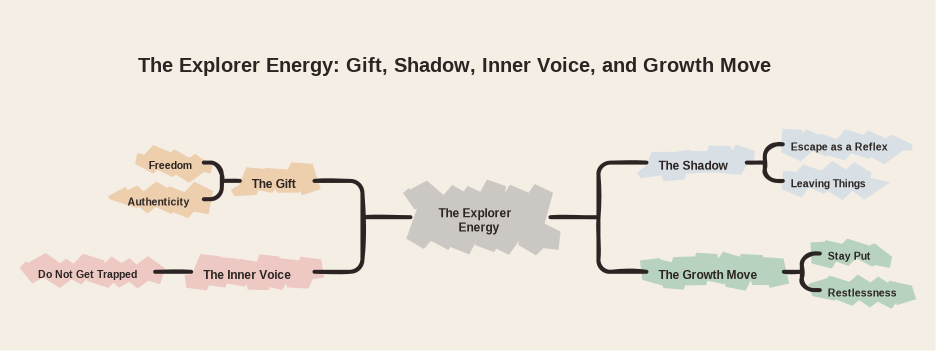
You need room to move — and your inner voice warns, "Don't get trapped." Your growth lives between staying free and letting something (or someone) actually hold you.
You're built for the open road — new places, new ideas, new versions of yourself. Routine reads as slow suffocation, and you can feel a cage forming in situations other people call stability. Your life is a collection of experiences most people only bookmark.
Your inner voice runs on freedom: "Don't get trapped." It's kept you authentic in a world that rewards conformity. But the same voice can't always tell the difference between a cage and a commitment — so it sometimes has you walking away from things that were actually holding you, not holding you back.
Your shadow is escape as a reflex. When things get heavy — a relationship deepening, a job getting real, a feeling settling in — the exit starts glowing. Movement becomes a way to outrun whatever was about to catch up.
Growth edge: freedom you have to protect this hard isn't freedom yet. The test isn't whether you can leave — you've proven that. It's whether you can stay put long enough to find out what's on the other side of the restlessness. When the exit glows, ask: "Am I moving toward something, or just away?"
here's one thing to try tonight: Next time the exit starts glowing, wait 48 hours before you move. If it's a real cage, it'll still be a cage on Thursday. If it was a feeling, you just saved something worth keeping.
You say what everyone else is only thinking — and your inner voice asks, "Says who?" Your growth lives between breaking what's broken and building something you're for.
You see the rule that makes no sense and you won't pretend it does. You say the thing everyone's thinking, you ask the question that makes the room go quiet, and broken systems don't survive you for long. Once you've named it, the people who were quietly going along with it find it easier to stop.
Your inner voice runs on questioning: "Says who?" It's kept you honest and hard to push around. But said often enough, it rewires you — every instruction starts to sound like a challenge, agreeing feels like losing, and you can end up resisting good advice because of who gave it.
Your shadow is opposition as identity. If you're only defined by what you're against, whoever you fight is writing your story. Pushing against something becomes a need, and when there's nothing to push against, you'll find something — sometimes in the people closest to you.
Growth edge: rebellion matures into leadership the day it stops needing an enemy. The same nerve that tears down a bad rule can build a better one. When you feel the "no" rising, ask — "What am I for here, and would I still want it if nobody were pushing back?"
here's one thing to try tonight: Pick one thing you usually criticize and spend half an hour this week building a small alternative — a draft, a proposal, a better version. Notice how it feels to be for something.
You still believe things can be good — and your inner voice promises, "It'll be fine." Your growth lives between keeping hope and looking straight at what's wrong.
You still believe things can turn out well, and around you people remember that too. You give second chances, you see the good in people early, and you bring a steadiness to hard moments that isn't naive — it's chosen. Hope is harder to keep than cynicism, and you keep it.
Your inner voice runs on trust: "It'll be fine." It's carried you through things that would have hardened someone else. But repeated long enough, the sentence rewires you — worrying starts to feel disloyal, bad news becomes something to smooth over, and "fine" is the answer before you've looked at the question.
Your shadow is rose-colored avoidance. You keep the peace by refusing to see what's actually wrong — the letter you haven't opened, the friendship that keeps hurting, the doubt you talk yourself out of. The problem doesn't go away; it just grows where you're not looking.
Growth edge: hope that has looked at the problem is stronger than hope that won't — you can see clearly and still believe. When "it'll be fine" arrives fast, ask — "Have I actually looked at this, or am I reassuring myself so I don't have to?"
here's one thing to try tonight: Pick the one thing you've been telling yourself will be fine and look at it properly this week — open it, name it, or write down what's actually true. Then decide whether it's fine.
The questions and result descriptions in this quiz draw on the studies below. The quiz is a self-reflection tool, not a diagnosis, and none of these papers tested this quiz itself.
Jung CG (1959). The Archetypes and the Collective Unconscious (Collected Works, Vol. 9, Part 1). Princeton University Press (Bollingen Series XX).
Pearson CS (1991). Awakening the Heroes Within: Twelve Archetypes to Help Us Find Ourselves and Transform Our World. HarperSanFrancisco.
Mark M, Pearson CS (2001). The Hero and the Outlaw: Building Extraordinary Brands Through the Power of Archetypes. McGraw-Hill.
Your archetype leads on steady days. Who leads on hard ones?
Your archetype leads on steady days. Who leads on hard ones?
The Jungian 12 describe how you move when things feel settled. Pressure brings out someone else: the pattern that steps in when you feel blamed, exposed or boxed in. The shadow archetype quiz finds it with 12 statements in about 2 minutes, with no email asked.
The classic 12 archetypes are: Ruler, Hero, Caregiver, Sage, Magician, Creator, Lover, Everyman, Jester, Explorer, Rebel, and Innocent. The set comes from Jungian psychology as popularized by Carol Pearson, and each represents a distinct pattern of motivation, inner voice, and behavior under pressure.
Who created the 12 archetypes?
Not Jung himself. Carl Jung described archetypes as recurring patterns in the collective unconscious but never fixed a list of 12. The twelve came from Carol S. Pearson: Awakening the Heroes Within (1991) named twelve, and The Hero and the Outlaw (Margaret Mark and Pearson, 2001) set the Ruler, Hero, Sage, Jester and Rebel list that most quizzes, including this one, use today.
Is the 12 archetypes quiz really free?
Yes — free to take, with no email required, no signup, and no paywall on your result. The quiz is 36 questions and takes about 5 minutes. Your results — dominant archetype, shadow pattern, and inner voice — are shown immediately.
How does this archetype test work?
36 questions. The first 24 find your motivation family (Ruler, Sage, Lover or Explorer). The last 12 are statements you rate; the highest-rated one inside your family is your archetype.
Can I have more than one archetype?
Yes. Most people carry a dominant archetype and a strong secondary one. If two scores are close, you have a dual archetype — which is common and means you draw strength from more than one family.
Is this the same as the female or male archetypes quiz?
Same structure, different taxonomy: this test uses the classic gender-neutral Jungian 12. MindLift also has a 12 female archetypes quiz and a 12 male archetypes quiz — all free, no email.
Is the archetype test scientifically valid?
No. The 12 archetypes test is not a validated psychological measure, and its results have not been tested for reliability or validity the way a clinical test would be. It is a self-reflection tool built on Carl Jung's idea of archetypes, as later arranged into 12 types by Carol S. Pearson. Use your result to notice your inner voice under pressure, not as a diagnosis.
Keep exploring
If you are in crisis or thinking about harming yourself, call or text 988 (US) or find a local line at findahelpline.com. MindLift is a self-help tool and not a replacement for professional care.