Turn this into a daily habit — free to start in the MindLift app:
Every style archetype has a strength that people notice first. Each one also has a sentence that quietly turns that strength into a limit. Call it the snag thought. It sounds like good sense, and it starts the same loop every time.
This article gives each of the six personal style archetypes its snag thought, the four-step loop that thought tends to set off, and one reframe that answers it. The reframes come from cognitive behavioural therapy (CBT), where catching a thought and answering it with a more accurate, believable alternative is a core skill with a strong evidence base[1]. Seeing a situation in a new way, known as cognitive reappraisal, is also one of the more effective ways people change how they feel[2].
Not sure which style archetype is yours? Take the personal style archetype quiz first (12 questions, about two minutes), then come back to your section. For the traits and shadow side of each type in more depth, read the 6 style archetypes, explained.
How a style strength gets snagged
Style is the visible layer of how you handle being seen. The Natural’s ease, the Classic’s standards and the Social Spark’s energy are real strengths. The snag comes when the strength becomes a rule: stay low-key, get it exactly right, keep the room lit. A rule like that pushes you toward a protective move. The move brings short-term relief, then a cost, and the cost feels like proof that the rule was needed.
Each card below shows that loop in four steps, then the reframe. The reframe is not a pep talk. It answers the specific claim inside the snag thought, so the loop has something to push against.
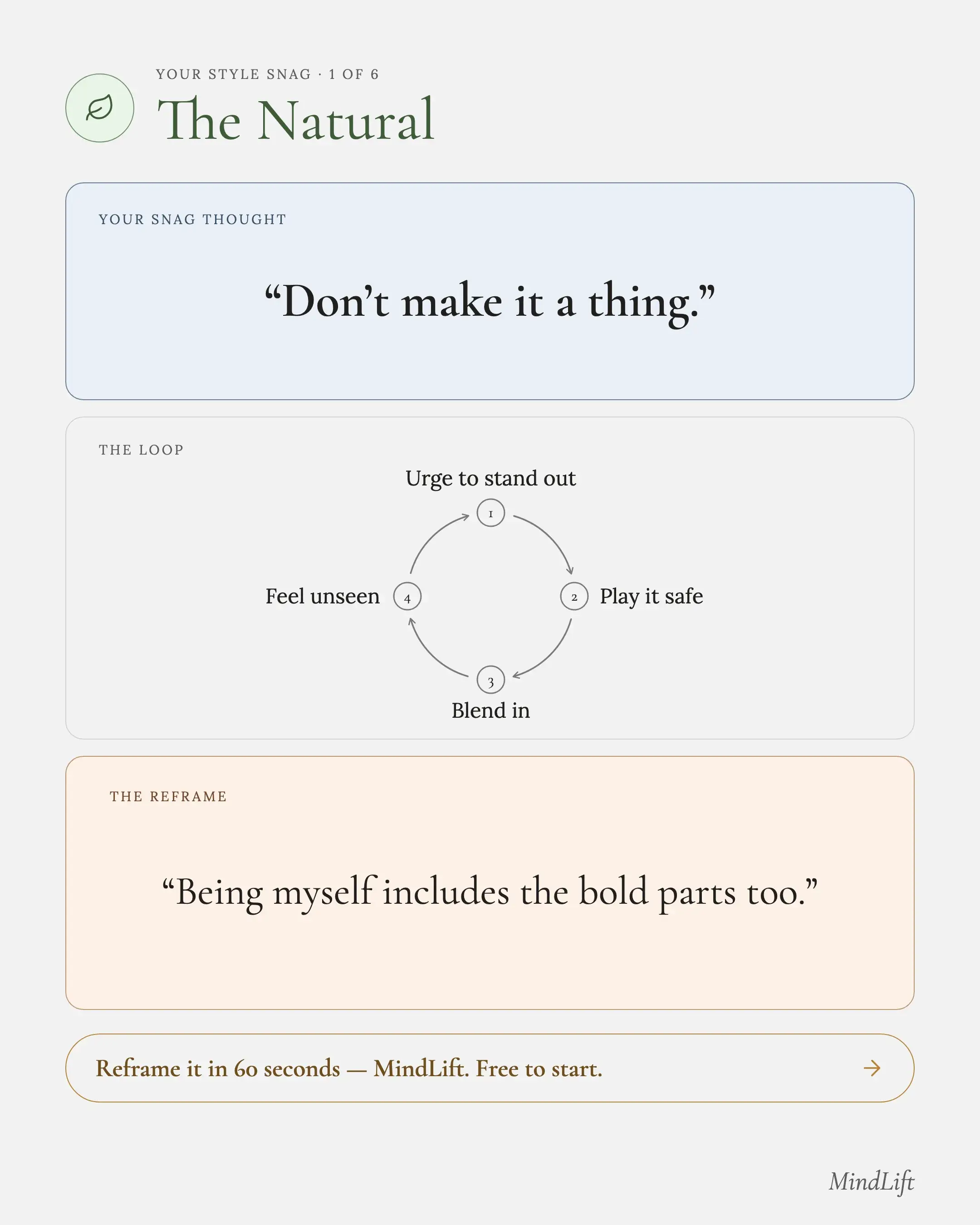
The Natural: “Don’t make it a thing.”
The Natural values authenticity and comfort, and people trust her because she never seems to be performing. The snag thought treats any bold choice as a performance. An urge to stand out gets talked down, she plays it safe, she blends in, and then she feels unseen, which makes the next bold choice feel even riskier. The reframe treats the bold parts as part of being herself, not a betrayal of it.
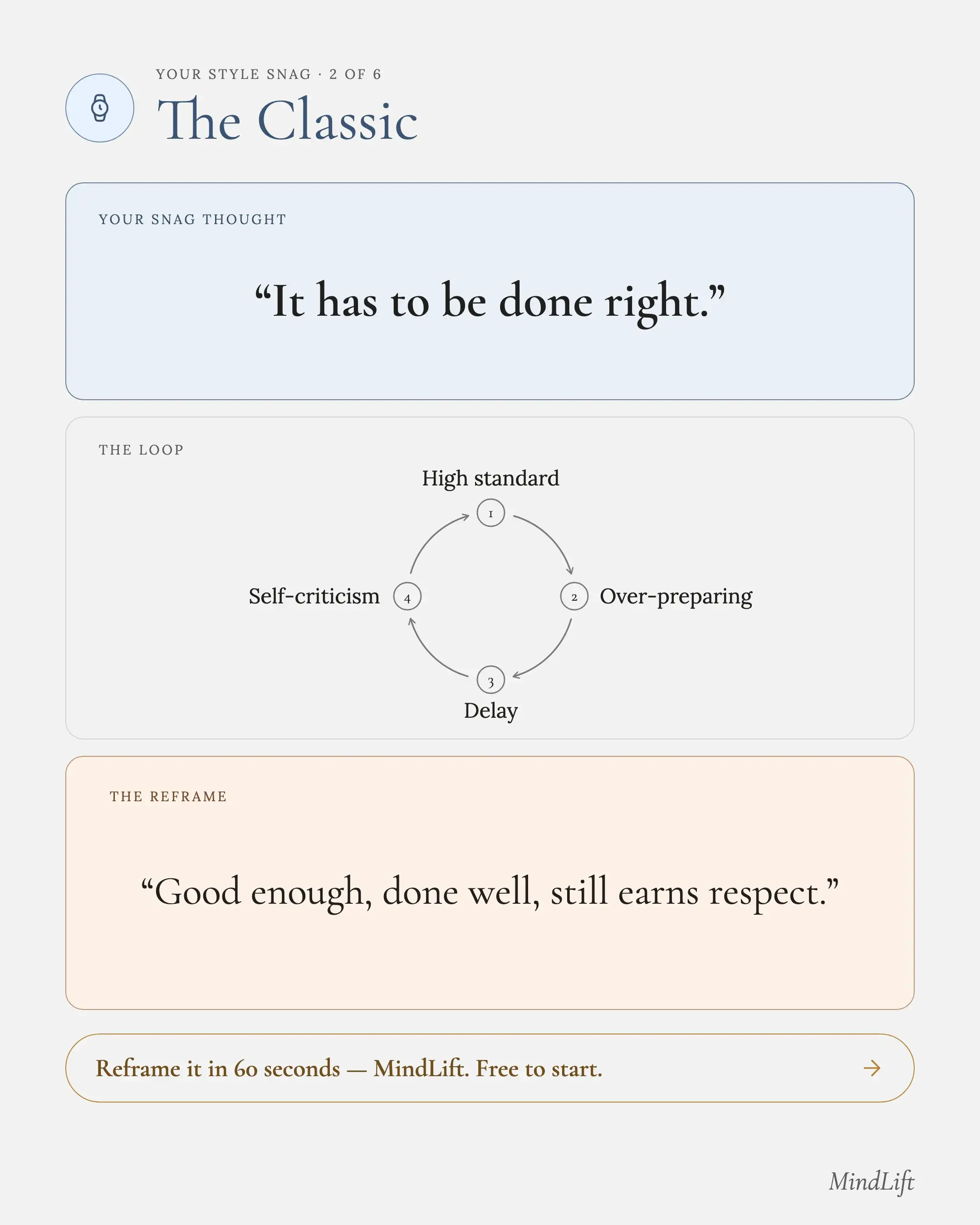
The Classic: “It has to be done right.”
The Classic values quality and doing things well, which makes her dependable and polished. The snag thought turns a high standard into an all-or-nothing rule: right, or not at all. Over-preparing leads to delay, and delay fuels self-criticism, which raises the standard again. The reframe keeps the care and drops the idea that only flawless earns respect.
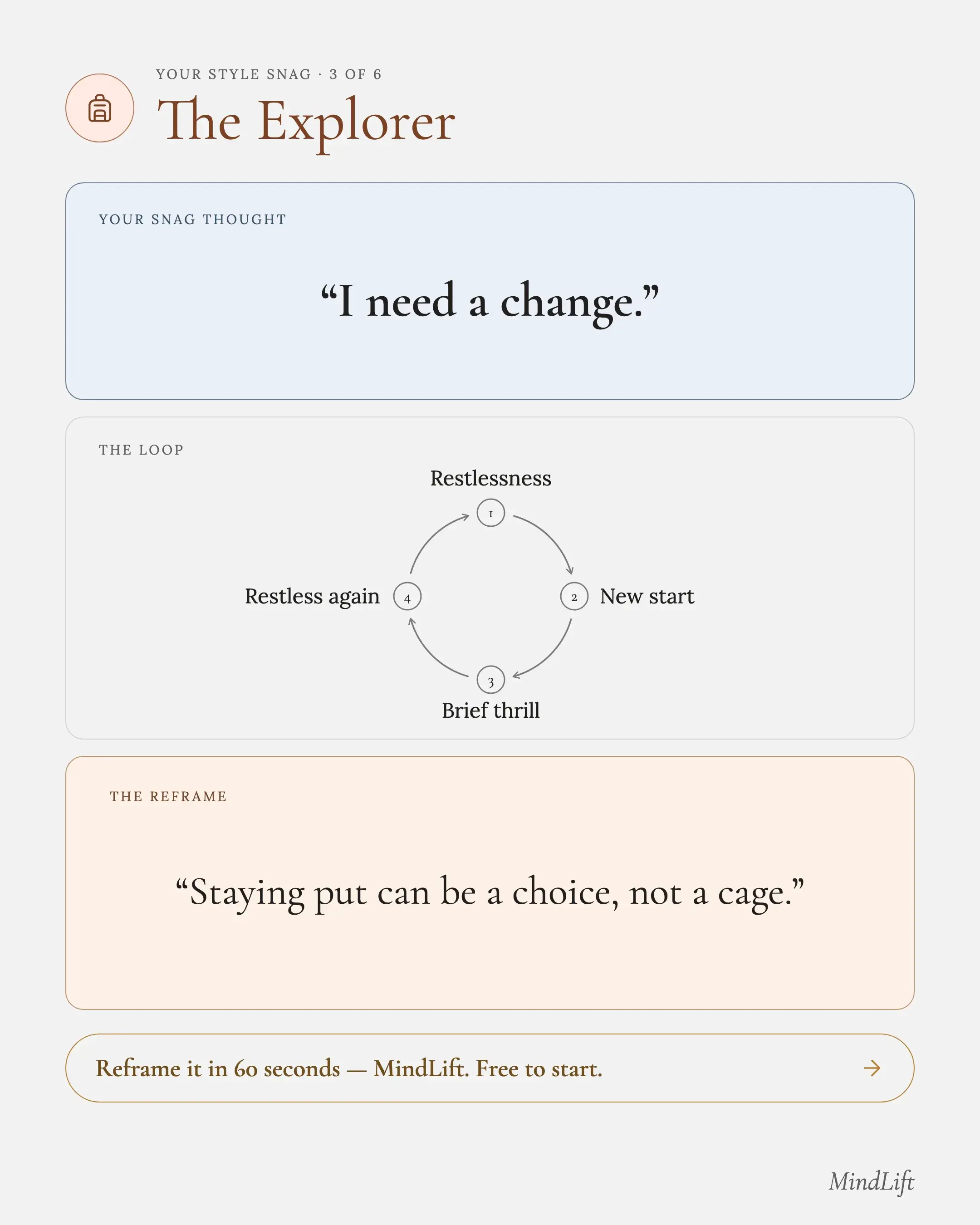
The Explorer: “I need a change.”
The Explorer values freedom and new experience, and she adapts easily to new places. The snag thought reads restlessness as proof that something must change, which CBT calls emotional reasoning: a feeling treated as a fact. A new start brings a brief thrill, and then the restlessness returns. The reframe makes staying put something she can choose, not something that traps her.
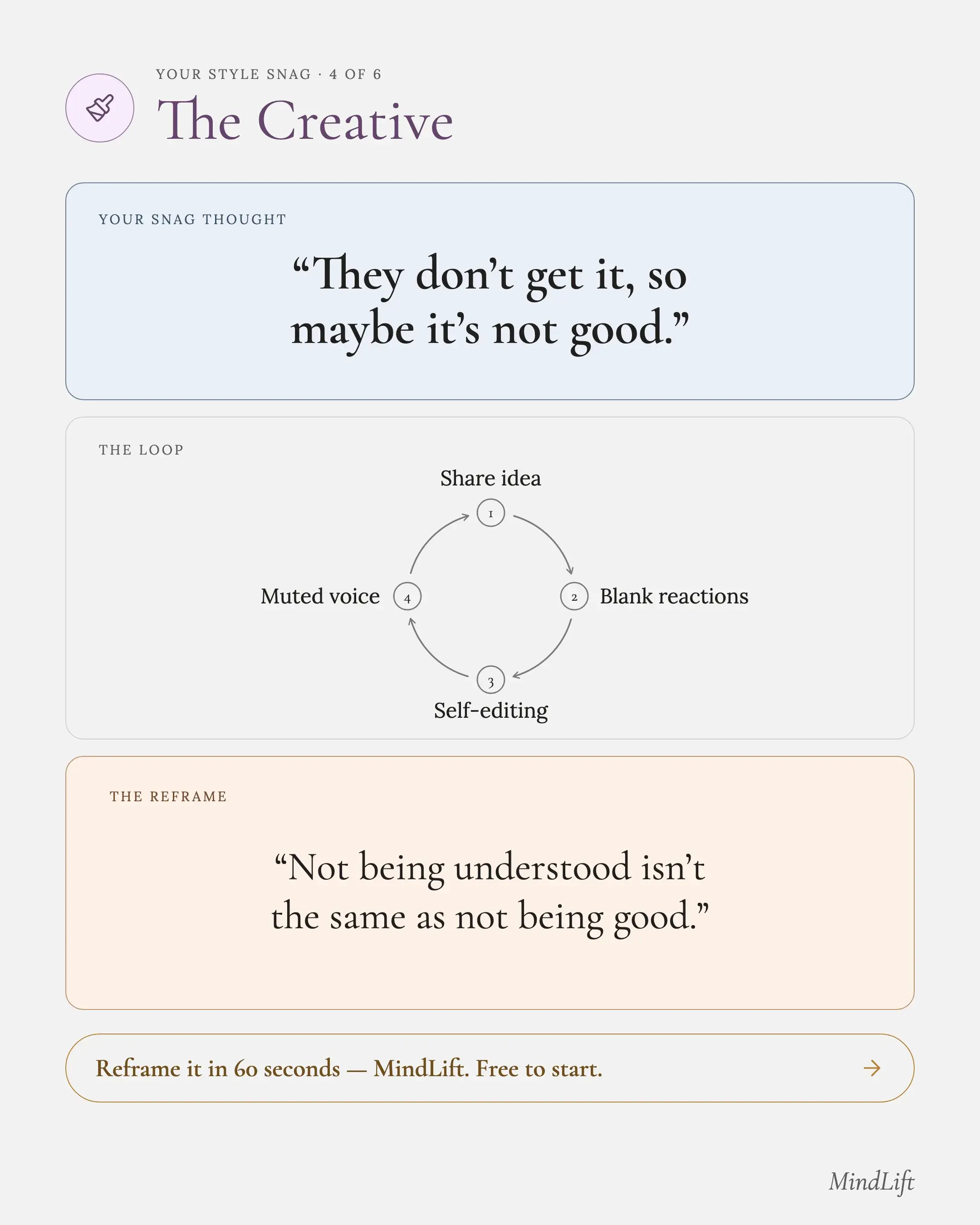
The Creative: “They don’t get it, so maybe it’s not good.”
The Creative values originality and sees the world differently. The snag thought hands the verdict on her ideas to whoever is in the room. She shares an idea, meets blank reactions, starts editing herself, and ends up with a muted voice. Jumping from “they didn’t get it” to “it isn’t good” is a conclusion the evidence doesn’t support. The reframe separates being understood from being good.
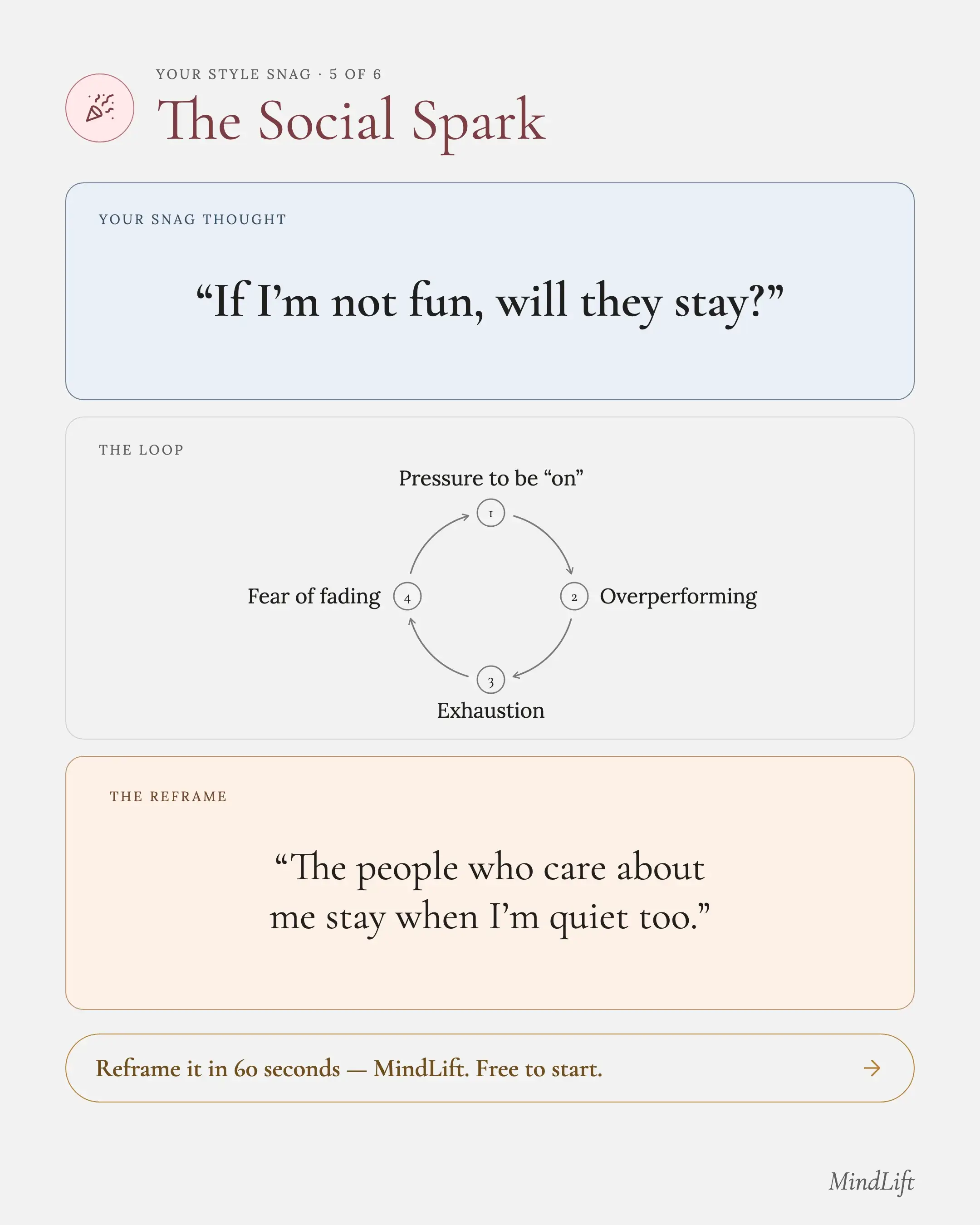
The Social Spark: “If I’m not fun, will they stay?”
The Social Spark brings energy wherever she goes, and people feel good around her. The snag thought ties her place in the group to keeping the room lit. That is fortune telling: predicting people will leave without checking. The pressure to be “on” leads to overperforming, then exhaustion, then a fear of fading that brings the pressure back. The reframe lets the people who care about her stay through the quiet moments too.
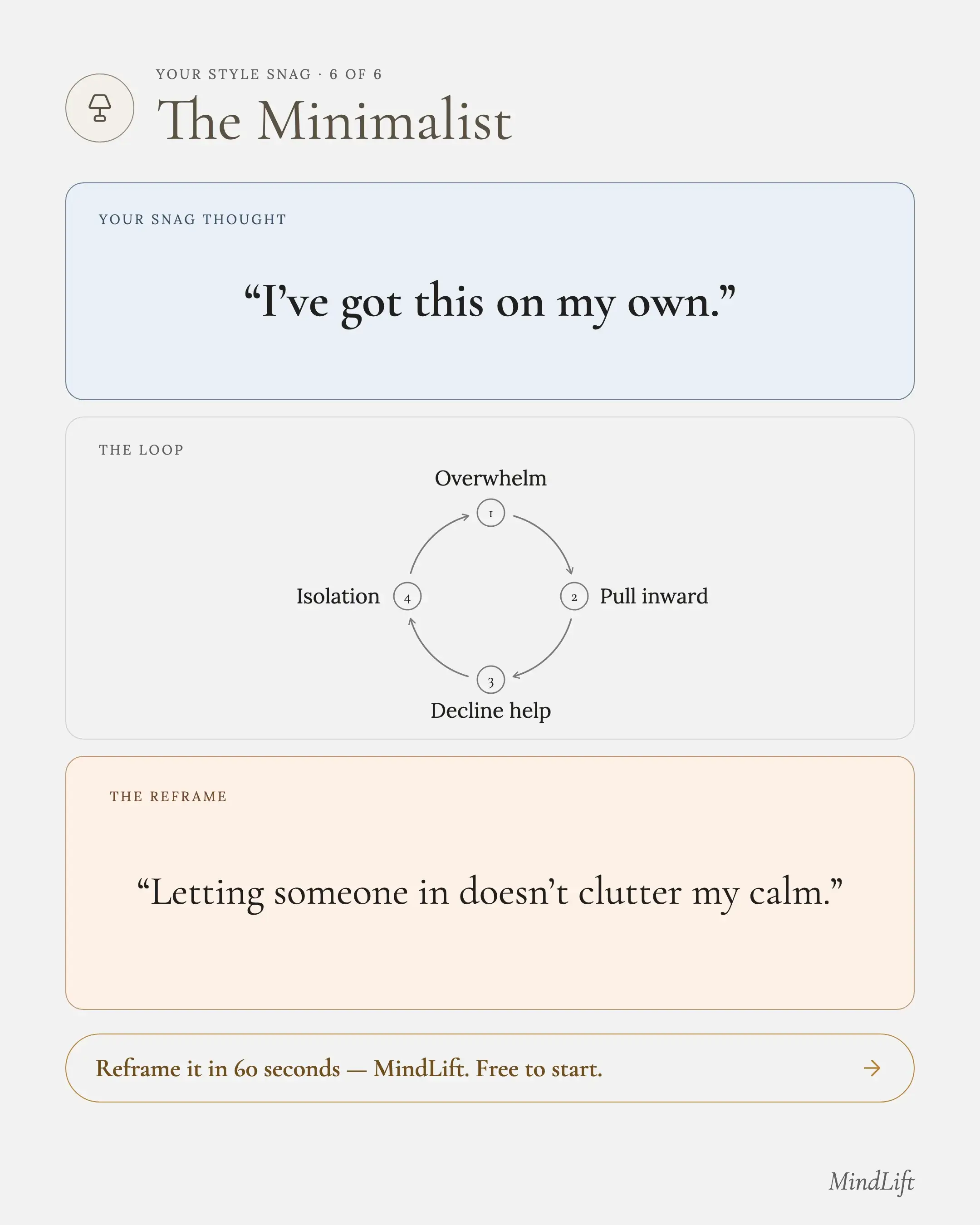
The Minimalist: “I’ve got this on my own.”
The Minimalist values clarity, calm and intention. The snag thought treats other people as clutter. When overwhelm hits, she pulls inward, declines help and ends up isolated, which makes the overwhelm heavier. The reframe keeps her calm and still makes room for someone else.
Catch the thought, not the archetype
You don’t need to be sure of your style archetype to use this. Read the six snag thoughts and notice which one made you wince. That is the one worth answering. Most people recognise two, because most people are a blend of two style archetypes.
The loop rarely breaks in one go. What changes is how quickly you notice the first step. At first you may catch the snag thought only after you have already blended in, over-prepared or declined the help. Later you catch it halfway through. Eventually you catch it as it arrives, which is when a reframe has the most room to work.
In MindLift: write the thought exactly as it sounds in your head. MindLift names the pattern behind it and gives you a reframe. Save the ones that land to your Favorites, so the answer is ready the next time your snag thought shows up.
Want to go further? Find your type with the personal style archetype quiz, read the signature thought of each of the 12 archetypes for the personality side of the same idea, or browse the full list of thinking traps behind these loops.
MindLift helps you turn harsh self-talk into a kinder response, in about 60 seconds, at the moment the spiral starts.
Download MindLift and answer your snag thought. Free to start, on iOS 15+, Android 8+ and the web.
Style archetypes are a self-reflection framework, not a diagnosis. If a thought loop is affecting your daily life, consider talking to a licensed mental health professional. MindLift is a self-help tool and not a substitute for professional care.
Frequently asked questions
What is a style snag thought?
A snag thought is the short sentence your inner voice uses when your style strength starts working against you. For the Natural it is "Don't make it a thing." For the Classic it is "It has to be done right." It is a habit of interpretation, not a fact, so you can notice it and answer it.
Are these the same six archetypes as the style quiz?
Yes. The cards use the same six results as the MindLift personal style archetype quiz: the Natural, Classic, Explorer, Creative, Social Spark and Minimalist. Each quiz result names the same snag thought shown on its card.
What if two of the snag thoughts sound like me?
That is common. Most people are a blend of two style archetypes, and the snag thought that shows up can change with the setting. Work with whichever thought is loudest this week.
Is a reframe just a positive affirmation?
No. An affirmation asks you to believe something good about yourself. A reframe answers the specific claim inside the thought with a version that is more accurate and still believable. "Good enough, done well, still earns respect" works because it disputes the idea that only flawless earns respect.
Are style archetypes a personality diagnosis?
No. Style archetypes are a self-reflection framework, not a clinical category. If a thought loop is affecting your sleep, work or relationships for weeks at a time, talk to a licensed mental health professional.
Like what you're reading?
Accelerate your growth journey
Reframe the patterns that hold you back — and watch your Top Pattern change over time.


Free to start · no account required
- Hofmann, S. G., Asnaani, A., Vonk, I. J. J., Sawyer, A. T., & Fang, A. (2012). The efficacy of cognitive behavioral therapy: A review of meta-analyses. Cognitive Therapy and Research, 36(5), 427–440. — DOI (opens in a new tab)
- Webb, T. L., Miles, E., & Sheeran, P. (2012). Dealing with feeling: A meta-analysis of the effectiveness of strategies derived from the process model of emotion regulation. Psychological Bulletin, 138(4), 775–808. — DOI (opens in a new tab)
CBT & Self-Talk Researchers
MindLift content is grounded in cognitive behavioral therapy principles and designed to help you shift harsh self-talk in real time. Our guides focus on practical, evidence-based techniques you can use in the moment.
Was this article helpful?