
Turn this into a daily habit — free to start in the MindLift app:
You have a presentation tomorrow. Somewhere between finding out and walking in, a feeling shows up. Everyone calls it the same thing — nerves, anxiety, dread. But it's not one feeling. It's at least two, and they don't respond to the same fix.
Is all pre-presentation anxiety the same?
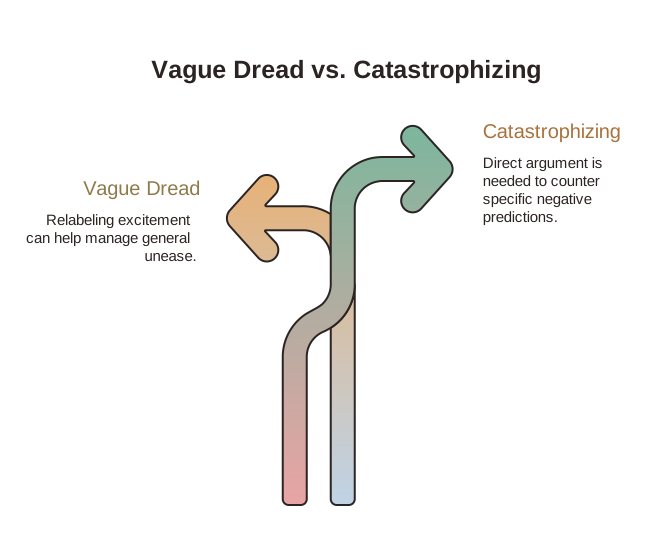
No. "Presentation anxiety" is actually at least two different things — vague dread with no content, and catastrophizing, a specific predicted scene — and they don't respond to the same fix.
The first kind is vague. It doesn't have content. You just feel unsettled — tight chest, restless, a general sense that something's coming. If someone asked "what exactly are you afraid will happen," you'd struggle to answer beyond "I don't know, it just feels bad."
The second kind has content. It's not a feeling, it's a prediction, fully cast: you'll open your mouth and forget everything, someone will ask a question that exposes you don't actually know the material, the room will go quiet in that specific way that means it's over. That's catastrophizing — a scene, with details, that your brain is treating as the likely outcome instead of one option out of many.
Both get called "presentation anxiety." Only one of them is actually about the presentation. The other is about a story your brain already finished writing.
The tell: can you finish the sentence?
Here's the fastest way to know which one you're dealing with. Try to finish this sentence: "I'm afraid that ___."
If you land on something specific — a moment, a line, a reaction from a specific person — that's catastrophizing. You have a scene. You could describe the lighting.
If you can't finish the sentence, if the honest answer is closer to "I don't know, I just feel bad about it," that's dread. It's real, but it's arousal without a claim attached to it yet.
This distinction matters more than it sounds like it should, because the two need opposite kinds of help.
Why does "I'm excited" work on one of these and not the other?
If you've read about the karaoke study — the one where saying "I'm excited" out loud before a nerve-racking task measurably outperformed saying "I'm nervous" — you already know the mechanism: anxiety and excitement are close to the same physiological state, and a lot of what determines the outcome is which label your brain assigns to the arousal.
That swap is genuinely effective on vague dread. Dread has no content to argue with — it's just arousal looking for a story, and "excited" is as valid a story as "nervous." Relabeling it works because there's nothing underneath it contradicting the new label.
Catastrophizing doesn't budge the same way. You can say "I'm excited" as many times as you want over a fully-formed prediction that you're going to forget your lines in front of your director — the prediction is still sitting there afterward, untouched, because a mood word doesn't argue with a specific claim. It's like changing the music playing in a room where an actual argument is happening. The volume shifts. The argument doesn't.
A mood word doesn't argue with a specific claim.
Relabeling arousal changes how dread feels; it doesn't touch a fully-formed catastrophic prediction, which has to be examined directly instead.
The three catastrophizing patterns that show up before a presentation
Catastrophic predictions before a presentation tend to cluster into a few recognizable shapes:
The audience reaction chain. You picture a specific expression on a specific person's face — bored, unimpressed, exchanging a look with the person next to them — and treat that imagined reaction as information about how it's actually going to go, before it's happened.
The blank-mind chain. You rehearse the moment your mind goes empty mid-sentence, in detail, more vividly than you rehearse the actual content. The fear of forgetting gets more mental airtime than the material itself.
The technical failure chain. The slides won't load, the clicker won't work, the one demo that's supposed to land falls apart in front of everyone — a specific failure point, imagined with enough detail that it starts to feel like a memory of something that already happened, rather than a guess about something that hasn't.
All three share a structure: a plausible-sounding scene, played on a loop, standing in for a prediction. That's what makes catastrophizing convincing — it doesn't feel like a guess. It feels like recall.
Naming it isn't enough
Knowing the term "catastrophizing" rarely defuses it. Telling yourself "I'm just catastrophizing" can even backfire — it can read as dismissing something that feels, in the moment, completely reasonable. The thought needs to actually be argued with, not labeled and set aside.
That argument has a shape. Ask what specifically you're afraid of, not the general dread version — the actual scene. Then ask what it's based on: is there real precedent, or is this the worst version your brain could generate under pressure? Most catastrophic predictions, examined directly, turn out to be built on very little — a mind reaching for the most vivid possible outcome, not the most likely one.
The realistic alternative usually isn't "it'll be perfect." It's something more specific and more useful: you'll probably lose your place at least once and recover, most of the room is thinking about their own presentation more than yours, a technical hiccup is a five-second delay, not the whole thing collapsing.
When the loop doesn't stop with logic alone
Some catastrophic thoughts loosen once you've examined them like this. Others are stickier, especially the ones tied to a specific memory of something going wrong before, or a specific person whose reaction actually matters to you. In those cases, working through it alone tends to loop instead of resolve — you argue with the thought, feel briefly better, and then it comes back with the same details an hour later.
That's the gap MindLift is built for. You type the actual sentence — not "I'm nervous about tomorrow," the real one, "they're going to see I don't actually know this as well as I'm pretending to" — and get three reframes back in under a minute, each tagged with the distortion driving it. Not a generic pep talk standing in for the fix. A reframe of the specific claim you made, built to hold up against it. It's free to start, on iOS and Android.
If you took the pressure response quiz and landed on Catastrophizer, this is the same mechanism from your result, in more depth — the loop where predicting the worst outcome doesn't prepare you for it, just braces you against something that hasn't happened yet.
If you'd rather start on paper, the reframe toolkit walks through the same distortions in worksheet form — useful for the first few times you catch a prediction mid-scene and want a structure to argue with it.
For one reframe a week delivered straight to your inbox, The Sunday Reframe is built around exactly this — small, specific shifts instead of vague reassurance.
Frequently asked questions
Is catastrophizing the same as being realistic about risk?
No. Realistic risk assessment weighs several outcomes and their actual likelihood. Catastrophizing fixates on the worst outcome and treats it as the default, without weighing it against anything else.
Why does catastrophizing feel more convincing than regular worry?
Because it's specific. A detailed, sensory prediction is processed more like a memory than a guess, which is part of why it feels so hard to argue with — it doesn't feel speculative from the inside.
What if I genuinely can't tell if my dread has content or not?
That's common, especially when the dread has been sitting there for a while. Try writing down the actual sentence, out loud or on paper, instead of trying to identify it in your head — most people find the specific version surfaces once they're forced to finish the sentence rather than just feel the feeling.
Does the "I'm excited" reframe ever work on catastrophizing at all?
It can take the edge off the raw arousal, which sometimes makes the specific thought easier to examine afterward. But it won't argue with the prediction itself — that part needs a reframe built around the actual claim, not the mood underneath it.
Like what you're reading?
Continue your wellness journey
Reframe negative thoughts in 60 seconds — free to start in the MindLift app.


Free to start · no account required
CBT & Self-Talk Researchers
MindLift content is grounded in cognitive behavioral therapy principles and designed to help you shift harsh self-talk in real time. Our guides focus on practical, evidence-based techniques you can use in the moment.
Was this article helpful?