Turn this into a daily habit — free to start in the MindLift app:
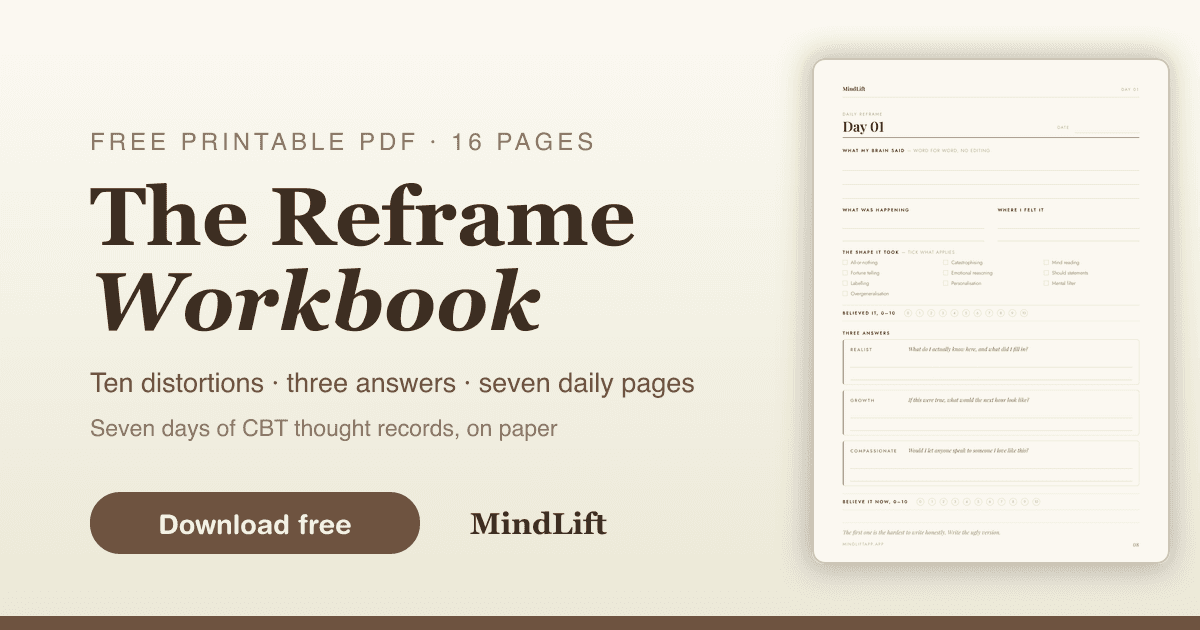
Every thought spiral starts as a sentence. "I ruined that." "They probably think I'm annoying now." The Reframe Workbook is a free, printable 16-page PDF built around one method: write the thought down word for word, name the shape it took, then answer it three ways. Seven daily pages, no app required, no right mood required — just the thought on paper and a page that talks back to it.
What's inside the workbook
Sixteen pages, and every one of them is either a reference you'll come back to or a page you write on. The method is the same one the MindLift app runs, slowed down to handwriting speed.
- The loop you're actually in. Trigger, thought, feeling, body, action, evidence — the six-stage chain a negative thought runs in about four seconds, with a worked example traced stage by stage. The thought is the only link you can catch and hold still, which is why the rest of the workbook works on that one.
- Ten shapes a thought takes. All-or-nothing thinking, catastrophizing, mind reading, fortune telling, emotional reasoning, should statements, labelling, personalization, mental filter, and overgeneralization — each with a plain definition and a "sounds like" line, plus a box to mark the two you recognize as yours.
- One thought, three answers. The realist answer (what do I actually know, and what did I fill in?), the growth answer (if this were true, what would the next hour look like?), and the compassionate answer (would I let anyone speak to someone I love like this?), with a worked example and a practice block before Day 01.
- Map the thought. A warm-up page for the thought that keeps coming back: where it shows up, who is in the room, what it makes you do, what it makes you avoid, whose voice it uses, and what it costs.
- Seven daily reframe pages. The thought word for word, what was happening, the distortion it took, how much you believed it from 0 to 10, three answers, and a second rating afterwards. The page is built to be reprinted.
- What seven days showed. A distortion tally, a before-and-after belief grid, the thought that came back more than once, and the reframe that actually landed.
The method itself is explained step by step in How to reframe a negative thought, which walks the same 11:40pm thought through all three answers. Read it first if you want to know why the pages are laid out the way they are.

Who it's for
The workbook is for anyone who overthinks, ruminates, or argues with their own brain at night — and wants something more concrete than "just let the thought go." It works because slowing down works: writing a thought down exactly as it sounds, naming the distortion, and answering it three ways is the core loop of cognitive restructuring, one of the best-studied techniques in CBT. If you've read our guides on thinking traps or why rumination makes everything worse, this is the printable version of the fix.
It is not therapy and doesn't replace it. Think of it as the paper companion for the 167 hours between sessions. The read-this-first page says so plainly, and it includes a crisis-safety note for the nights that are heavier than a worksheet.
Not sure which thought to start with? If most of yours show up while you're scrolling, take the two-minute quiz Why do you actually scroll? — it names the pattern and points you at the swap that works for it.
How to use it
Four rules, and they are the whole method. Use it when it happens, not at a scheduled hour — the page is for the moment the thought lands, and two minutes is enough. Write the thought word for word, not the tidy version. Name the shape before you argue with it. Then answer three ways, not one, and let the answer that bounces off bounce off.
Print it, or write on it on a tablet. Reprint the daily page as often as you need. Miss four days and come back on the fifth: nothing resets, because there is no streak to break.
For the moments a pen can't cover, the MindLift app gives the same three answers — realist, growth, compassionate — on your own words in under 60 seconds, free to start on iOS and Android.
Frequently asked questions
Is the Reframe Workbook really free?
Yes. The Reframe Workbook is a free 16-page PDF. You enter your email, the download starts immediately, and you're subscribed to the MindLift newsletter — which you can unsubscribe from anytime with one click.
What cognitive distortions does the workbook cover?
The reference pages cover ten: all-or-nothing thinking, catastrophizing, mind reading, fortune telling, emotional reasoning, should statements, labelling, personalization, mental filter, and overgeneralization. Each one comes with a plain-language definition and a "sounds like" example, and every daily page has a tick-box list so you can tag the thought you just wrote down.
Is this a CBT thought record?
Yes. Each of the seven daily pages is a thought record: what was happening, the thought written word for word, the distortion it took, how much you believed it from 0 to 10, three reframes, and a second belief rating afterwards. It's designed for everyday use, not as a clinical instrument, and it doesn't replace therapy.
What are the three reframes?
The realist answer asks what you actually know and what you filled in. The growth answer asks what the next hour would look like if the thought were true. The compassionate answer asks whether you would let anyone speak to someone you love that way. One of the three usually bounces off; the workbook is built so that the other two still land.
Can I print the workbook?
Yes — it's designed to be printed. It's laid out on A4 and prints correctly on US Letter with "fit to page". The daily page is built to be reprinted as many times as you need, and the whole file also works on a tablet with a stylus.
Do I need the MindLift app to use the workbook?
No. The workbook works entirely on paper. The app gives the same three answers digitally — realist, growth, and compassionate responses to your own words in under 60 seconds — for the moments when you don't have a pen and a quiet page.
Like what you're reading?
Continue your wellness journey
Reframe negative thoughts in 60 seconds — free to start in the MindLift app.


Free to start · no account required
CBT & Self-Talk Researchers
MindLift content is grounded in cognitive behavioral therapy principles and designed to help you shift harsh self-talk in real time. Our guides focus on practical, evidence-based techniques you can use in the moment.
Was this article helpful?