
Turn this into a daily habit — free to start in the MindLift app:
You're about to walk into the interview. The first date. The pitch. The thing you've been dreading since it went on the calendar. Your heart's going. Your hands are doing the thing. And every piece of advice you've ever gotten says the same thing: calm down. Take a breath. Relax.
Here's the problem. It doesn't work. Not because you're bad at breathing — because you're using the wrong emotion.
Why do anxiety and excitement feel like the same thing?
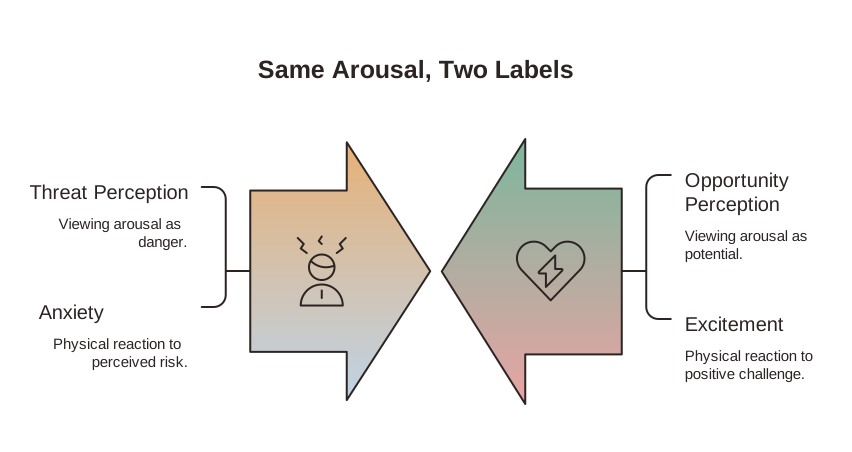
Physiologically, anxiety and excitement are almost identical. Elevated heart rate. Faster breathing. A spike in adrenaline. Your body doesn't actually know the difference between "this is a threat" and "this is a thrill" — it just knows it's aroused. The label comes from you, after the fact, when your brain scans the situation and decides which story to tell.
As behavioral researcher Vanessa Van Edwards puts it in her TEDx talk You Are Contagious: "anxiety and excitement are very similar emotions. The only difference is mindset."
That's the whole game. Not managing the feeling. Renaming it.
What did the karaoke study on anxiety find?
In a karaoke study, people who said "I'm excited" out loud before singing outscored those who said "I'm nervous" — same task, no extra preparation, just a different sentence spoken first.
There's a research finding that keeps showing up because it's almost too simple to believe. Researchers brought people into a lab and had them sing into voice-accuracy software, cold, no warmup, judged on pitch and rhythm — about as nerve-racking as it sounds.
One group walked in and sang with no instruction at all. A second group was told to say "I'm nervous" out loud first. A third group said "I'm excited" out loud first. The "I'm nervous" group scored the lowest. The no-instruction group landed in the middle. The "I'm excited" group scored highest — roughly 25 to 30 points higher than the nervous group, on the same task, with the same amount of preparation (none).
Nothing about their skill changed in the three seconds before they sang. One sentence changed. That's it. This comes from Harvard psychologist Alison Wood Brooks' research on anxiety reappraisal — worth noting that saying it out loud matters more than just thinking it.
Different people run this play in completely different ways under pressure — some rehearse, some freeze, some skip straight to the worst case. Which one are you? takes about a minute and names the pattern you default to.
Why does "calm down" backfire?
Most anxiety advice asks you to do something physiologically difficult: drop from high arousal to low arousal, fast, on command, usually while the stressful thing is still happening. That's a big jump, and it's why "just relax" so rarely lands when you're actually anxious.
Reappraisal doesn't ask you to drop the arousal. It asks you to keep it and change what it means.
High heart rate isn't 'I'm about to fail,' it's 'I'm about to do something that matters.' Same body, different sentence.
It's also why a lot of calming tools ask something of you that you don't have yet — you have to already be somewhat regulated to meditate your way down. MindLift was built the other direction: it meets you in the spike, not after it.
The two-word swap works for jitters. It doesn't work for spirals.
"I'm excited" is a blunt instrument. It works beautifully when the anxious feeling is vague and situational — pre-performance nerves, a general sense of dread before something hard. There's no specific belief to argue with, just arousal looking for a label. That's the part most retellings of this study leave out.
It stops working the moment your anxious thought has content. "I'm going to bomb this and everyone will notice" isn't vague arousal — it's a specific prediction, usually one built on a pattern you've told yourself before. Swapping one word doesn't touch the belief underneath it. You can say "I'm excited" through gritted teeth at a thought like that and it will just sit there, unconvinced.
That thought needs to be argued with directly. Not with a mood word — with the actual cognitive distortion driving it. That one's fortune-telling. That one's catastrophizing. That one's all-or-nothing. Each one has a shape, and each one needs its own argument — not a blanket "cheer up." (If catastrophizing is the specific loop you're in, the fix for it looks different from a mood swap.)
When the swap isn't enough
This is the gap MindLift is built for. Not the pre-performance jitters — the specific, textured, 11pm version of an anxious thought that has your name and your history baked into it.
You type the actual thought, in your own words, not a mood word. You get three reframes back in under a minute — a Realist one, a Growth one, and a Compassionate one — each tagged with the exact cognitive distortion it's undoing. Not a generic line written by someone who's never met you. A reframe of what you actually said, built to hold up against the specific thing your brain is arguing. It's mental first aid for the hours between the thought and the therapist — the 167 hours a week therapy doesn't cover. It's free to start, on iOS and Android.
Try the two-word version right now
Before your next nerve-racking thing — a call, a workout, a hard conversation — say "I'm excited" out loud. Not in your head. The research found the spoken version outperforms the silent one; hearing yourself say it does something the internal monologue doesn't.
A few things that make excitement easier to trigger in the first place, straight from the same body of work: ask a question that makes someone search for a good memory instead of a status update — "working on anything exciting lately?" beats "how are you." Use your hands when you talk. Let your smile reach your eyes instead of performing one. And don't pick up the phone when you're in a bad mood — the person on the other end will feel it before you say a word.
The swap is the fast version. For the thoughts it can't reach, the reframe toolkit walks through the specific distortions on paper, and The Sunday Reframe sends one small, specific shift to your inbox each week.
Frequently asked questions
Does saying "I'm excited" actually work if I don't believe it yet?
Yes, at least short-term — researchers call it a "fake it until you feel it" effect. Saying it out loud tends to produce some of the real feeling, even when you start out skeptical. The spoken version outperforms just thinking it.
What's the actual difference between anxiety and excitement, if the body reaction is the same?
Appraisal, not physiology. Same arousal, different meaning assigned to it. Your body registers the activation; your mind decides whether it means "threat" or "thrill." That meaning is the one piece you have control over.
What if my anxious thought is more specific than general nerves — like a fear tied to something that keeps happening?
That's a belief, not a mood, and a one-word swap won't move it much. It needs a reframe that engages with what you actually said — which is the difference between saying "I'm excited" and running the specific thought through a tool built to argue with it, like MindLift.
Is this the same as toxic positivity — just telling yourself you feel good when you don't?
No. You're not overriding the feeling or pretending it's not there. You're keeping the same energy and changing the story you're telling about why it's there. The arousal stays; only the label moves.
Like what you're reading?
Continue your wellness journey
Reframe negative thoughts in 60 seconds — free to start in the MindLift app.


Free to start · no account required
- Brooks AW (2014). Get excited: Reappraising pre-performance anxiety as excitement. Journal of Experimental Psychology: General, 143(3), 1144–1158. — DOI (opens in a new tab)
- Jamieson JP, Mendes WB, Blackstock E, Schmader T (2010). Turning the knots in your stomach into bows: Reappraising arousal improves performance on the GRE. Journal of Experimental Social Psychology, 46(1), 208–212. — DOI (opens in a new tab)
CBT & Self-Talk Researchers
MindLift content is grounded in cognitive behavioral therapy principles and designed to help you shift harsh self-talk in real time. Our guides focus on practical, evidence-based techniques you can use in the moment.
Was this article helpful?