
Turn this into a daily habit — free to start in the MindLift app:
You've had the thought a hundred times. You know it's probably not completely true. You've tried telling yourself to stop — it doesn't work. You've tried thinking positively — it doesn't land.
What actually works, according to decades of cognitive behavioral therapy research, is restructuring the thought. Not replacing it with something cheerful. Not suppressing it. Restructuring it — examining the evidence, finding the distortion, and arriving at something more accurate.
That process has a name: cognitive restructuring. And it works significantly better when you write it down.
This page gives you the framework, explains each step, and includes an interactive worksheet you can use right now.
What Is Cognitive Restructuring?
Cognitive restructuring is one of the foundational techniques in CBT. The premise is straightforward: thoughts are not facts. Negative thoughts — especially the persistent, looping ones — are often distorted interpretations of events, not accurate descriptions of reality.
By examining a thought systematically, you can identify how it's distorted, find evidence for and against it, and construct a more balanced thought that your brain can actually accept.
This is different from positive thinking. Positive thinking asks you to replace a negative thought with a positive one. The problem is your brain often rejects the replacement because it doesn't feel true. Cognitive restructuring asks you to replace a distorted thought with an accurate one — and accuracy your brain can accept, even when it isn't comfortable.
The technique is most effective for the kind of thoughts that spiral. The ones that loop. The ones that feel more real at 2am than they did at noon.
When to Use This Worksheet
This worksheet is designed for overthinking and negative thought loops specifically. Use it when:
- You're replaying a situation and can't let it go
- You notice yourself catastrophising about something uncertain
- A negative belief about yourself keeps resurfacing
- You've already tried "just not thinking about it" and it isn't working
- You're stuck in a spiral and need a structured way out
It works best when you write things down rather than keeping them in your head. Externalising the thought — putting it somewhere outside of you — reduces its emotional intensity and gives you something concrete to examine rather than a fog.
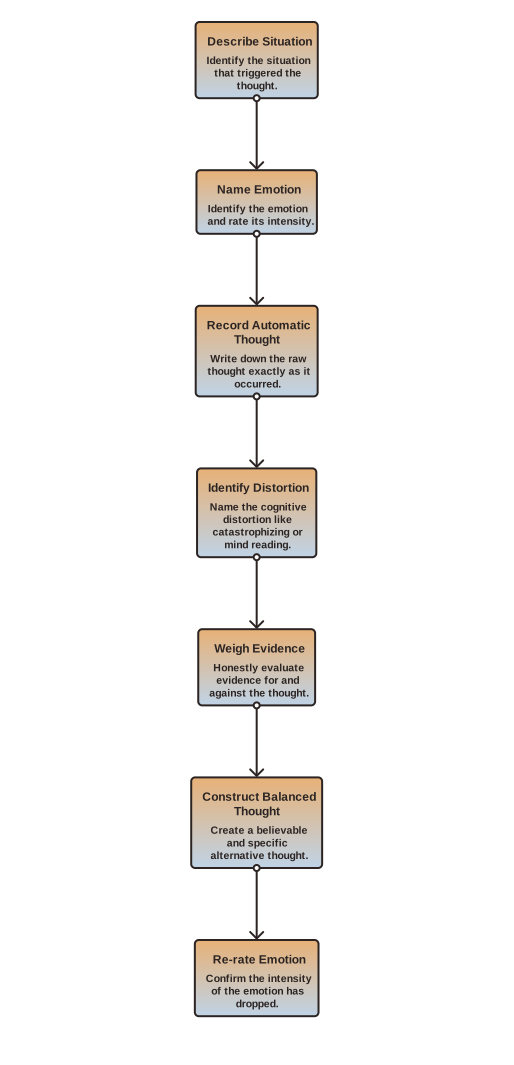
The 6 Steps of Cognitive Restructuring
Step 1: Identify the situation
What happened? Keep this factual and brief — just the observable event, not your interpretation of it.
Not: "Everything went wrong at work today."
But: "My manager gave brief feedback on the report I submitted."
The goal here is to separate the event from the meaning you're already assigning to it.
Step 2: Name the emotion and rate its intensity
What are you feeling, and how intense is it on a scale of 1–10?
Being specific about emotion matters. "Bad" is not an emotion. "Anxious," "ashamed," "humiliated," "rejected," "defeated" — these are emotions. The more precisely you can name the feeling, the more accurately you can trace it back to the thought driving it.
The intensity rating matters too. It gives you a baseline to compare against after you've worked through the exercise.
Step 3: Write the automatic thought
What was the exact thought that passed through your mind? Not the polished version — the raw one. The thought you'd be embarrassed to say out loud.
"They think I'm incompetent."
"I always ruin things."
"Nobody actually likes me."
Automatic thoughts are the ones that arrive uninvited, feel immediately credible, and carry strong emotion. They're usually brief, categorical, and absolute.
Step 4: Identify the cognitive distortion
Which thinking error is the thought using? Common ones in overthinking:
- Catastrophising — escalating to the worst case
- Mind reading — assuming you know what others think
- All-or-nothing thinking — no middle ground
- Emotional reasoning — feeling it makes it true
- Personalisation — making their behaviour about you
- Fortune telling — treating fear as fact
You may find more than one. That's normal. Name the primary one.
Step 5: Examine the evidence
This is the core of cognitive restructuring. Two questions:
What's the evidence that supports this thought? Write down actual evidence — facts, events, behaviours — not feelings. "I feel like they hate me" is not evidence.
What's the evidence against this thought? What contradicts it? What would you notice if you were looking for disconfirming information rather than confirming it?
This step tends to be uncomfortable because your brain has been collecting supporting evidence for the thought for a long time and almost none against it. That asymmetry is the distortion. The exercise is to deliberately correct for it.
Step 6: Write a balanced, realistic thought
Not a positive thought. A balanced one — one that takes both columns of evidence into account.
The language matters here. It should:
- Use first person ("I")
- Be specific rather than general
- Avoid absolute words (always, never, everyone, no one)
- Be something you could actually believe
Original: "I always ruin everything."
Balanced: "I made a mistake in this specific situation. I've also handled things well in situations X and Y. One mistake doesn't define the whole pattern."
After writing the balanced thought, re-rate the emotion. It rarely drops to zero — that would be suspicious. But a meaningful reduction in intensity (from 8 to 5, say) confirms the restructuring is working.
A Note on "Balanced" vs "Positive"
The most common mistake people make with cognitive restructuring is trying to arrive at a thought that feels good rather than a thought that feels true. These aren't the same thing.
If you've genuinely made a mistake, the balanced thought isn't "I'm great and that didn't matter." It's "I made a mistake, it had these specific consequences, I can do X differently next time, and it doesn't mean everything I do is ruined."
That's less comfortable than a positive reframe. It's also something your brain will actually hold onto, because it doesn't require you to ignore reality to believe it.
The goal is accuracy. Emotional relief is the by-product of accuracy, not the target.
Use the Worksheet Below
The interactive worksheet below walks you through all six steps. You can work through it directly on this page — no account, no sign-up, no data stored.
For best results, slow down at Step 5. The evidence columns are where the real work happens.
After the Worksheet: What Comes Next
Cognitive restructuring works cumulatively. The first time you do it, it may feel mechanical. The fifth time, it starts to feel natural. The twentieth time, you start catching distortions in real time — before they spiral into full overthinking sessions.
The long-term goal isn't to complete the worksheet every time you have a negative thought. It's to internalize the process so you develop what CBT calls cognitive flexibility: the ability to recognise a distorted thought, hold it less tightly, and arrive at a more accurate interpretation without needing to write it all out.
That takes time. It takes repetition. It takes doing the worksheet on the small thoughts, not just the big ones.
When to Seek More Support
A worksheet is a tool, not a treatment. For recurring negative thought patterns — especially those connected to depression, generalised anxiety, OCD, trauma, or long-standing beliefs about your worth — working with a CBT-trained therapist will take you significantly further than self-help alone.
The worksheet is most useful when you can already identify that a thought is probably distorted. If every thought feels completely true and you can't imagine evidence against it, that's a signal worth taking to a professional.
Frequently asked questions
What is cognitive restructuring?
Cognitive restructuring is a core technique from Cognitive Behavioral Therapy (CBT). It works by systematically examining a negative or distorted thought — identifying the thinking error, weighing the evidence for and against it, and constructing a more accurate, balanced thought in its place. Unlike positive thinking, cognitive restructuring aims for accuracy rather than optimism.
How is cognitive restructuring different from positive thinking?
Positive thinking asks you to replace a negative thought with a positive one. The problem is your brain often rejects the replacement because it doesn't feel true. Cognitive restructuring asks you to replace a distorted thought with an accurate one — and accuracy your brain can accept, even when it isn't comfortable. The emotional relief follows from accuracy, not from forcing optimism.
How many times do I need to do this before it works?
The first time you do cognitive restructuring, it may feel mechanical. The fifth time, it starts to feel more natural. The twentieth time, you start catching distortions in real time — before they spiral. The process is cumulative: the worksheet builds the skill gradually. How quickly you recover from negative thought loops shifts gradually with regular practice — it varies from person to person, and there is no fixed timeline.
Can I use this worksheet for anxiety?
Yes. Cognitive restructuring is one of the most well-researched CBT techniques for anxiety. The worksheet is particularly useful for anticipatory anxiety (catastrophising about uncertain events), social anxiety (mind-reading others' reactions), and generalised worry. For severe anxiety or panic, working with a CBT-trained therapist will provide additional support and personalisation.
What if I can't think of any evidence against the thought?
That's a signal, not a dead end. If you genuinely can't find any disconfirming evidence, try this: What would a close friend say if they heard this thought? What would you say to a friend who held this belief? What information are you filtering out because it doesn't fit the narrative your brain has already decided on? The inability to find counter-evidence is often itself a cognitive distortion — mental filtering in action.
Like what you're reading?
Continue your wellness journey
Reframe negative thoughts in 60 seconds — free to start in the MindLift app.


Free to start · premium optional