Turn this into a daily habit — free to start in the MindLift app:
You know the move. Catch the harsh thought, find a kinder or more accurate way to read the situation, feel the pressure drop. Most days it works. Then one day you run the same steps on a different problem and nothing happens — the reframe sits there, technically correct and completely inert, and you conclude that you are bad at this. There is a less self-punishing explanation, and a 2026 study puts some evidence under it.
Why doesn't reframing always work?
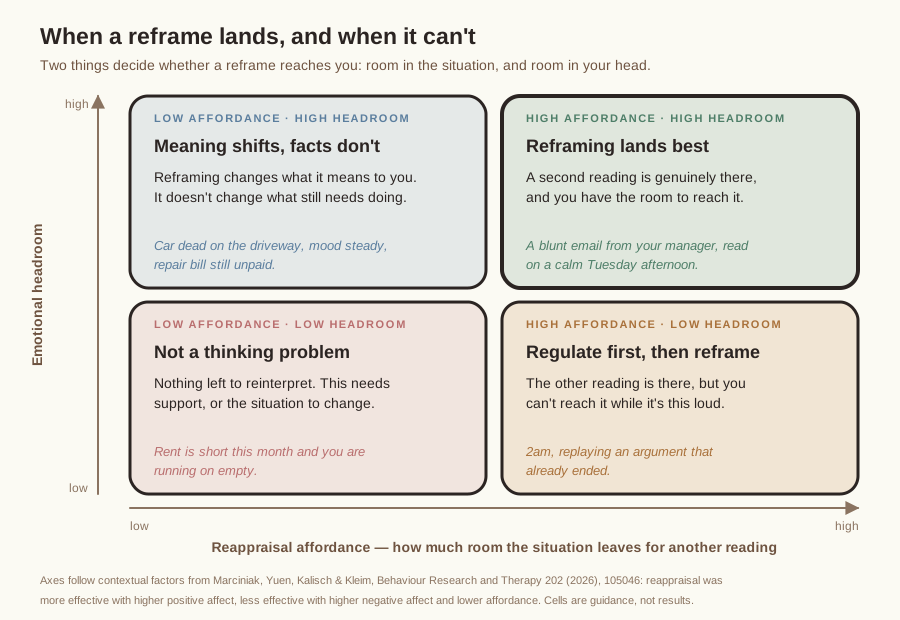
Because reframing has conditions. It needs an alternative reading that genuinely exists in the situation, and it needs enough emotional headroom for you to reach that reading. In a 2026 ecological momentary study, cognitive reappraisal was less effective when negative affect was higher and when the situation offered less room to reinterpret it — and more effective when positive affect was higher and the stressor more severe. When both conditions are missing, the problem is the situation, not your positive thinking.
Marciniak et al. (2026), Behaviour Research and Therapy
What the study actually did
Most of what we know about cognitive reappraisal comes from laboratories, where researchers induce a standardized stressor and measure what reappraising it does. That design is clean, and its limitation is obvious once named: a stressor engineered to be identical for every participant is not the stressor waiting for you on a Tuesday. The authors of this study set out to address exactly that gap in ecological validity.
They asked 100 young adults to use a mobile app called ReApp for three weeks. Participants recorded the stressors that actually happened to them in daily life and practiced cognitive reappraisal three times a day. That is an ecological momentary design — real stressors, recorded near the moment they occurred, rather than a single lab episode. The headline conclusion is that reappraisal effectiveness is highly context-dependent.
Condition one: is there another reading in there?
The study measured something called reappraisal affordance — how much room a situation gives you to interpret it differently. Lower affordance was associated with reappraisal working less well. This is the part most advice skips, because it is the part that is not about you.
Consider two stressors. Your manager replied to your message with one word, and you read it as contempt. That situation is dense with affordance: she was in a meeting, she answers everyone that way, she was being efficient rather than cold. A dozen readings fit the same facts, and choosing a fairer one is not denial — it is accuracy. Now consider the second: your rent went up by an amount you do not have. There is no reading of that sentence that makes the number smaller. You can reframe what it says about you, which is worth doing, but the situation itself has almost nothing to offer.
The study also reported what its authors describe as the first evidence that reappraisal effectiveness varies across stressor domains: it appeared better suited to health-related stressors than to lack-of-resources stressors. That is a finding about categories of problem, and it lines up with the affordance idea rather than replacing it.
Condition two: can you get there from here?
The second condition is emotional headroom. Reappraisal was associated with working less well when participants reported higher negative affect, and better when they reported higher positive affect. In plain terms: the further into the spiral you already are, the harder it is to reach the alternative reading, even when that reading is sitting right there.
This is worth separating from motivation. Nobody in a 2am spiral is failing to try hard enough. Reaching for a different interpretation is a cognitively demanding move, and demand goes up exactly when capacity goes down. If a reframe bounces off at your worst moment, that is a predictable feature of the moment — not a referendum on whether the skill works for you.
There is a practical reading of this. If reappraisal is easier with headroom, then the reps that build the skill are best banked when you have some: the mildly annoying email, the small comparison, the ordinary Tuesday thought. Practice on the 4-out-of-10 moments so the pattern is already grooved when a 9 arrives. That is also the argument for catching a thought early, before it has spent an hour compounding.
What did not predict effectiveness — including time
Two things the study found did not predict how well a reappraisal worked are worth naming. One was participants' subjective stress level. The other was the time spent generating the reappraisal.
That second one quietly dismantles a common piece of guilt. If you have ever assumed a proper reframe requires a journal, twenty uninterrupted minutes, and a mood, this finding suggests otherwise: longer did not mean better. A short reframe is not a compromise version of the real thing. It is the same move, done in the time you actually have — which is the entire premise behind doing it in about sixty seconds, standing in a hallway, before the next meeting.
Interestingly, the study also found reappraisal was more effective when the stressor was more severe, while the person's own rating of how stressed they felt did not predict much. Those are different measurements, and holding them together is the honest position: this is one study, with a nonclinical sample of 100 young adults, and its authors call for further research rather than declaring the question closed.
What reframing cannot do
Some problems are not thought problems. If you cannot make rent, if the bills are past due, if your housing or your workplace or your relationship is unsafe, no interpretation of those facts changes them. Being told to think about it differently in that situation is not help — it is a way of handing the problem back to you.
If that is where you are, the useful next move is practical rather than cognitive: a payment plan or hardship arrangement, a free debt or benefits advice service, a housing or employment advocate, a union representative, a local support organisation, a person you trust who can help you make calls. Those are structural levers, and they do things no reframe can do.
Reframing still has a job in those situations, but it is a smaller and more honest one. It can stop the situation from becoming a verdict on your worth — the slide from I cannot cover this month to I am a failure and always will be. The first sentence is a problem you can get help with. The second is a story that makes getting help feel pointless, and that one is worth arguing with.
A quick way to tell which situation you are in
Before you try to reframe something, ask one question: if a fair, well-informed friend looked at this, is there a different reading of the facts available to them? Not a nicer feeling — a different reading. If yes, reframing is the right tool, and the work is finding the version you can actually believe. If no, you have a situation problem, and the next step is practical help, support, or a decision, not a better sentence.
There is a middle case, and it is the most common one. The facts are fixed, but the conclusion you drew about yourself from them is not. The deadline slipped and that is real; I am unreliable and everyone knows it is the part with affordance. Aim there. That is usually where the room is.
The point is a better aim, not more effort
If you take one thing from this research, let it be that a reframe failing is data about the moment, not evidence about you. Sometimes the situation had no give. Sometimes you were too far into it to reach the other reading. Neither means the skill is broken, and neither is fixed by trying harder at the same thing.
The version that compounds is small and well-aimed: catch one harsh sentence, check whether a different reading genuinely exists, and if it does, write the one you would actually believe. If you want the step-by-step, start with how to reframe a negative thought — and if you are curious what the move is doing underneath, what happens in your brain when you reframe covers it. MindLift walks you from the harsh sentence to a Realist, Growth, or Compassionate version in about sixty seconds, free to start — which, per this study, is long enough.
This article is for general information and is not medical advice. MindLift is not a treatment and the study described here did not test it. If distress is severe or persistent, or if you are struggling to cope, please speak to a licensed mental health professional or your local emergency service.
Frequently asked questions
Why does reframing sometimes not work?
Because reframing depends on the situation, not just on effort. In a 2026 study published in Behaviour Research and Therapy, cognitive reappraisal was less effective when participants reported higher negative affect and when the situation offered lower "reappraisal affordance" — that is, less room to legitimately interpret it another way. Both are features of the moment, not failures of technique.
What is reappraisal affordance?
Reappraisal affordance describes how much room a situation gives you to reinterpret it. A tense email you read as hostile has high affordance, because a neutral reading is genuinely available. A rent increase you cannot pay has low affordance, because there is no alternative reading that changes the facts. In the study, lower affordance was associated with reappraisal being less effective.
Does a quick reframe work as well as a long one?
The study found that time spent generating a reappraisal did not predict how effective it was. That is only one finding from one study, but it suggests that spending longer on a reframe is not automatically better — and that a short, well-aimed reframe is not a lesser version of the practice.
What should I do when there is nothing left to reframe?
Treat it as information rather than failure. If the stressor is a resource problem — rent, bills, an unsafe living or working situation — the useful next move is practical or structural: a payment plan, a benefits or debt advice service, a housing or employment advocate, a trusted person who can help you act. Reframing can help you stay steady enough to take those steps; it cannot substitute for them.
Does this mean CBT reframing does not work?
No. The study looked at when cognitive reappraisal is more or less effective in everyday life, not at whether it works at all. Its authors suggest reappraisal training may be optimized by adjusting practice to contextual factors, and call for further research. This is a single study with a nonclinical sample of 100 young adults, so it is best read as a refinement, not a verdict.
Like what you're reading?
Continue your wellness journey
Reframe negative thoughts in 60 seconds — free to start in the MindLift app.


Free to start · no account required
- Marciniak, M. A., Yuen, K. S. L., Kalisch, R., & Kleim, B. (2026). Contextual factors influence effectiveness of cognitive reappraisal. Behaviour Research and Therapy, 202, 105046. — DOI (opens in a new tab)
CBT & Self-Talk Researchers
MindLift content is grounded in cognitive behavioral therapy principles and designed to help you shift harsh self-talk in real time. Our guides focus on practical, evidence-based techniques you can use in the moment.
Was this article helpful?