
Turn this into a daily habit — free to start in the MindLift app:
It's 11:40pm. You sent the message four hours ago. It's been read. You have now rewritten the last thing you said about six times in your head, and the sentence your brain has finally settled on is:
"I said too much. She's tired of me."
Somewhere underneath, you know this might not be true. You have known that for four hours. Knowing it has not helped once.
That isn't a willpower problem, and it isn't proof that you're bad at this. It's a structural thing about how the thought is built. Advice like challenge your negative thoughts or try to see the positive skips the part that actually matters, which is why it slides off. What follows is the method that doesn't — three steps, roughly two minutes, no requirement that you feel better about anything while you do it.
Why the thought feels like a fact
Before the technique, the mechanism, because the technique doesn't make sense without it. A negative thought doesn't arrive alone. It arrives inside a loop, and the loop runs in about four seconds, from something that happened to something it seems to prove.
- Trigger — she read the message at 21:14 and didn't reply.
- Thought — "I said too much. She's tired of me."
- Feeling — shame, about a seven out of ten.
- Body — chest first, then the jaw.
- Action — you type an apology, delete it, put the phone face down.
- Evidence — no reply comes, because you never sent anything. "See. I always make it weird."
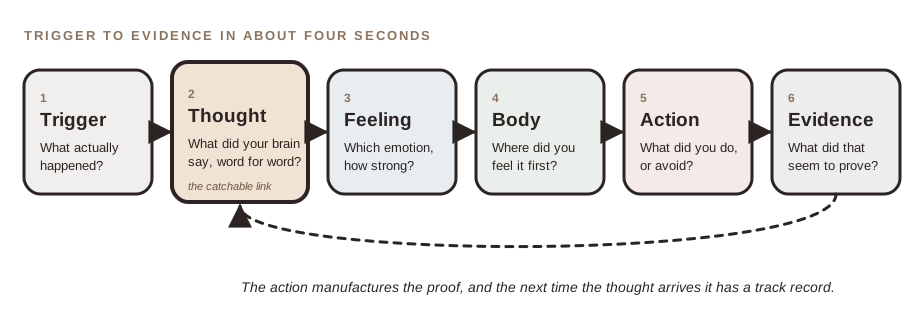
Look at the last step, because that's the whole trap. The thought produced an action, and the action manufactured the proof. You didn't send the follow-up, so nothing came back, so the silence you were afraid of became real silence — and now the thought has a source it can quote at you. Next time it arrives it will be louder, because it has a track record. That is the loop your thoughts run in, and it explains why the same sentence keeps coming back.
This is why arguing with the feeling never works. You cannot reason with a tightened jaw. You cannot decide to feel less ashamed. Of the six links in that chain, exactly one can be caught and held still long enough to examine, and it's the thought — a sentence, in words, that you can write down and ask questions of.
That's the entire premise of cognitive behavioural therapy, and it's narrower than most people assume. CBT doesn't ask you to be positive. It asks you to slow one link in a fast loop long enough for the next thought to be yours instead of the loop's.
Step 1: Write it word for word
Not the tidy version. Not "I was feeling a bit insecure about the message." That's a summary of the thought, written by the part of you that's trying to look reasonable, and reframing a summary does nothing — because the summary is not what will be running in your head at 3am.
Write the actual sentence. The one in the second person, often, with your name in it. The one that would embarrass you if someone read it over your shoulder.
- "I said too much. She's tired of me."
- "Everyone can tell I don't know what I'm doing."
- "I'm the one people are polite to, not the one they call."
- "I've wasted my thirties."
Two things happen the moment it's on paper or on a screen, and both are mechanical rather than inspirational.
The first is that the thought stops being the lens and becomes the object. While it's in your head, you are looking through it — it's the frame everything else is arriving inside. Once it's written, you're looking at it. This is the difference between wearing tinted glasses and holding them up to the light, and it's most of the work.
The second is that written thoughts get noticeably weaker. Spoken and unspoken thoughts have enormous latitude — they blur, they escalate, they borrow authority from your mood. Written down they have to commit to a specific claim. "Everyone can tell" looks very different on paper, where "everyone" has to mean actual named people who were actually in the room.
If you take nothing else from this article, take this one: don't skip to the reframe. The exact wording is the evidence.
Step 2: Name the shape before you argue with it
Distorted thoughts are not lies. They're true things, bent — which is exactly why they're so persuasive, and why that's not true is such a weak response. There usually is something true in there. It's just been stretched over far more territory than it can cover.
There are a small number of standard bends. You don't need to memorise all of them; you need to recognise the two or three that are yours.
All-or-nothing thinking. Two settings available: perfect and worthless. "I didn't reply for three days, so I'm a terrible friend."
Catastrophising. You skip the ten likely outcomes and land on the worst one, then start planning for it. "She hasn't texted back. Something has happened to her."
Mind reading. You decide what someone thinks of you, then treat it as something they actually said out loud. "He kept it short. He's decided I'm not worth the effort."
Fortune telling. You call the ending before anything has happened, and then don't start. "There's no point applying. I already know how it goes."
Emotional reasoning. Feeling it is taken as proof of it. "I feel like a fraud, so I must be one."
Should statements. A private rulebook nobody else agreed to, enforced only against you. "I should be further along than this by now."
Labelling. One event becomes a permanent noun, and the noun is you. "I forgot the deadline. I'm a mess."
Overgeneralisation. One instance becomes always, never, everyone, every time. "This always happens to me."
Now go back to your written sentence and name the bend. "I said too much. She's tired of me" is mind reading — you have her reading time and nothing else, and you filled in the rest — with some fortune telling stacked on top. If you want to know which two are yours, the pattern usually shows in how your self-talk sounds under pressure.
Naming does something that arguing doesn't. It moves the thought from this is my situation to this is a category of thought I produce. It stops being news about the world and becomes information about a habit. That shift is small and it is the point of the whole step.
Step 3: Answer it three ways
Most people go wrong at this step, and it's a good mistake to make — they write one reframe, it doesn't land, and they conclude the method doesn't work on them. A single reframe is a single angle of attack, and the thought is only vulnerable from certain directions. Write three.
The realist answer. What do I actually know here, and what did I fill in? This one separates the reported facts from the parts you supplied. Use it when the thought is wearing the costume of a fact.
She read it at 21:14. That's the entire evidence base. I supplied "too much," I supplied "tired of me," and I supplied a reason for a four-hour gap on a Tuesday night.
The growth answer. If this were true, what would the next hour look like? This one converts a verdict into an instruction. Use it when the thought might be partly accurate but has become a dead end.
Say I did overshare. Then the move is to send one normal message tomorrow rather than a paragraph of apology tonight. Oversharing is a thing I did, not a category I live in.
The compassionate answer. Would I let anyone speak to someone I love like this? This one changes the register, not the content. Use it when the thought is cruel rather than merely wrong — because cruelty is a separate problem from inaccuracy, and accuracy doesn't fix it.
You reached out to someone on a night you were lonely. That's not a mistake you need to apologise for at midnight.
Write all three even when two feel pointless. Which one lands is not predictable from the inside, and the one that bounces off hardest is often the one worth noticing — people who can't write the compassionate answer are usually not short of evidence, they're short of permission. The MindLift app gives all three answers to a typed thought in about a minute, if you want to see the shape of them before writing your own.
What to do when the reframe doesn't work
Sometimes you'll write all three answers and the thought is exactly as loud as before. That's normal, and there are two things worth knowing about it before you decide the method has failed on you.
First, measure it rather than judging it. Before you write, rate how much you believe the thought from 0 to 10. Rate it again after. If it went from an 8 to a 6, that is a success — it means the thought is movable, which is the only property that matters. Reframing is not supposed to take you to 0. It's supposed to buy you enough room that your next action isn't dictated by the loop. A 6 will let you send the message. A 0 was never on the table.
Second, a thought that survives all three answers is telling you something. It's usually older than this week. Thoughts that don't move under evidence, reframing or kindness tend to be sitting on a core belief — I'm too much, I have to earn my place, people leave — that was installed long before this particular Tuesday. That's not a failure of technique. It's a signal that the useful next step is a person, not a page: a friend, a GP, a therapist. Reframing works on the sentence. Someone else is needed for the thing underneath it.
And if what's happening tonight is heavier than that — if you're thinking about harming yourself, or you can't keep yourself safe — this isn't the right tool right now, and neither is any app. Contact your local emergency number or a crisis line in your country, and tell one person tonight.
Doing this in sixty seconds, when there's no paper
Written down, this takes about two minutes. The problem is that most of the moments where you need it don't come with two minutes and a pen. They come in a queue, a stairwell, a bathroom at work, 3am with the phone already in your hand.
That's what MindLift is for. You type the thought exactly as it arrived, and you get the three answers back — realist, growth, compassionate — each tagged with the distortion it's addressing, in around sixty seconds. It works with your words rather than a stock affirmation, and it gets more accurate about your particular loops the more you use it.
And if you want to do it by hand first, which is worth doing at least once, the free Reframe Workbook is the paper version — the ten distortions, the three answers, and seven daily pages with the belief rating built in. Enter your email and the download starts straight away.
If you're in acute distress or having thoughts of harming yourself, please contact a local crisis line or emergency services. MindLift is a self-help tool for everyday negative thinking and isn't a substitute for professional support. For what CBT is and isn't, see the CBT techniques hub.
Frequently asked questions
How is reframing different from positive thinking?
Positive thinking replaces a negative claim with a nicer one and asks you to believe it. Reframing checks the original claim against the evidence and keeps whatever survives. If the honest answer is "yes, that went badly," reframing says so — and then asks what follows from it. It's an accuracy exercise, not a mood exercise.
How long does it take to work?
The belief rating usually moves on the first attempt, by a point or two. What takes longer is recognising the distortion in real time rather than an hour later, and that's typically a few weeks of catching them late before you start catching them early. Catching it late still counts.
What if I can't tell which distortion it is?
Then pick the closest one and move on. The value is in the act of categorising, not in getting the label right. Two thoughts often share three distortions, and no clinician would care which one you picked.
Do I have to write it down, or can I do it in my head?
In your head works once you've done it on paper enough times to know the shape. Early on, written is meaningfully more effective, because the vagueness that keeps the thought powerful is exactly what writing removes.
Is this the same as what a CBT therapist does?
It's one component of it — cognitive restructuring — done alone and without the diagnostic and relational parts. It's a real technique, not a watered-down version of one, but it isn't therapy and it isn't a substitute for it. It works well in the gaps between sessions, which is most of the week.
Like what you're reading?
Continue your wellness journey
Reframe negative thoughts in 60 seconds — free to start in the MindLift app.


Free to start · no account required
CBT & Self-Talk Researchers
MindLift content is grounded in cognitive behavioral therapy principles and designed to help you shift harsh self-talk in real time. Our guides focus on practical, evidence-based techniques you can use in the moment.
Was this article helpful?