
Turn this into a daily habit — free to start in the MindLift app:
Somewhere you picked up a number — 21 days, 30 days, 90 days — for how long it takes the brain to change. Here's where those numbers actually come from, which ones have studies behind them, and the honest timeline for rewiring a thought pattern.
How long does it take to rewire your brain?
Depends what 'rewired' means. Skill-level changes (like getting better at reframing thoughts) show up within weeks of practice. Structural gray-matter changes have been measured at 8 weeks to 3 months of training. Habit automaticity took a median of 66 days in the key study — with a real range of 18 to 254. The famous '21 days' has no study behind it at all.
Lally et al. (2010); Hölzel et al. (2011); Draganski et al. (2004)
Where "21 days" actually came from
Not a brain scan. Maxwell Maltz was a plastic surgeon in the 1960s who noticed his patients took "a minimum of about 21 days" to psychologically adjust after operations — a new nose, an amputated limb. He wrote that observation in a self-help book (Psycho-Cybernetics), and four decades of retelling sanded "a minimum of about" down to a hard number. No controlled study of habit or thought change has ever produced 21 days. The most-cited number in behavior change is an artifact of paraphrasing.
The numbers that do have studies behind them
66 days — median time to habit automaticity. Phillippa Lally's team at UCL tracked 96 people building one new daily habit and modeled when the behavior became automatic. Median: 66 days. Range: 18 to 254. Drinking a glass of water after breakfast automated fast; 50 sit-ups took months. The honest headline isn't "66 days" — it's that simple actions in stable contexts automate quickly and complex ones slowly, and missing a single day made no measurable difference.
8 weeks — measurable gray-matter change. Harvard's Hölzel and Lazar scanned people before and after an 8-week mindfulness program and found increased gray-matter density in the hippocampus and other regions tied to learning and emotion regulation. Two months of daily-ish mental practice left a physically detectable trace.
3 months — new skill, new structure. In the famous Nature juggling study (Draganski 2004), adults who practiced juggling for three months showed gray-matter expansion in motion-processing areas — which partially receded when they stopped. Brain structure tracks what you practice, in both directions. That last part matters: rewiring is maintained by use, not achieved once.
Weeks — improvement in thought-level skills. Closest to what most people mean by "rewiring": Denny and Ochsner trained people in cognitive reappraisal — reframing — across sessions spread over weeks, and both the skill and its emotional payoff grew with practice. We've broken down exactly what happens in the brain during a reframe — the short version is that the pathway you're strengthening is prefrontal control over the amygdala's alarm, and it strengthens like anything else: with reps.
Why the range is 18–254 and not a number
Because the variables are yours. Four of them do most of the work:
- Frequency. Repetition is the mechanism, so ten 60-second reps spread across real moments beat one Sunday journaling session. This is also why people who visibly rewired under pressure all describe daily practices, not breakthroughs.
- Context. Practicing on the live thought, in the moment it fires, builds the association where you actually need it — not in the abstract.
- Believability. A reframe you accept recruits the control circuitry; a slogan you don't just bounces. Honest beats positive.
- Sleep. Consolidation of new patterns happens disproportionately during sleep — one more reason the 3am spiral deserves a 60-second interruption instead of an hour of indulgence.
The honest timeline for a thought pattern
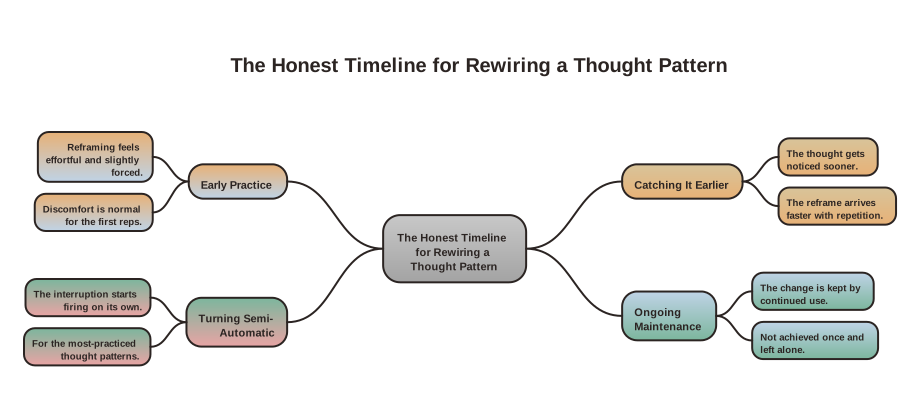
Put the studies together and a realistic arc looks like this. Week 1: reframing feels effortful and slightly fake — that's the expensive first reps, and it's normal. Weeks 2–4: you start catching thoughts earlier; the reframe arrives faster (this is the window the training studies measure). Months 2–3: the interruption starts firing semi-automatically for your most-practiced thought patterns — the 66-day territory. Ongoing: like the jugglers, you keep what you use. None of it requires believing anything mystical. It requires a practice small enough that you'll actually repeat it.
MindLift makes the rep 60 seconds: type the thought in your own words, get a Realist, Growth, and Compassionate reframe. Free to start, premium available. Try MindLift — free to start →
Frequently asked questions
How long does it take to rewire your brain?
There is no single number, but the research gives honest ranges. Synaptic-level changes begin with the first repetitions. Trainable skills like cognitive reappraisal show measurable improvement within weeks of practice. Structural gray-matter changes have been detected after 8 weeks (mindfulness training) to 3 months (learning a new motor skill). And habit automaticity — a new behavior running without effort — took a median of 66 days in the definitive study, with a range of 18 to 254 days.
Is the 21-day habit rule true?
No. The 21-day figure comes from Maxwell Maltz, a 1960s plastic surgeon who observed that patients took "a minimum of about 21 days" to adjust to changes like a new face or a lost limb — a clinical observation about self-image, not a controlled study of habit formation. When researchers actually measured habit formation (Lally et al., 2010, tracking 96 people daily), the median was 66 days and simple habits formed much faster than complex ones. "Minimum of about 21 days" became "21 days" through repetition, which is ironic.
How fast can you change negative thought patterns?
Faster than full habit change, because you're training a response, not building a routine from nothing. Longitudinal reappraisal training (Denny & Ochsner, 2014) found people got measurably better at reframing across sessions spread over weeks, with the emotion-regulation benefit increasing with practice. Clinically, CBT trials often show meaningful symptom movement within 4–6 sessions. The first reframe is the hardest; the pathway gets cheaper with every rep.
What actually speeds up brain rewiring?
Four things the research consistently supports. Frequency: many short practices beat rare long ones, because repetition drives synaptic strengthening. Real context: practicing on live thoughts in real moments transfers better than abstract exercises. Believability: a reframe you accept engages the control circuitry; one you don't creates pushback. And sleep — consolidation of new patterns happens substantially during sleep, which is one more reason 3am spirals are worth interrupting rather than indulging.
Can an adult brain still rewire, or is it too late?
Adult neuroplasticity is settled science. The landmark studies were done on adults: London taxi drivers' hippocampi, adult jugglers' gray matter after 3 months of practice, adults in 8-week mindfulness programs. The adult brain rewires more slowly than a child's and needs more repetition, but the mechanism never switches off. What actually stops most adults isn't biology — it's that repetition requires a practice small enough to repeat, which is the design problem MindLift's 60-second reframe exists to solve.
Like what you're reading?
Continue your wellness journey
Reframe negative thoughts in 60 seconds — free to start in the MindLift app.


Free to start · no account required
- Lally, P., van Jaarsveld, C. H. M., Potts, H. W. W., & Wardle, J. (2010). How Are Habits Formed: Modelling Habit Formation in the Real World. European Journal of Social Psychology, 40(6), 998–1009. — DOI (opens in a new tab)
- Draganski, B., Gaser, C., Busch, V., Schuierer, G., Bogdahn, U., & May, A. (2004). Neuroplasticity: Changes in Grey Matter Induced by Training. Nature, 427(6972), 311–312. — DOI (opens in a new tab)
- Hölzel, B. K., Carmody, J., Vangel, M., Congleton, C., Yerramsetti, S. M., Gard, T., & Lazar, S. W. (2011). Mindfulness Practice Leads to Increases in Regional Brain Gray Matter Density. Psychiatry Research: Neuroimaging, 191(1), 36–43. — DOI (opens in a new tab)
- Denny, B. T., & Ochsner, K. N. (2014). Behavioral Effects of Longitudinal Training in Cognitive Reappraisal. Emotion, 14(2), 425–433. — DOI (opens in a new tab)
Mental Wellness Researchers
Part of the MindLift team dedicated to translating psychological research into practical tools for everyday mental wellness.
Was this article helpful?