
Turn this into a daily habit — free to start in the MindLift app:
"Reframe the thought" sounds like advice from a poster. But when you actually do it — catch the thought, name it, rework it — something specific and measurable happens between your prefrontal cortex and your amygdala. Here is that sequence, with the brain scans to back it up.
What happens in your brain when you reframe a thought?
fMRI studies show that reframing (cognitive reappraisal) increases activity in prefrontal control regions while decreasing activity in the amygdala — the area that tagged the thought as a threat. A meta-analysis of 48 neuroimaging studies confirms the pattern. With repeated practice, the skill strengthens: the reframing pathway becomes easier to activate each time you use it.
Ochsner et al. (2002); Buhle et al. (2014), Cerebral Cortex
MindLift is a software-only CBT app for rapid cognitive reframing — it uses no brain scans or sensors. You type the thought that set off the alarm and get a realistic, kinder reframe in your own words in about 60 seconds: one repetition of the reappraisal skill the research below describes.
First, what fires: the alarm before the argument
A thought like "they're going to realize I can't do this" doesn't arrive neutrally. The amygdala — a small structure whose job is tagging incoming information for threat — responds fast, ahead of your slower reasoning circuits. That's why the body reaction (tight chest, heat, dread) often lands before you've consciously finished the thought. Nothing is malfunctioning; the alarm system is simply built to fire first and ask questions later.
The problem is what happens next. Left alone, the tagged thought keeps re-triggering the alarm — the loop we've mapped in the neuroscience of overthinking. Reframing is the deliberate interruption of that loop, and it has a distinct neural signature.
What the scans show when you reframe
In 2002, Kevin Ochsner and colleagues put people in an fMRI scanner, showed them negative images, and asked them to reinterpret what they were seeing — the lab version of reframing, which researchers call cognitive reappraisal. Two things happened at once: activity rose in the dorsolateral and ventrolateral prefrontal cortex — the regions that hold goals, weigh interpretations, and exert control — and activity in the amygdala dropped. Participants also reported feeling measurably less negative.
One study is a data point. This one became a field. By 2014, enough neuroimaging work had accumulated for Buhle and colleagues to run a meta-analysis across 48 studies, and the pattern held: reappraisal reliably engages prefrontal control regions and reliably reduces amygdala response. In plain terms: when you generate a genuinely different interpretation of a thought, the reasoning circuitry comes online and turns the alarm down. Not as a metaphor — as a replicated measurement.
Why typing the thought out is not a small step
Here's the part most people skip, and the research says it's doing real work: putting the thought into exact words. UCLA's Matthew Lieberman and colleagues found that simply labeling an emotion — turning "ugh" into "I'm afraid they regretted inviting me" — by itself reduces amygdala activity and engages right ventrolateral prefrontal cortex. They called it affect labeling, and it happens before any reframing has even started.
A vague dread is hard to regulate because there's nothing for the prefrontal cortex to grip. A specific sentence is workable material. This is why "just think positive" fails while writing the thought down helps — and it's why MindLift's reframe flow starts by making you type the exact thought, not select a category. The articulation is step one of the neural sequence, not paperwork before it.
The part that compounds: practice rewires the default
The most useful finding is the least dramatic one: reappraisal behaves like a trainable skill. In longitudinal work by Denny and Ochsner, participants who practiced reappraisal across multiple sessions got better at it week over week — the emotional benefit grew with repetition. That's neuroplasticity doing its ordinary job: pathways you activate repeatedly become easier, faster, and more automatic to fire.
Which means every individual reframe is doing two things. It's handling this thought, now. And it's lowering the activation cost of the next reframe — the same compounding we describe in rewiring negative thinking and the neuroplasticity guide. The first rep is the most expensive one you'll ever do.
How to train it (what the research actually suggests)
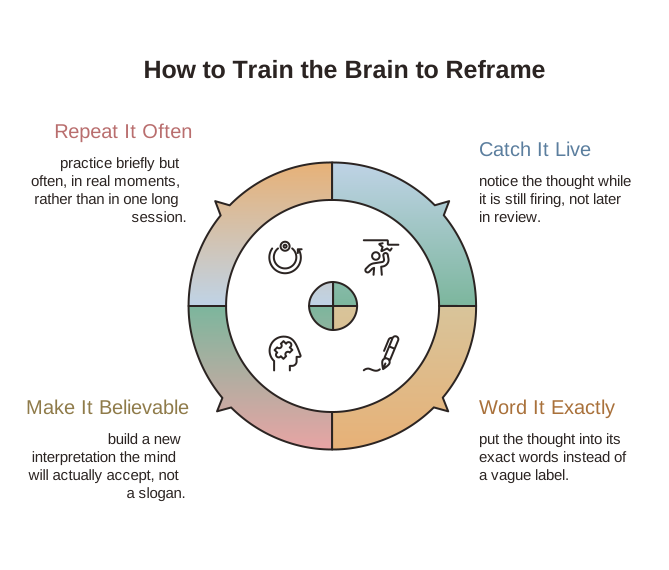
- Catch it in the moment, not in review. The amygdala is active when the thought is live — that's when regulation has something to regulate. A reframe at 9pm about a thought from 9am is a memory exercise.
- Word the thought exactly. Affect labeling is free regulation. "I'm spiraling" is a label for the fog; "I think I embarrassed myself in that meeting" is a thought you can actually rework.
- Make the new interpretation believable. The prefrontal cortex is generating a case, not a slogan. An honest "one awkward answer doesn't erase the prepared ones" regulates; an unbelievable "it went perfectly" doesn't.
- Go for frequency over duration. Training studies use repeated short practice. Sixty seconds, many times, in real situations — that's the protocol the pathway responds to.
The honest caveat, and the bottom line
Neuroscience framing gets abused, so to be precise about the claim: reframing is not a switch that deletes negative thoughts, brain scans measure group averages rather than your Tuesday, and for clinical anxiety or depression this is a skill that supports treatment, not a replacement for it. What the evidence does support is narrower and more useful: reappraisal reliably engages your brain's control circuitry, reliably quiets its alarm, and gets cheaper every time you practice it.
You are not stuck with the first interpretation your amygdala tags. You have a second system — it just needs the thought in words, a believable alternative, and reps.
MindLift is a free-to-start app built around exactly this sequence: type the thought in your own words, get a Realist, Growth, and Compassionate reframe in about 60 seconds. Try MindLift — free to start →
Frequently asked questions
What happens in the brain when you reframe a negative thought?
Two things, measurably. Prefrontal control regions — especially the dorsolateral and ventrolateral prefrontal cortex — increase their activity as you generate the new interpretation, and the amygdala, which tagged the thought as a threat, decreases its response. This pattern was first captured in fMRI by Ochsner and colleagues in 2002 and has since been confirmed by a meta-analysis of 48 neuroimaging studies. In plain terms: the reasoning circuitry comes online and turns the alarm down.
What is cognitive reappraisal?
Cognitive reappraisal is the mental act of changing the meaning of a situation to change its emotional impact — the lab term for reframing. Instead of suppressing the feeling ("don't think about it"), you reinterpret what the thought means: "I'll fail this interview" becomes "I'm walking in prepared, and one interview isn't a verdict on me." It's one of the most studied emotion-regulation strategies in psychology and a core mechanism of CBT.
Why does writing or typing a thought out help calm it?
This is affect labeling. UCLA research by Lieberman and colleagues found that simply putting a feeling into words reduces amygdala activity and engages the right ventrolateral prefrontal cortex — before any reframing has even happened. A vague sense of dread and the typed sentence "I'm afraid they regretted inviting me" are processed differently by your brain. Naming the exact thought is step one of the neural sequence, which is why tools that make you articulate the thought outperform trying to reason with a fog.
Can you get better at reframing with practice?
Yes — reappraisal behaves like a trainable skill, not a fixed trait. In longitudinal training research by Denny and Ochsner, people who practiced reappraisal repeatedly over weeks got measurably better at it, and the emotion-regulation benefit increased with practice. That's consistent with how neuroplasticity works everywhere else in the brain: the pathways you use repeatedly become easier and faster to activate, so each rep lowers the effort the next one takes.
How is reframing different from positive thinking?
Positive thinking pastes a pleasant statement over the thought; reframing changes the interpretation while staying honest about the facts. The brain difference matters: statements you don't believe create pushback rather than regulation, while a credible reinterpretation engages prefrontal control and reduces the threat response. That's why MindLift's reframes work from the exact thought you type, in your own words — a Realist, Growth, and Compassionate take in about 60 seconds. Free to start, premium available.
Like what you're reading?
Continue your wellness journey
Reframe negative thoughts in 60 seconds — free to start in the MindLift app.


Free to start · no account required
- Ochsner, K. N., Bunge, S. A., Gross, J. J., & Gabrieli, J. D. E. (2002). Rethinking Feelings: An fMRI Study of the Cognitive Regulation of Emotion. Journal of Cognitive Neuroscience, 14(8), 1215–1229. — DOI (opens in a new tab)
- Buhle, J. T., Silvers, J. A., Wager, T. D., Lopez, R., Onyemekwu, C., Kober, H., Weber, J., & Ochsner, K. N. (2014). Cognitive Reappraisal of Emotion: A Meta-Analysis of Human Neuroimaging Studies. Cerebral Cortex, 24(11), 2981–2990. — DOI (opens in a new tab)
- Lieberman, M. D., Eisenberger, N. I., Crockett, M. J., Tom, S. M., Pfeifer, J. H., & Way, B. M. (2007). Putting Feelings Into Words: Affect Labeling Disrupts Amygdala Activity in Response to Affective Stimuli. Psychological Science, 18(5), 421–428. — DOI (opens in a new tab)
- Denny, B. T., & Ochsner, K. N. (2014). Behavioral Effects of Longitudinal Training in Cognitive Reappraisal. Emotion, 14(2), 425–433. — DOI (opens in a new tab)
Mental Wellness Researchers
Part of the MindLift team dedicated to translating psychological research into practical tools for everyday mental wellness.
Was this article helpful?