
Turn this into a daily habit — free to start in the MindLift app:
CBT gets recommended so universally — by therapists, doctors, apps, and every mental health thread on the internet — that it's fair to get suspicious. Nothing works for everyone. So what does the actual evidence say, including the parts the marketing leaves out?
Does CBT actually work?
Yes, with caveats. Across hundreds of randomized trials and multiple meta-analyses, CBT shows moderate-to-large effects for anxiety, depression, and stress — the strongest research base of any psychotherapy, which is why reviewers call it the current gold standard. It is not equally effective for everything, effects are larger against waitlists than active treatments, and digital CBT works about as well as face-to-face — if you actually use it.
Butler et al. (2006); Cuijpers et al. (2016); David et al. (2018)
How strong is the evidence that CBT works?
CBT's real distinction isn't that it works — it's how thoroughly that claim has been tested. Butler and colleagues reviewed 16 separate meta-analyses back in 2006 and found large effects for unipolar depression, generalized anxiety, panic disorder, and social phobia. Hofmann's 2012 umbrella review covered 106 meta-analyses. Cuijpers and colleagues re-ran the depression and anxiety numbers in 2016 using only the strictest trial designs, and the effects held — smaller than the early hype, still clinically meaningful. By 2018, David, Cristea and Hofmann could write, in a peer-reviewed argument rather than a press release, that CBT is the current gold standard of psychotherapy — not because it's finished science, but because no other approach has survived this volume of controlled testing.
For comparison: this is the level of scrutiny that manifestation has never faced — and it's the difference between a method and a mood board.
What are the limits of the CBT evidence?
CBT's evidence is strong, but it comes with four limits worth knowing before you rely on it.
- Effect sizes depend on the comparison. CBT looks strongest against waitlists (doing nothing). Against pill placebo or other active therapies the margins shrink. It still wins or ties — but "large effect" headlines usually come from the easiest comparison.
- It's not a cure-all. The evidence is much stronger for anxiety and depression than for, say, severe psychiatric conditions where CBT is an adjunct, not a primary treatment. Averages also hide non-responders: a meaningful minority of people in every trial don't improve.
- Relapse exists. CBT's durability after treatment ends is one of its best features — skills persist where prescriptions stop — but it is protection, not immunity.
- The skill has to be practiced. Every delivery format shows the same moderator: outcomes track engagement with the exercises, not exposure to the ideas. Reading about thought records changes nothing. Doing them does.
Does it still work through a screen?
This is the question that matters if your realistic options are an app or nothing. The meta-analytic answer is more positive than most people expect: Carlbring and colleagues pooled 20 randomized trials that directly compared internet-delivered CBT with face-to-face therapy and found equivalent outcomes across anxiety, mood, and somatic problems. Guided digital CBT is now in clinical guidelines in several countries.
The asterisk, again, is engagement. Digital CBT fails the way gym memberships fail — not in mechanism but in attendance. That's the actual design problem for any CBT tool: shrink the rep until it fits inside a real moment. One thought, one reframe, sixty seconds — done at 11pm when the spiral is live, not scheduled for a Tuesday module.
How does CBT work? The core skill you can test today
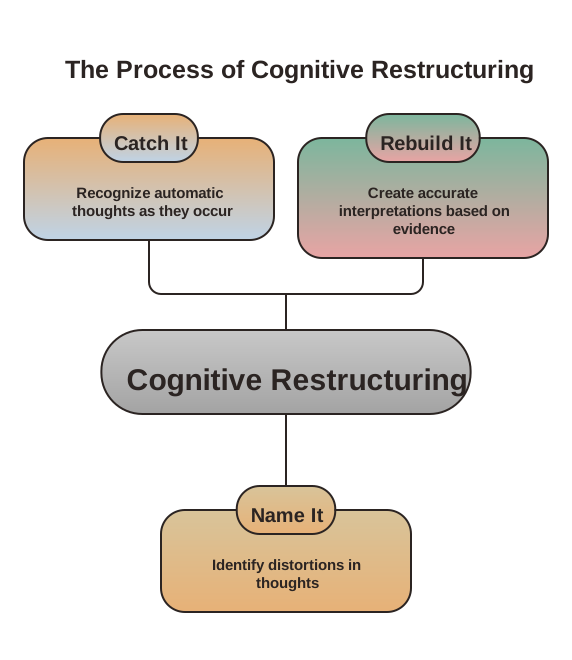
Strip CBT to its load-bearing move and you get cognitive restructuring: catch the automatic thought, name what's distorted in it, build a more accurate interpretation. It's trainable, and the training shows up in the brain — neuroimaging of reappraisal shows prefrontal control engaging while the amygdala's alarm drops, with the skill strengthening over weeks of practice. If you want the full toolkit, our CBT techniques guide walks through the major methods.
So does CBT actually work? The bottom line
Does CBT work? For anxiety, depression, stress, and overthinking-shaped problems: yes, with the most rigorous evidence base in psychotherapy — and with real limits that honest practitioners state up front. It works better in person or online than it does unused. And its core skill doesn't require waiting for a diagnosis, a waitlist, or a perfect moment: the next distorted thought you catch is a rep.
One more honest line: if you're dealing with severe symptoms, self-harm thoughts, or anything that frightens you, an app is not the tool — a clinician is. CBT skills support treatment; they don't replace it.
MindLift is a free-to-start app built on CBT's core skill: type the thought in your own words, get a Realist, Growth, and Compassionate reframe in about 60 seconds. Try MindLift — free to start →
Frequently asked questions
Does CBT actually work?
Yes — with the strength of evidence depending on the problem. Across hundreds of randomized controlled trials summarized in multiple meta-analyses (Butler 2006; Hofmann 2012; Cuijpers 2016), CBT shows moderate-to-large effects for anxiety disorders, depression, and stress-related problems, and it is the psychotherapy with the most rigorous research support — which is why a 2018 review in Frontiers in Psychiatry called it the current gold standard. It is not equally effective for every condition or every person.
Is CBT as effective as medication?
For depression and most anxiety disorders, meta-analyses find CBT roughly comparable to antidepressant medication during treatment, with one notable difference: CBT's effects tend to persist better after treatment ends, because you keep the skill. For moderate-to-severe cases, combining both often outperforms either alone. This is a decision to make with a clinician, not a blog post — the research describes averages, not you.
Does online or app-based CBT work?
Meta-analytic evidence says yes: a systematic review of 20 head-to-head trials (Carlbring et al., 2018) found internet-delivered CBT produced outcomes equivalent to face-to-face therapy for a range of anxiety and mood problems. The consistent catch across digital mental health research is engagement — the tools work for people who actually do the exercises. That's why the design bet behind MindLift is making one rep of the core skill take 60 seconds instead of a 30-minute module.
How long does CBT take to work?
Standard protocols run 12–20 sessions, and trials typically measure outcomes at 8–16 weeks. But symptom improvement often begins earlier — several studies show meaningful gains within the first 4–6 sessions, and sudden-gains research finds a large share of total improvement can arrive between single sessions. The skill component (spotting and reframing distorted thoughts) starts paying back as soon as you use it on a real thought.
What is the actual mechanism — why does CBT work?
CBT's working ingredient is changing the appraisal, not suppressing the feeling. You learn to catch an automatic thought ("everyone noticed I froze"), identify the distortion in it, and generate a more accurate interpretation. Neuroimaging of this exact operation — cognitive reappraisal — shows prefrontal control regions engaging while the amygdala's threat response drops. Repeat it and the reinterpretation pathway strengthens: skill acquisition, not positive thinking.
Like what you're reading?
Continue your wellness journey
Reframe negative thoughts in 60 seconds — free to start in the MindLift app.


Free to start · no account required
- Butler, A. C., Chapman, J. E., Forman, E. M., & Beck, A. T. (2006). The Empirical Status of Cognitive-Behavioral Therapy: A Review of Meta-Analyses. Clinical Psychology Review, 26(1), 17–31. — DOI (opens in a new tab)
- Cuijpers, P., Cristea, I. A., Karyotaki, E., Reijnders, M., & Huibers, M. J. H. (2016). How Effective Are Cognitive Behavior Therapies for Major Depression and Anxiety Disorders? A Meta-Analytic Update of the Evidence. World Psychiatry, 15(3), 245–258. — DOI (opens in a new tab)
- David, D., Cristea, I., & Hofmann, S. G. (2018). Why Cognitive Behavioral Therapy Is the Current Gold Standard of Psychotherapy. Frontiers in Psychiatry, 9, 4. — DOI (opens in a new tab)
- Carlbring, P., Andersson, G., Cuijpers, P., Riper, H., & Hedman-Lagerlöf, E. (2018). Internet-Based vs. Face-to-Face Cognitive Behavior Therapy for Psychiatric and Somatic Disorders: An Updated Systematic Review and Meta-Analysis. Cognitive Behaviour Therapy, 47(1), 1–18. — DOI (opens in a new tab)
CBT & Self-Talk Researchers
MindLift content is grounded in cognitive behavioral therapy principles and designed to help you shift harsh self-talk in real time. Our guides focus on practical, evidence-based techniques you can use in the moment.
Was this article helpful?