Turn this into a daily habit — free to start in the MindLift app:
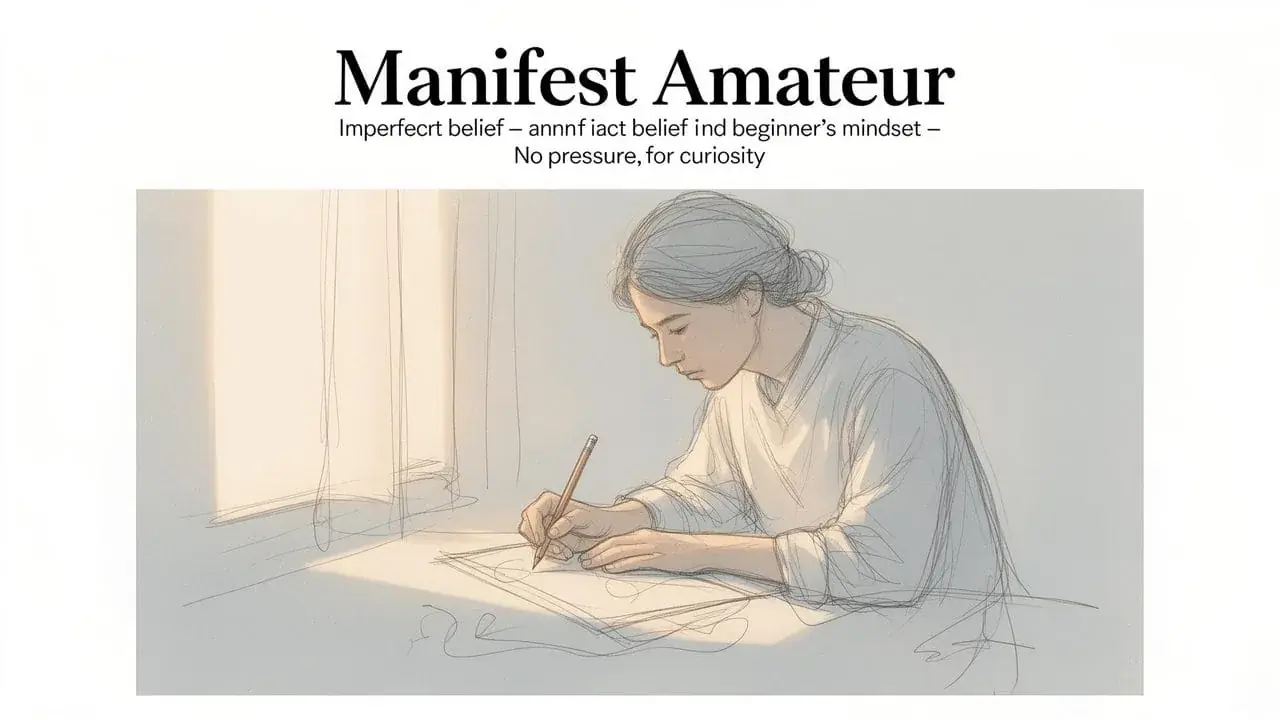
The most honest way to manifest something is to do it like an amateur.
Not confidently. Not consistently. Not with a morning routine laminated in your Notes app. Amateur manifestation doesn't glow. It hesitates. It forgets. It half-believes and keeps going anyway.
MindLift, a software-only CBT app that helps you reframe negative self-talk, wrote this guide, so it reads manifestation as mindset and action rather than magic. Read about MindLift, or find your own pattern with the negative self-talk test.
Which is precisely why it works.
Experts manifest with certainty. Amateurs manifest with curiosity. They try things without fully committing to the story. They don't demand proof from the universe or themselves. They experiment. They wobble. They leave room for surprise.
There's less pressure that way.
Professional manifestation has rules. Visualize clearly. Speak positively. Eliminate doubt. Feel as if it's already yours. When it doesn't work, the failure is framed as personal. You didn't believe hard enough. You weren't aligned. You slipped.
Amateur manifestation has no such contract.
It sounds more like:
"I don't know if this will work, but I'm open."
"This might be delusional, but I'm curious."
"I'm not sure I deserve this yet, but I'd like to try."
These sentences aren't inspiring. They're permissive.
Psychologically, amateurs are safer places for change. When belief is tentative, the nervous system stays relaxed. There's no performance to maintain. No identity to protect. No pressure to be "someone who manifests."
You're just someone noticing patterns and adjusting behavior.
That's manifestation, stripped down.
Amateurs don't visualize outcomes perfectly. They visualize feelings loosely. Less panic. More ease. A different texture to the day. They're not attached to how it arrives. They're attached to how it feels when it does.
And because they're not watching themselves perform belief, they're more likely to notice opportunities when they appear.
Manifestation fails most often when it becomes a test. A test of faith. A test of worth. A test of discipline.
Amateurs don't test themselves. They play.
They try a sentence and see how it lands.
They imagine a future and don't punish themselves for doubting it.
They stop when it feels forced.
This is why amateur manifestation pairs so well with realism. It doesn't require optimism. It requires attention.
- Attention to what drains you.
- Attention to what repeats.
- Attention to what quietly improves when you stop fighting it.
You don't have to believe fully to move differently. You just have to believe a little more than yesterday.
That's the amateur advantage.
Some people keep their manifestation amateur on purpose. Short sentences. Low expectations. Gentle experiments. Tools like MindLift lean into this energy—not by promising outcomes, but by offering believable reframes. Words that don't ask you to transform, only to shift slightly. Enough to change direction without feeling watched by your own ambition.
Because the truth is, most meaningful change doesn't come from certainty.
It comes from trying something without making it your identity.
The Psychology of Beginner's Mind
Carol Dweck's research on growth mindset introduced a distinction that is quietly radical: people who believe their abilities are fixed protect what they have, while people who believe abilities can grow seek what they lack. Beginners, by definition, land on the growth side — not by philosophy but by necessity. They have nothing to protect.
This is the psychological advantage the amateur carries into any intentional practice, including manifestation. When you don't have a reputation to maintain — when you're not "someone who meditates perfectly" or "someone who always sets powerful intentions" — you're free to try things that might not work. And things that might not work are exactly what experimentation requires.
In Zen Buddhism, this state is called shoshin: beginner's mind. The teacher Shunryu Suzuki described it simply: "In the beginner's mind there are many possibilities, but in the expert's mind there are few." Applied to manifestation, this means the amateur's uncertainty is not a bug. It's the space where something new can enter.
The expert has a method. The amateur has a question. And questions are what keep you moving.
Why Perfectionism Kills Manifestation Before It Starts
Perfectionism looks like high standards. But functionally, it's often a protection strategy. If I never try in earnest, I can never truly fail. The manifestation version of this is the person who researches every visualization method, reads every book, watches every video — and never actually sits down and imagines what they want.
Professional manifesting inadvertently feeds this. It implies there's a right way, and that deviation from it explains why things aren't working. This creates a loop: you try, it doesn't immediately work, you conclude you must have done it wrong, you go back to learning more. The practice becomes a way of staying in preparation mode indefinitely.
- You try
- It doesn't immediately work
- You conclude you must have done it wrong
- You go back to learning more
Step 4 feeds back into step 1.
Amateur manifesting breaks the loop by removing the standard entirely.
There's no correct visualization frequency. No minimum belief threshold. No test to pass before your intention counts. You set a loose direction, notice what moves toward it, and adjust. That's the whole framework.
Imperfect action beats perfect preparation, every time.
Three Amateur Manifesting Experiments
These aren't rituals. They're experiments. Try one loosely, without commitment to outcome, and notice what happens.
1. The direction sentence.
Write one sentence about what you'd like more of in the next thirty days. Not a goal — a direction. "More ease in conversations." "Work that feels less like performance." "A sense that rest is allowed." Don't refine it. Don't make it SMART. Just write it down somewhere you'll see it occasionally, and then go about your day.
2. The thirty-second imagining.
Once, before sleep, imagine what it would feel like if one small thing you want has already happened. Not the dramatic version — the ordinary version. The feeling of finishing something without criticizing yourself. The feeling of a conversation going simply well. Hold it for thirty seconds. Don't try to believe it fully. Just let the feeling visit.
3. The noticing practice.
For one week, note one small thing per day that moved in the direction of what you wrote down. Not evidence that manifestation works — just evidence that your attention is now oriented differently. Direction-setting changes what you notice. What you notice changes what you act on. What you act on changes what happens. That's the mechanism, and it doesn't require any metaphysics.
Manifest amateur.
Stay curious.
Leave room for disbelief.
It's often the most honest way forward.
Frequently asked questions
What does it mean to manifest as an amateur?
It means approaching manifestation without needing to do it 'right.' Amateur manifesting is characterized by imperfect belief, doubt alongside hope, and playful intention rather than rigid visualization rituals. This is actually closer to how positive psychology and self-efficacy research suggests intention-setting works — direction matters more than certainty.
Can you manifest if you have doubts?
Yes. Doubt is a natural part of belief, not a disqualifier. The all-or-nothing view of manifestation — that it only works with complete conviction — is psychologically unrealistic. Research on hope theory shows that having a goal plus some sense of pathway toward it is sufficient to produce motivating action, even with uncertainty.
What's the difference between manifesting and wishful thinking?
Wishful thinking is passive — wanting without directing behavior toward the outcome. Manifestation in its practical sense involves clearly articulating a desired outcome (which focuses attention), noticing relevant opportunities, and taking imperfect action toward it. The mechanism is cognitive and behavioral, not metaphysical.
Why is being a beginner at something actually an advantage?
Beginners are less constrained by how things 'should' be done. They experiment more freely and are less paralyzed by perfectionism. Psychologist Carol Dweck's growth mindset research shows that embracing beginner status produces better long-term learning than trying to maintain the appearance of competence.
Like what you're reading?
Accelerate your growth journey
Reframe the patterns that hold you back — and watch your Top Pattern change over time.


Free to start · premium optional