
Turn this into a daily habit — free to start in the MindLift app:
"I'm not good enough." "I can't change." "It's too risky." These aren't facts — they're learned interpretations your mind has treated as truth for years. Here's how to identify them, examine the evidence underneath them, and build something more believable in their place.
What are limiting beliefs and how do I overcome them?
Limiting beliefs are deeply held convictions that constrain your potential — like 'I'm not good enough' or 'I can't change.' To overcome them: identify patterns in your thoughts, challenge beliefs with evidence, create believable bridge beliefs instead of unrealistic jumps, and take small actions aligned with your new belief. Change tends to take weeks to months of consistent practice, not a single realization.
Understanding Limiting Beliefs
Limiting beliefs are deeply held convictions about ourselves, others, or the world that constrain our potential and prevent us from pursuing our goals. These beliefs often operate below conscious awareness, quietly influencing our decisions, behaviors, and the opportunities we allow ourselves to pursue.
Unlike facts, beliefs are interpretations of our experiences that we've accepted as truth. While some beliefs serve us well, limiting beliefs create invisible barriers that keep us stuck in patterns of self-sabotage, fear, and unfulfilled potential. The good news? Because beliefs are learned, they can be examined, challenged, and transformed.
How limiting beliefs operate
- Automatic: they trigger unconscious responses and behaviors
- Self-fulfilling: they influence our actions in ways that confirm the belief
- Protective: originally formed to help us avoid pain or rejection
- Generalized: applied broadly across different life situations
- Emotionally charged: connected to strong feelings and past experiences
Common Limiting Beliefs That Hold Us Back
While limiting beliefs are highly personal, certain themes appear repeatedly across different people and cultures. Recognizing these common patterns can help you identify your own limiting beliefs more easily.
Self-worth beliefs
- "I'm not good enough"
- "I don't deserve success/happiness"
- "I'm not smart/talented/attractive enough"
- "I have to be perfect to be lovable"
- "Other people are better than me"
Capability beliefs
- "I can't change"
- "I'm not creative/athletic/smart"
- "I always fail at this"
- "I'm too old/young to start"
- "I don't have what it takes"
Safety & security beliefs
- "The world is dangerous"
- "I can't trust people"
- "If I try, I'll just get hurt"
- "Success leads to problems"
- "It's safer to stay where I am"
Possibility beliefs
- "Money is evil/corrupting"
- "You have to struggle to succeed"
- "Good things don't happen to people like me"
- "Dreams are unrealistic"
- "I have to choose between success and relationships"
How to Identify Your Limiting Beliefs
Identifying limiting beliefs requires honest self-reflection and attention to patterns in your thoughts, emotions, and behaviors. Since these beliefs often operate unconsciously, it takes deliberate effort to bring them into awareness.
1. The "completion" exercise
Complete these sentences quickly, without thinking too hard about your answers:
- "I can't _____ because _____"
- "People like me don't _____"
- "If I try to _____, then _____"
- "I'm not the type of person who _____"
- "I could never _____ because _____"
2. Goal analysis method
Think of a goal you've been wanting to achieve but haven't started or have repeatedly abandoned:
- What thoughts come up when you imagine pursuing this goal?
- What reasons do you give yourself for not starting?
- What would you tell a friend who wanted to pursue this same goal?
- What's the worst thing that could happen if you tried?
3. Pattern recognition
Look for recurring patterns in your life:
- What types of situations do you consistently avoid?
- When do you find yourself procrastinating or self-sabotaging?
- What negative thoughts repeat most often in your mind?
- In what areas of life do you feel "stuck"?
Techniques for Challenging Limiting Beliefs
Once you've identified a limiting belief, the next step is to examine its validity and usefulness. Many limiting beliefs look far less solid under careful scrutiny, revealing themselves as old protective habits rather than current truths.
The Socratic questioning method
- Evidence: "What evidence do I have that this belief is true? What evidence contradicts it?"
- Source: "Where did this belief come from? Who first told me this?"
- Usefulness: "How is this belief serving me? How is it limiting me?"
- Logic: "Is this belief logical? Are there exceptions to this rule?"
- Perspective: "What would I tell a friend who believed this about themselves?"
The evidence court
Create two columns: "Evidence For" and "Evidence Against" your limiting belief. Be honest and thorough. The "against" column is often stronger than you expect.
Example: "I'm not creative" vs. evidence of creative moments, solutions you've found, or times others complimented your creativity.
The worst-case scenario
Imagine the absolute worst outcome if your limiting belief were false and you acted differently. Often, our fears are much worse than reality.
Then ask: "Could I handle this outcome? What would I do if it happened? How likely is this to actually occur?"
The Belief Reframing Process
Reframing involves creating new, more empowering beliefs to replace limiting ones. This process requires patience and consistency, as you're changing thinking habits that have been reinforced over years.
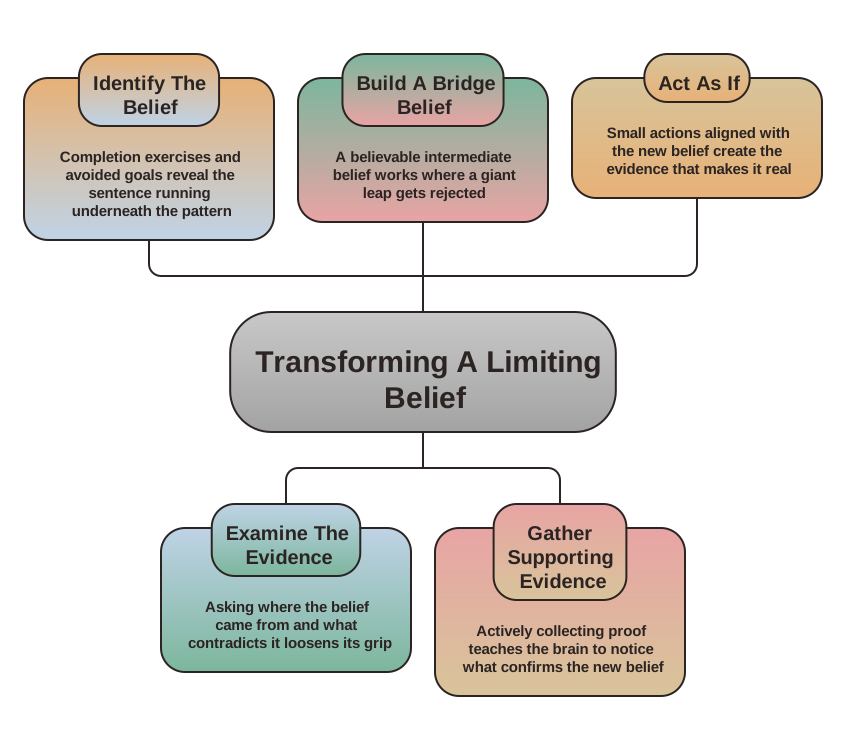
Step 1: Create bridge beliefs
Don't jump from "I'm terrible at this" to "I'm amazing at this." Your mind won't believe it. Instead, create believable bridge beliefs:
From: "I'm not creative"
Bridge: "I'm learning to express my creativity" or "I have creative potential I'm developing"
To: "I am creative and express it in unique ways"
Step 2: Find supporting evidence
Actively look for evidence that supports your new belief. Your brain's confirmation bias will start noticing proof of what you're focusing on.
Step 3: Act as if
Begin taking small actions that align with your new belief. If you're developing the belief "I am capable of learning new skills," start learning something small.
Building Empowering Beliefs
Empowering beliefs are the positive counterparts to limiting beliefs. They expand your sense of possibility, increase confidence, and motivate action toward your goals.
Characteristics of empowering beliefs
- Possibility-focused: "I can learn and grow"
- Resource-oriented: "I have or can develop what I need"
- Growth-minded: "Challenges help me become stronger"
- Self-compassionate: "I deserve kindness and success"
- Action-inspiring: "Every step forward matters"
Affirmations, visualization, and an evidence journal
Affirmations: create positive statements that reinforce your new beliefs. Keep them believable — statements that feel too far from where you are can backfire.
Visualization: regularly imagine yourself living from your empowering beliefs. See yourself succeeding and handling challenges.
Evidence journal: keep a daily record of evidence that supports your new beliefs, no matter how small.
Maintaining Your Progress
Transforming limiting beliefs is an ongoing process, not a one-time event. Your old beliefs may resurface during stress or setbacks, but this is normal and temporary. The key is having strategies to maintain your progress and continue growing.
Maintenance strategies
- Regular check-ins: monthly review of your beliefs and progress
- Support system: share your journey with trusted friends or a coach
- Continuous learning: read books and attend workshops on personal growth
- Mindfulness practice: stay aware of your thought patterns
- Celebrate progress: acknowledge every step forward, no matter how small
Remember, the goal isn't to become perfect or eliminate all doubt. It's to develop a healthier, more empowering relationship with your thoughts and beliefs. Every time you catch a limiting belief and choose a more empowering perspective, you're practicing a healthier thinking habit.
Quick reference: daily belief work
- Morning: read your empowering beliefs and set intentions
- Midday: notice any limiting thoughts and gently reframe them
- Evening: journal about evidence that supports your new beliefs
- Weekly: review progress and adjust your empowering belief statements
- Monthly: celebrate growth and identify new beliefs to work on
5-Step Process to Transform Limiting Beliefs
Identify the Limiting Belief
Use completion exercises ('I can't ___ because ___'), goal analysis (what stops you from pursuing goals?), and pattern recognition (what situations do you avoid?). Write down specific limiting beliefs you discover.
Pro Tip: Pay attention to thoughts starting with 'I can't...', 'I'm not...', or 'I always/never...'
Examine Its Origins and Evidence
Ask: Where did this belief come from? What evidence supports it? What evidence contradicts it? Create two columns listing proof for and against the belief.
Pro Tip: The 'evidence against' column is often stronger than you expect
Create a Bridge Belief
Don't jump from 'I'm terrible' to 'I'm amazing'—your mind won't believe it. Create believable intermediate beliefs like 'I'm learning and improving' or 'I have potential I'm developing.'
Pro Tip: The bridge belief should feel uncomfortable but possible, not impossible
Gather Supporting Evidence
Actively look for examples, moments, and situations that support your new belief. Keep an evidence journal. Your brain's confirmation bias will start noticing proof automatically.
Pro Tip: Even tiny examples count—no evidence is too small to record
Act As If and Practice Consistently
Take small actions aligned with your new belief. If developing 'I am capable,' do something slightly outside your comfort zone weekly. Practice your new belief daily through affirmations, visualization, and conscious reframing.
Pro Tip: Action creates evidence, which strengthens belief, which encourages more action—positive spiral
MindLift is built for the moment a limiting belief shows up — name the thought and get a Realist, Growth, and Compassionate reframe in about 60 seconds. Free to start, premium available. Try MindLift — free to start →
Frequently asked questions
How do I know if I have limiting beliefs?
Common signs include recurring negative self-talk, feeling stuck in certain areas of life, avoiding challenges, making excuses for not pursuing goals, or noticing patterns of self-sabotage. Pay attention to thoughts that start with 'I can't...', 'I'm not...', or 'I always/never...'
Where do limiting beliefs come from?
Limiting beliefs often form in childhood from family messages, school experiences, peer interactions, or traumatic events. They can also develop from repeated failures, societal conditioning, or comparing ourselves to others. Our brains create these beliefs as protective mechanisms, even when they no longer serve us.
How long does it take to change a limiting belief?
The timeline varies depending on how deeply ingrained the belief is and how consistently you work on changing it. Some people notice shifts within weeks, while deeply rooted beliefs may take months of consistent effort. The key is patience and persistent practice with new thought patterns.
When should I seek professional help for limiting beliefs?
Consider professional help if limiting beliefs significantly impact your daily functioning, relationships, or mental health. If you're dealing with trauma-based beliefs, severe anxiety or depression, or if self-help methods aren't working after consistent effort, a therapist can provide specialized techniques and support.
Like what you're reading?
Accelerate your growth journey
Reframe the patterns that hold you back — and watch your Top Pattern change over time.


Free to start · premium optional