
Turn this into a daily habit — free to start in the MindLift app:
Saying grace looks like it belongs to a different era — something you do at your grandmother's table, not something with a mechanism behind it. But strip away the religious framing and what's left is a behaviour psychologists have actually studied: a short pause, a moment of gratitude, repeated at the same trigger every day.
That combination shows up constantly in wellbeing research, just not usually under the name "grace." The interesting question isn't whether it's a nice tradition — it's whether it does anything measurable. Here's what the research says, and where it runs out.
Does saying grace actually do anything psychologically?
Grace hasn't been tested as its own intervention, but its two ingredients have. Ritual research finds that a fixed, repeated pause lowers anxiety — but only when it's framed as a ritual rather than as random actions. Gratitude research finds a real but small effect on wellbeing (Hedges' g = 0.22 across 25 randomised trials), and one app-based trial cut repetitive negative thinking with d = 0.39. Grace plausibly inherits both. What it can't do is reach a specific distorted thought in the moment it happens.
Kirca, Malouff & Meynadier (2023); Brooks et al. (2016)
Grace is really two behaviours wearing one name
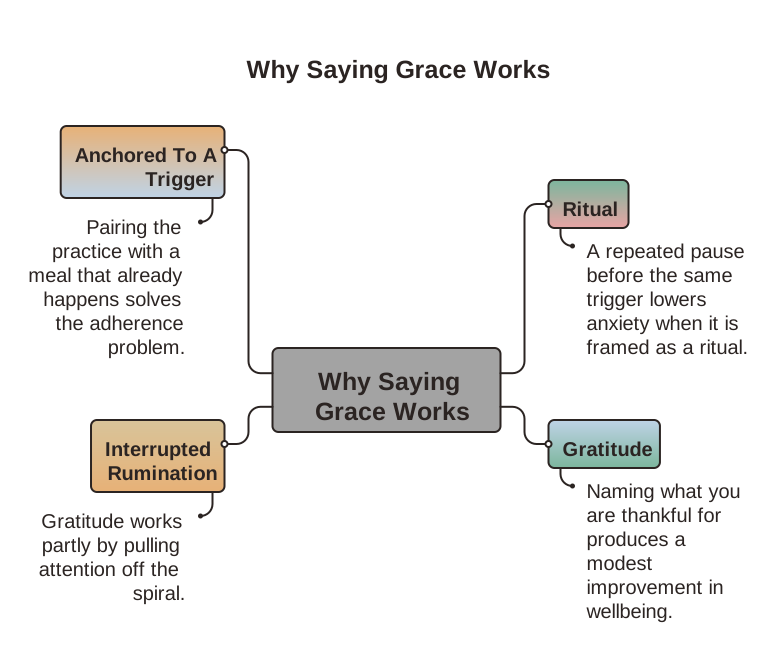
Saying grace bundles two things psychology treats as separate: a ritual (a fixed, repeated sequence of actions) and a gratitude practice (naming what you're thankful for). Each has its own research base, and separating them explains why grace tends to feel steadying even to people who aren't doing it for religious reasons.
It's also close to universal. Mealtime blessings show up across cultures with no contact with each other, with roots traced back millennia — ancient Hindu food blessings appear in early Vedic texts. Something that consistent across unconnected cultures is usually solving a real psychological need, not just a doctrinal one.
As for how common it still is: HuffPost, reporting a survey, put it at roughly 44% of Americans saying grace regularly against about 46% who almost never do. Worth flagging that the underlying survey dates to 2010, so treat it as a rough historical split rather than a current number.
The ritual half: why the pause itself settles you
Ritual researchers define a ritual narrowly — a rigid, repeated sequence of actions with no direct practical purpose, distinct from simply going through a routine. Grace fits that definition closely: the same words or pause, in the same order, before the same trigger, meal after meal.
The clearest evidence comes from work by Brooks and colleagues, who put people through deliberately stressful tasks — singing karaoke in public, a timed maths test — after either performing an invented ritual or not. The ritual group reported less anxiety, showed lower heart rate, and performed better. The detail that matters: the effect appeared when the behaviour was labelled a "ritual" rather than "random actions." The meaning attached to the pause did as much work as the pause.
The effect reaches below conscious awareness. In a separate study, participants who completed a week-long ritual showed a dampened error-related negativity — the brain's rapid electrical response to making a mistake — without performing any worse. The ritual didn't make them care less. It made failure land softer.
The gratitude half: real, replicated, and smaller than advertised
Gratitude has one of the more replicated effects in positive psychology, and it's worth being precise about its size. A 2023 meta-analysis pooled 25 randomised controlled trials covering 6,745 participants and found expressed gratitude interventions improved psychological wellbeing — life satisfaction, positive affect, and happiness — relative to neutral controls, with a Hedges' g of 0.22.
That's a small effect. Statistically solid, consistently replicated, and modest. Anyone selling gratitude as a treatment is overselling a real but quiet finding. This is the number the gratitude industry tends not to print.
The finding that matters most here is narrower. A pragmatic randomised trial of a gratitude app with 352 participants found it significantly reduced repetitive negative thinking — rumination — with an effect of d = 0.39, rising to d = 0.55 in the roughly one-third of participants who screened positive for depression. An earlier trial of an internet and app-based gratitude intervention looked at mechanisms and found its effect on anxiety and depression ran through that reduction in repetitive negative thinking.
Which is a quietly important result: gratitude appears to work partly by interrupting a loop. It's a small, gentle version of what cognitive reframing does deliberately — pulling attention off the spiral and onto something more accurate. It's also one of the few wellness rituals that holds up when you check it against the research.
Why pairing gratitude with a meal specifically works
There's a behavioural reason grace attaches to eating rather than standing alone, and it isn't only tradition. The Premack Principle holds that pairing a less automatically rewarding activity with a more rewarding one increases the odds you keep doing the less rewarding one. Gratitude is the less rewarding half. Dinner is the reliable half.
This is just good habit design. Gratitude interventions studied in isolation have a well-documented adherence problem — people start strong and drift within weeks. Anchoring the practice to something that already happens two or three times a day, with no reminder required, solves the exact failure mode that quietly kills most wellbeing habits by February.
Where grace hits its limit
Here's the honest gap. Ritual and gratitude research shows benefits for general mood, life satisfaction, and baseline rumination — the slow, ambient background of how you feel. None of it targets a specific distorted thought in the moment it arrives.
Saying grace before dinner won't touch the thought that hit you at 2pm in a meeting — I completely botched that presentation, everyone thinks I'm incompetent. That isn't a gratitude gap. It's a specific cognitive distortion — catastrophising, mind-reading — that needs catching and restructuring, not softening with a general thankfulness practice four hours later. Gratitude is maintenance. The research above doesn't claim otherwise, and neither should anyone quoting it.
That's the distinction MindLift is built around. Grace, gratitude journaling and similar rituals are genuinely useful for baseline wellbeing — the evidence is real, if small. But the sharp, specific thought that derails your afternoon needs something targeted: MindLift takes the thought you typed, in your own words, and returns three structured reframes within 60 seconds — Realist, Growth, and Compassionate — each tagged with the distortion underneath it. It's mental first aid for the 167 hours a week you're not in a therapist's office, built for the moment a daily ritual was never designed to reach. If you'd rather have the templates on paper, the reframe templates cover the same three angles.
The takeaway
Saying grace holds up better under research than it looks. The ritual and the gratitude inside it both have real evidence behind them — for mood, and for rumination. Just keep the size of the effect honest: small, steady, cumulative.
It's built for the slow, ambient work of feeling okay, not the sharp thought that hits mid-afternoon and won't let go. For that, you need something built for the moment itself. MindLift is free to start.
Frequently asked questions
Is saying grace scientifically proven to help mental health?
Not "grace" specifically — it has not been isolated and tested as its own intervention. But its two components, ritual and gratitude, both have randomised controlled trial evidence behind them independently. The combination is plausible and consistent with that research, though the honest answer is that nobody has run the trial on grace itself.
Do you need to be religious for saying grace to have psychological benefits?
No. The mechanisms behind the effect — a fixed repeated pause, and the act of naming something you're thankful for — don't depend on belief in a higher power. Even in a secular context, pausing to express thanks can create a sense of connection to the people at the table and to the meal itself.
How large is the effect of gratitude practices, really?
Smaller than the internet suggests. A 2023 meta-analysis of 25 randomised controlled trials covering 6,745 participants found expressed gratitude interventions improved psychological wellbeing with a Hedges' g of 0.22 — statistically significant, but a small effect. Gratitude is worth doing. It is not a treatment.
Why does gratitude reduce rumination specifically?
A pragmatic randomised trial of a gratitude app found it significantly reduced repetitive negative thinking (d = 0.39), with stronger effects in the subsample who screened positive for depression (d = 0.55). An earlier trial of an internet and app-based gratitude intervention examined mechanisms of change and found the effect on anxiety and depression ran through the reduction in repetitive negative thinking itself.
Is gratitude journaling the same as saying grace?
They share the gratitude mechanism, but grace adds the ritual component and is anchored to something you already do daily. Per the Premack Principle — pairing a less rewarding activity with a more rewarding one — that anchoring tends to make it more sustainable than a standalone journaling habit that relies on remembering.
What is the difference between a gratitude practice and MindLift?
A gratitude practice like grace supports general mood and lowers background rumination over time. MindLift is built for a different job: catching one specific distorted thought as it happens and reframing it in your own words within 60 seconds. Different timescales, different tools.
Like what you're reading?
Continue your wellness journey
Reframe negative thoughts in 60 seconds — free to start in the MindLift app.


Free to start · premium optional