
Turn this into a daily habit — free to start in the MindLift app:
If you've spent any time online lately, you've seen the mantra:"Delulu is the solulu."
It's funny, yes — but it also speaks to something deeper: People are tired of waiting to feel confident. They want to borrow confidence now, even if it feels a little… fictional.
Here's the twist: Psychology says this isn't as "delusional" as it sounds. In fact, the brain can respond well to slightly unrealistic self-belief, as long as it stays within the zone of healthy cognitive stretch.
Let's break down why "delulu confidence" works — and how to use it without losing your grip on reality.
1. The Brain Believes What You Repeat (Even If You Don't at First)
Research on the "illusory truth effect" shows that statements we hear repeatedly start to feel more true. Your brain doesn't only check whether a thought is objectively true — it also checks whether it's familiar.
This is why self-critical people believe cruel things about themselves: they've rehearsed them.
By the same logic, when you intentionally rehearse a slightly "delulu" belief like:"I'm the kind of person good things happen to,"your brain starts treating it like a real possibility.
This isn't denial. This is neuroplasticity.
Change the script → change the expectation → change the behavior.
2. Delulu Confidence Works Because It Interrupts Fear Loops
Overthinking and fear are forms of catastrophizing — a CBT distortion where your brain automatically predicts the worst-case scenario.
A little delusion interrupts that pattern.
When you think:
"Obviously they'll pick me for the role."
or
"Why wouldn't this work out?"
…you're giving your brain a new cognitive direction. Not realism — but mental possibility.
Once your brain stops bracing for failure, it allows you to take actions that previously felt too risky:
- Applying for things
- Speaking up
- Trying again
- Taking up space
- Moving toward opportunities
The confidence didn't come first — the delulu thought did.
3. The Secret: Your Delusion Has to Be Believable-ish
Research on affirmations shows a key mistake: If a statement feels too fake, your brain rejects it. Your inner critic becomes louder.
But if the statement is just a little outside your comfort zone, your brain engages and adapts.
This is called a cognitive bridge.
For example:
❌ "I am the most successful person on earth." (Brain: LOL no.)
✔ "I'm becoming someone who attracts really good opportunities."
"Delulu" only works when it's playfully believable.
A little stretch. Not a personality transplant.
4. Healthy Delusion Boosts Motivation — Reality Often Doesn't
This is the most underrated part:
People don't become confident first.
They take action first — then confidence grows.
But action requires motivation.
Realistic thinking ("This might fail.") rarely produces motivation.
A little delulu does.
It tricks your brain into acting as if things could work. And taking action builds:
- Competence
- Self-efficacy
- Momentum
- Agency
This is why so many high achievers seem "irrationally optimistic." It's not delusion. It's strategy.
5. "Manifestation" Is Often Just Behavioral Activation With Better Branding
CBT calls it: behavioral activation.
TikTok calls it: delulu manifestation.
But the process is the same:
- You picture something good happening.
- Your brain reduces avoidance.
- You take more aligned actions.
- Opportunities open because you're finally showing up.
- Your emotional state shifts → your behavior shifts → your results shift.
It's not magic. It's psychology wearing glitter.
6. The Danger Zone: When Delulu Becomes Disconnection
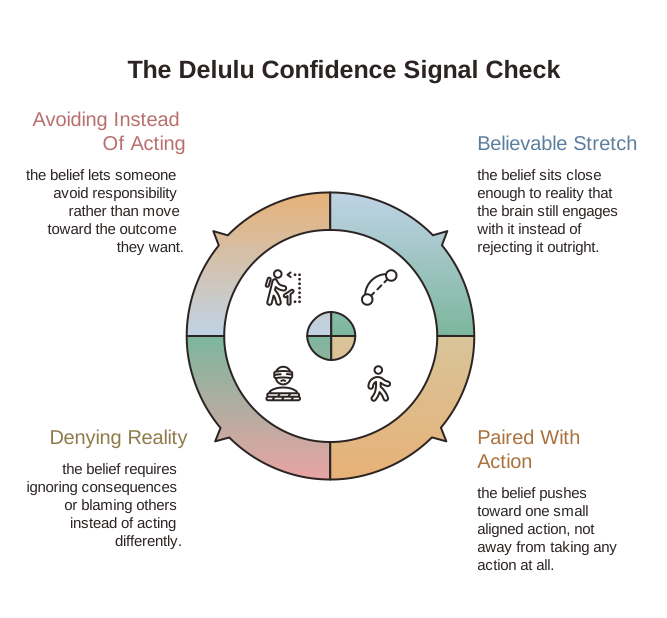
To keep this grounded (and responsible), here's where delulu stops being helpful:
- Ignoring consequences
- Denying reality
- Avoiding responsibility
- Blaming others for everything
- Self-importance without self-awareness
Healthy delusion stretches you.
Unhealthy delusion isolates you.
The line is simple:
If your "delulu confidence" helps you take better actions, it's useful.
If it helps you avoid actions, it's not.
So How Do You Use Delulu in a Healthy, Psychological Way?
Here's the formula the brain can work with:
1. Pick a tiny delulu belief that feels fun, not fake.
Example: "Good things just find me."
2. Pair it with one small aligned action.
Example: Send one email. Apply for one thing. Try one step.
3. Repeat it until it feels familiar.
The brain equates familiarity with truth.
4. Let behavior reinforce belief.
Confidence grows from evidence.
5. Adjust the delusion as your self-worth grows.
It evolves with you — not instead of you.
This is psychological confidence-building disguised as memes.
A Few "Healthy Delulu" Lines You Can Borrow
Not affirmations — more like playful permission slips:
- "The plot twist is that everything actually works out for me."
- "Of course they like me — I'm delightful."
- "I'm not lucky, I'm just aligned and slightly unhinged."
- "Why would the universe not choose me? Be serious."
Use them as cognitive warm-ups, not identity statements.
Final Thought: You Don't Need Permission to Believe in Yourself
Being "delulu" is not the goal.
Being expansive is.
Being willing to imagine better things for yourself than your anxiety allows.
Being brave enough to act before you feel ready.
Being slightly unrealistic in a world that taught you to shrink.
If "delulu" helps you break out of fear and step into possibility, it's not delusion —
it's psychological self-liberation.
Frequently asked questions
What does delulu mean psychologically?
Delulu (short for delusional) in modern slang refers to holding an optimistic belief others might consider unrealistic. Psychologically, a moderate version of this is supported by research: studies show that 'positive illusions' — slightly inflated self-assessments — correlate with better mental health, higher resilience, and greater persistence.
Is being delusionally confident actually good for you?
In moderation, yes. Research by Shelley Taylor shows that people who maintain slightly inflated views of their abilities tend to be more persistent, less depressed, and more resilient. The key is 'strategic optimism' — inflating possibility without losing contact with reality or consequences.
What is the difference between healthy confidence and actual delusion?
Healthy confidence takes selective action based on optimistic beliefs while remaining capable of updating based on feedback. Actual delusion resists all contrary evidence. The delulu mindset is healthy when it loosens self-limiting beliefs; it becomes problematic when it substitutes for honest self-assessment.
How do you use strategic confidence without lying to yourself?
By applying it directionally rather than absolutely. Instead of 'I'm definitely getting this job,' try 'I'm going to act as though I belong here and see what happens.' This shifts behavior without requiring a false belief — and behavioral change is what actually produces results.
Like what you're reading?
Accelerate your growth journey
Reframe the patterns that hold you back — and watch your Top Pattern change over time.


Free to start · premium optional