
Turn this into a daily habit — free to start in the MindLift app:
Every year on the first Monday of May, the world stops scrolling and starts staring.
The 2026 Met Gala — themed "Fashion Is Art" — delivered exactly what it promised. Beyoncé arrived as a co-chair in a sheer gown covered in diamonds outlining a skeleton, trailing a feathered coat with a train as long as her discography. Blake Lively shut down the carpet in Versace. Kim Kardashian showed up in a sculpted fiberglass top. Venus Williams wore a Swarovski gown inspired by her own National Portrait Gallery painting.
It was spectacular. It was surreal. And somewhere between the red carpet livestream and your For You page at midnight, something quiet happened in your brain.
You started comparing.
Why Your Brain Does This (And Why It's Not Your Fault)
Psychologists call it social comparison theory — the automatic, often unconscious tendency to evaluate ourselves by measuring against others. It's not a character flaw. It's wiring. Humans evolved to read their social environment constantly, because knowing where you stood in the group once determined whether you survived.
The problem is that your brain evolved for a village of 150 people — not a global red carpet broadcast featuring the most photographed, styled, and professionally lit humans on earth.
When you scroll the Met Gala and feel something drop in your chest, that's not vanity. That's an ancient survival mechanism pointed at an impossible target.
Social media has quietly made this a full-time cognitive job. In one experiment, students who limited social media to about 30 minutes a day reported less loneliness and depression than those who kept using it as usual. The Met Gala is social media turned up to eleven — a single night that generates millions of comparison triggers before you've even finished your dinner.
The Cognitive Distortions Hiding in Your Reaction
In Cognitive Behavioral Therapy (CBT), a cognitive distortion is a thought pattern that feels completely true but is actually a mental shortcut that leads you somewhere painful. The Met Gala activates several of the most common ones simultaneously.
Catastrophizing turns "She looks amazing and I feel frumpy tonight" into "I will never feel good in my own skin." One observation becomes a life sentence.
Mental filtering means your brain absorbs every image of physical perfection on the red carpet while completely filtering out the context: teams of stylists, personal trainers, custom-fitted couture, professional lighting, post-production editing, and the reality that many of those women have spoken openly about their own body image struggles.
Mind-reading is when you assume the person on screen feels exactly as confident and radiant as they appear. You're measuring your internal experience — your self-doubt, your tired body, your bad lighting — against someone else's external performance. It's a comparison that was never fair to begin with.
Should statements creep in quietly. "I should look like that by now." "I should care less about this." "I shouldn't feel this way." Should is one of the most self-punishing words in the English language.
None of these thoughts announce themselves as distortions. They feel like facts. That's what makes them so exhausting.
Fashion as Art — and What Gets Lost in the Translation
Here's something worth sitting with: the Met Gala theme this year wasn't "be the most beautiful person in the room." It was "Fashion Is Art."
Art is expression. Art is perspective. Art is a conversation between a creator and an audience — and good art makes you feel something, not feel lesser.
The gap between how the Met Gala is intended — as a celebration of artistic expression — and how many of us actually experience it — as a highlight reel of physical ideals we don't measure up to — is exactly the gap that CBT was designed to help close.
The art isn't the problem. The story your brain layers on top of it is.
What CBT Actually Does With a Thought Like This
CBT doesn't ask you to stop having the thought. It doesn't tell you to "think positive" or slap an affirmation over something painful. It asks you to do something harder and more honest: examine the thought.
The process looks like this:
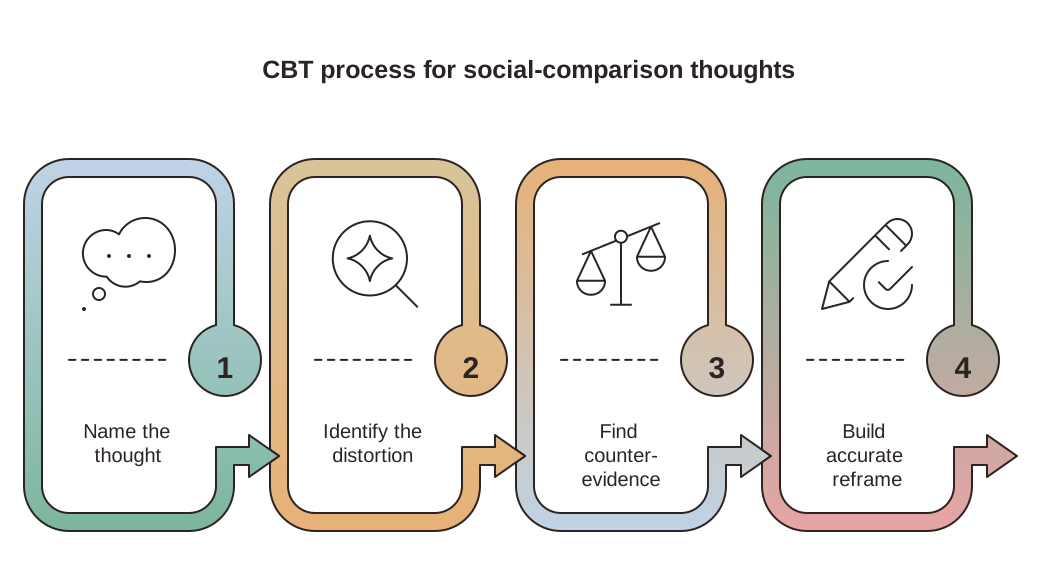
- Name the thought exactly. Not a vague feeling — the actual sentence running through your head. "I looked at Beyoncé tonight and felt like I've wasted the last five years of my life."
- Identify the distortion. What cognitive shortcut is at work here? Catastrophizing? Filtering? Comparison? Usually it's more than one.
- Find the counter-evidence. Not toxic positivity. Real evidence. What do you actually know about your body, your life, your worth that this thought is ignoring?
- Build the reframe. Not a lie in the other direction. A more accurate, more complete version of reality that you can actually believe.
The goal isn't to feel amazing about yourself every time you open Instagram. The goal is to stop letting a thought spiral run unchecked at midnight because you happened to watch a red carpet.
The 167-Hour Gap
The average person sees a therapist for one hour per week.
That leaves 167 hours — the hours you're commuting, scrolling, lying awake, watching the Met Gala — where you're managing your mind entirely on your own. Therapy is irreplaceable. But it was never designed to cover those 167 hours. That gap is where the quiet spirals live.
Where a single image becomes a ten-minute shame loop becomes a bad night becomes a pattern you don't even notice you're in.
MindLift was built for that gap — a free-to-start CBT-based app that helps you reframe a negative thought in about 60 seconds.
You type in the thought — your actual words, not a sanitized version — and MindLift reflects it back to you reframed. Not a generic affirmation. Not something that sounds like a wellness poster. Something that sounds like you, processed through the same logic a good therapist would use.
It doesn't replace therapy. It's mental first aid for the 167 hours between sessions. You can try MindLift — free to start.
The Next Time You're Scrolling the Red Carpet
The Met Gala will come back next year. The comparison spiral will try to come with it.
When you catch yourself in the middle of one — when a thought that started as "wow, that dress is stunning" has quietly become something harder and more personal — that's not a failure of character. That's a thought that needs examining, not swallowing.
You deserve the same quality of thinking about yourself that you'd extend to a friend sitting next to you on the couch, watching the same carpet, feeling the same things.
The art isn't the problem. The story your brain adds is — and that story can be rewritten.
Frequently asked questions
Why does scrolling the Met Gala make me feel bad about myself?
Social comparison theory explains this: your brain automatically benchmarks itself against others. The problem is it evolved for a village of 150 people, not a global red carpet featuring the most professionally lit, styled, and edited humans alive. The comparison was never fair to begin with.
What cognitive distortions are triggered by red carpet events?
The most common ones are mental filtering (absorbing images of physical perfection while ignoring the context: stylists, trainers, post-production editing), catastrophizing (turning one bad feeling into a life sentence), mind-reading (assuming celebrities feel as confident as they appear), and should statements ('I should look like that by now').
How does CBT help with social comparison and body image?
CBT doesn't ask you to stop having the thought. It asks you to examine it: name the exact thought, identify the distortion at work, find real counter-evidence, and build a more accurate reframe. The goal isn't to feel amazing after every scroll — it's to stop a thought spiral from running unchecked at midnight.
Is it normal to feel worse after watching the Met Gala?
Very normal. In one experiment, students who limited social media to about 30 minutes a day reported less loneliness and depression than students who kept using it as usual. The Met Gala is social media turned up to eleven — a single night generating millions of comparison triggers. Your reaction is wired, not weak.
Like what you're reading?
Continue your wellness journey
Reframe negative thoughts in 60 seconds — free to start in the MindLift app.


Free to start · premium optional