
Turn this into a daily habit — free to start in the MindLift app:
Self-worth is one of the hardest things to rebuild — especially when you've spent years talking to yourself in a way you'd never talk to a friend. And while affirmations can help, most people quit after two days because the statements feel fake, forced, or straight-up delusional.
Good news: That's not how affirmations are supposed to work.
CBT works from the idea that the thoughts we repeat shape how we feel and behave — but a new thought only takes hold if it feels emotionally believable (7/10 truth level) and aligned with our lived experience. When an affirmation is too big, your mind rejects it. It rebels. It shuts down. (Classic cognitive dissonance.)
Why Self-Worth Affirmations Help — Backed by Psychology
Self-affirmations aren't magic. They work because:
1. They reinforce your core values
When you reflect on what truly matters to you, it strengthens your sense of identity and self-integrity. This is why values-based affirmations are used in self-affirmation research — they help you withstand stress, criticism, or setbacks with more resilience.
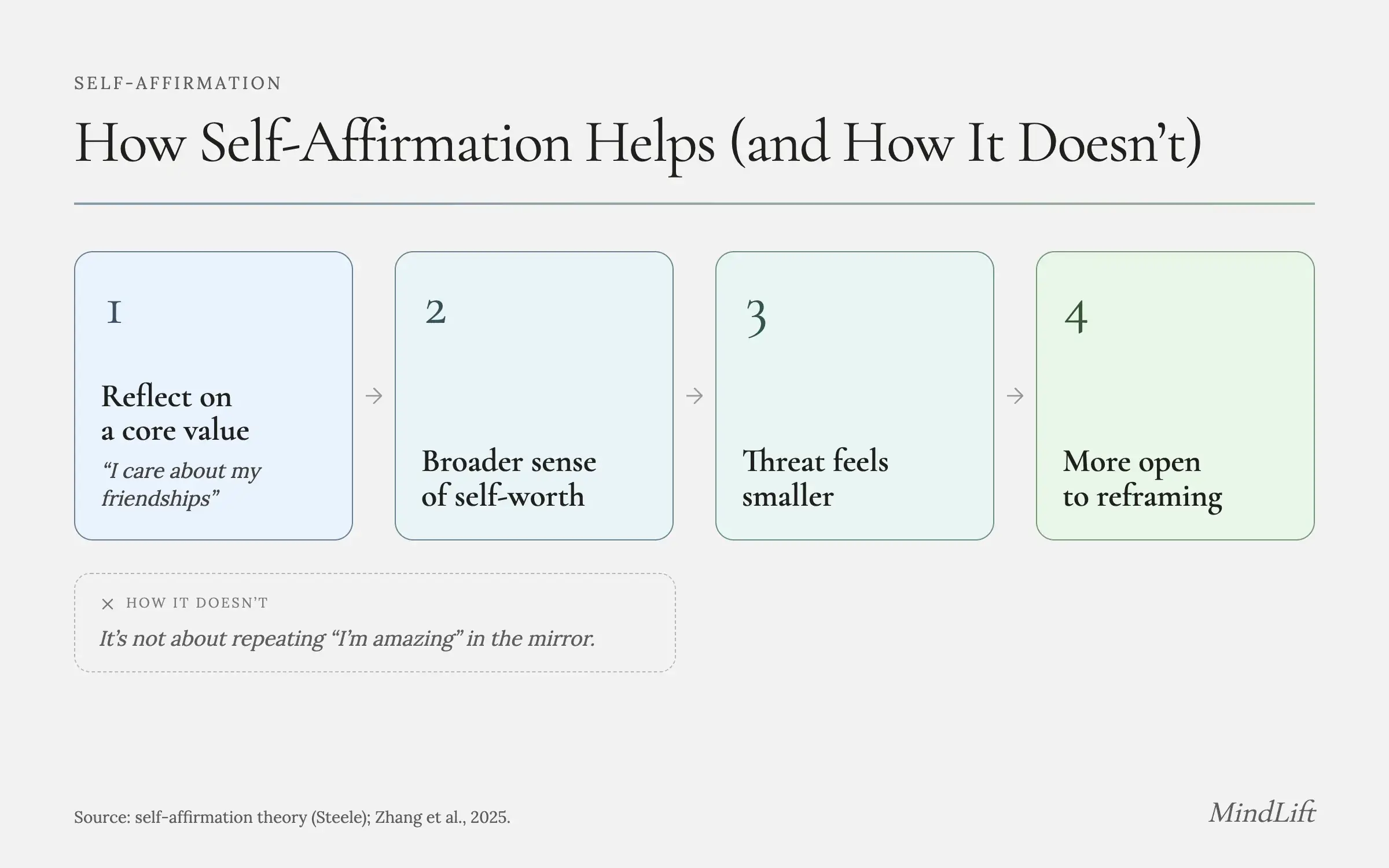
The source line in the diagram refers to Claude Steele's self-affirmation theory and to a 2025 meta-analysis by Zhang, Chen, Hu and Wang, which pooled 129 tests from 67 published studies of self-affirmation interventions in nonclinical, general populations and found small but significant gains in self-perception, general well-being and social well-being (American Psychologist, 2025). It tested self-affirmation exercises, not MindLift.
2. They interrupt self-criticism loops
Negative self-talk fuels anxiety, avoidance, and low motivation — a classic CBT "vicious cycle."
Affirmations introduce a new voice: one that is more balanced and realistic.
3. They help your brain learn new patterns
A response you practise becomes a response that's easier to reach. Each time you answer "I'm not good enough" with a believable alternative, you're rehearsing a different route through the same moment. Over time, that route gets shorter, and the harsh one gets a little less automatic.
How Low Self-Worth Talks at 7 PM
The loop, as it runs for a lot of people: you've had a normal day. A friend cancels dinner by text — "so sorry, work is mad, can we do next week?" — and within about ten seconds the inner monologue has turned it into this:
"She's cancelling because she doesn't actually want to see me. People always drift off eventually. I'm the friend you keep out of politeness, not the one you'd rearrange things for. I don't know why I expected anything different."
Look at the shape of it. One cancelled dinner became a claim about the friendship, then a claim about all friendships ("always"), then a claim about who you are ("the politeness friend"), then resignation. Low self-worth isn't a feeling that arrives out of nowhere — it's a chain of thoughts like this, running so fast you only feel the end of it.
"I am worthy of love" bounces straight off that chain. It's a 2/10 on believability in the moment. What actually lands is a 10%-kinder version of each link:
"She said work is mad, and I have no evidence it's anything else. One reschedule isn't a drift. I'm practising not treating every cancellation as a verdict on me. I can reply 'no problem, next week' and mean it — and if I still feel raw in an hour, that's allowed too."
It's not triumphant. It's true enough to say without flinching, which is the entire point. That reply becomes the affirmation you keep: "One cancelled plan isn't a verdict on me."
How to Build Self-Worth Affirmations That Don't Feel Fake
The CBT Formula
Step 1 — Identify the painful thought
"I'm not good enough."
"I'm always messing things up."
"No one cares about me."
Step 2 — Ask: What's a slightly kinder version of this?
Not perfect. Not magical. Just 10% softer.
Step 3 — Phrase it in a way that creates possibility
"I'm learning that I matter."
"I'm practicing seeing my strengths."
"I deserve respect, even when I make mistakes."
Step 4 — Add repetition
Consistency, not intensity, is what changes a pattern.
The Believability Test
Before you keep an affirmation, say it out loud and rate it: how true does this feel, 0 to 10, right now? Not how true you'd like it to be. If it's under 6, it's too far ahead of you and will trigger the argument you're trying to avoid. If it's a 9 or 10, it's probably too safe to change anything. The sweet spot is around 7 — a statement you can nod at, with a small stretch in it.
Two ways to move a statement into the zone. If it scores too low, shrink the claim: "I'm worthy of love" becomes "I'm worthy of the same patience I give other people." If the score is still low, add "I'm learning" or "I'm practising" to the front, which turns a claim about who you are into a claim about what you're doing — much harder for the critic to dispute.
Try This in 60 Seconds
You don't need a quiet room or a journal. Next time the critic gets loud:
- Catch it. The sentence, first. Repeat it to yourself without softening it: "I'm the friend people keep out of politeness."
- Soften it. Ask the one question: "What's a 10% kinder version that's still true?" Not the opposite. One notch. "I don't actually know why she cancelled, and I'm not going to decide it's about me."
- Rate it. Score it. If it's a 6 or 7 out of 10 on believability, say it once more, slowly, and move on with your evening. If it's lower, shrink it again and repeat.
That's one rep. Self-worth is rebuilt in reps, not breakthroughs.
A 60-Second Daily Self-Worth Ritual
If you want results, consistency beats intensity. Try this:
- Morning (15 seconds): Pick one affirmation that feels 70% true. Say it once out loud.
- Throughout the day (30 seconds): When a self-critical thought hits, pause and ask: "Is there a gentler version of this thought?"
- Night (15 seconds): Repeat the same affirmation while brushing your teeth.
It helps to know how loud your critic actually is before you start. Run the inner critic severity check — a short scale, not a diagnosis — and you'll see whether you're dealing with a background hum or a voice that's running most of your decisions. That changes how small your first affirmation should be.
Why MindLift Makes Affirmations Work Better
Most apps throw random quotes at you. MindLift does the opposite.
It uses CBT principles and self-affirmation theory to generate statements that actually land.
Plus:
- ✔ You can flip the card for a CBT insight
- ✔ Repetition builds a personalized "self-worth vault"
- ✔ Audio mode supports emotional learning
- ✔ Short statements fit into anxious moments
To end on the thing self-help pages usually skip: affirmations are for the everyday critic. If your self-worth feels close to zero most days, if it comes with low mood that's lasted weeks, or if it includes thoughts of not wanting to be here, that's not a self-help problem — talk to a doctor or a therapist. The techniques on this page come from CBT, and CBT with a professional is where they work best.
Frequently asked questions
Why don't typical affirmations work for self-worth?
Most affirmations feel too big and trigger cognitive dissonance - your mind rebels when statements feel unbelievable. CBT-based affirmations start at 70% believability and gradually build.
What is the CBT formula for building self-worth affirmations?
Identify the painful thought, ask 'what's a 10% kinder version?', phrase it to create possibility rather than certainty, and add consistent repetition to build new patterns.
How long until self-worth affirmations start working?
There's no fixed timeline, and anyone who gives you one is guessing. The first change most people notice is catching the harsh thought sooner, not feeling better — that usually shows up after a few weeks of daily practice. The deeper shift, where the kinder voice arrives on its own, is slower and depends on how old the pattern is. Believability and repetition matter more than intensity.
What makes CBT affirmations different from regular affirmations?
CBT affirmations are grounded in cognitive behavioral therapy principles - they challenge limiting beliefs with realistic alternatives rather than forcing overly positive statements.
Like what you're reading?
Continue your wellness journey
Reframe negative thoughts in 60 seconds — free to start in the MindLift app.


Free to start · premium optional