
Turn this into a daily habit — free to start in the MindLift app:
You're sitting in a meeting, and everyone else seems to just know things. The right terminology, the confident tone, the ease of someone who's never once wondered if they're supposed to be there. You say something, and it comes out smaller than you meant it to.
Later, you're scrolling and a former classmate just got promoted. Someone from your old team started their own company. A friend of a friend just closed on a house. None of it is really about you. All of it feels like it's about you.
And underneath it, quietly, a sentence you've said to yourself so many times it barely registers as a thought anymore: everyone around me is more qualified, more together, further along — and I'm just stuck.
Here's the thing nobody tells you about that sentence: it's not really about them. And it's not really about being stuck, either.
The Feeling Isn't Wrong. The Explanation Is.
"Stuck" is a real feeling. It's not manufactured, and it's not something to talk yourself out of. But the explanation your brain reaches for — I'm stuck because everyone around me is better — is doing something sneaky. It's taking a real, valid feeling (stagnation, frustration, wanting more) and attaching it to a comparison that was never designed to hold that weight.
Here's the mechanism: your brain doesn't compare your whole self to their whole self. It compares your inside view — every doubt, every false start, every 2am spiral you've ever had about your own life — to their outside view: the promotion announcement, the LinkedIn post, the version of them that made it to the highlight reel. You're not losing a fair fight. You're losing a fight that was rigged before it started, because you're the only person in the comparison with access to the full data set.
This isn't a reason to stop noticing what other people have. It's a reason to notice what your brain is doing with that information — because "I'm stuck" and "they're ahead" feel like the same observation, but they're not. One is a feeling. The other is a story your brain built to explain the feeling, using the worst possible evidence.
Why "Just Stop Comparing Yourself" Doesn't Work
You've heard it. You've probably said it to a friend. It doesn't work, and here's why: telling yourself to stop comparing is like telling yourself to stop noticing color. Comparison isn't a bad habit you picked up — it's a basic function of how humans figure out where they stand in a group, and it's been doing that job since long before LinkedIn existed.
The problem was never that you compare. The problem is what you compare, and how little scrutiny the comparison gets before it becomes a verdict on your entire life. "She got promoted faster than me" becomes "I'm behind." "He started his company already" becomes "I've wasted time." One sentence has a specific fact in it. The other has your whole sense of self riding on a timeline nobody actually agreed to.
The Loop That Keeps You Stuck
It usually goes like this: you notice someone else's progress → you measure your current position against it → you feel behind → the feeling of being behind becomes urgency or shame → the urgency either pushes you into frantic overcorrection or freezes you completely → nothing changes → you notice someone else's progress again, and the loop restarts, a little more convinced of itself each time.
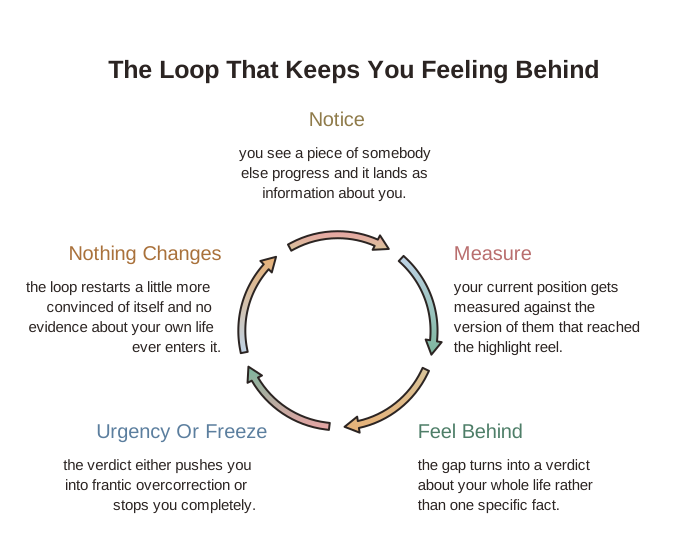
Notice what's missing from that loop: any actual evidence about your life. Not your effort, not your circumstances, not the version of "qualified" that would actually be true for the specific path you're on. Just a comparison, repeated until it hardens into an identity.
This is why "stuck" so often doesn't loosen its grip even when things objectively change. You can get the promotion, finish the degree, hit the milestone — and still feel behind, because the loop was never actually measuring your progress. It was measuring the gap between you and whoever you last compared yourself to, and there's always going to be someone ahead of that line.
Not sure which loop your brain defaults to under stress? The free What's Your Mental Loop? quiz names it in about two minutes — the Comparison Loop is one of the eight patterns it checks for, no email required.
What "Qualified" Actually Means Here
Say the word "qualified" out loud and ask yourself: qualified by whose definition, for what specific thing, measured against what standard? Most of the time, there isn't a real answer. "Qualified" has quietly become a vibe — a feeling of ease and confidence other people seem to broadcast — rather than an actual, checkable list of things you either have or don't.
This matters because you can't fix a vibe. You can only feed it, endlessly, by finding more people who seem to have it. That's the trap: the sense of being unqualified isn't really asking you to get more qualified. It's asking an unanswerable question and then treating your inability to answer it as proof you've already lost.
What Stuck Is Actually Protecting You From
Here's a question worth sitting with, even if it's uncomfortable: what would you have to risk if you stopped comparing and just moved?
Sometimes "I'm not qualified enough yet" is doing quiet, important work — it's a socially acceptable reason to not put something out into the world where it could fail, be judged, or simply not be enough. Staying stuck, in that light, isn't laziness or lack of ambition. It's a way of staying safe from a verdict you're not ready to hear. That doesn't make it the right strategy. It makes it a human one — which is a very different thing than a character flaw.
This is usually the exact moment a quote or a pep talk stops being useful, because general encouragement doesn't know what you're actually protecting yourself from. It can't. It wasn't built from your specific sentence — it was built from someone else's idea of what you probably need to hear.
That's the gap MindLift was built to close. You type the actual thought — I'm not qualified enough, everyone around me is further ahead — in your own words, and within 60 seconds you get three ways through it: a realist reframe that questions the assumption underneath the comparison, a growth angle that asks what moving forward would actually require (not what feeling ready would require), and a compassionate one that doesn't let you off the hook by pretending the feeling isn't real. Not a poster. A response, built from your own words, for the exact 11pm moment a generic quote can't reach.


A Reframe, Worked Through
Take the actual sentence: I'm stuck because everyone around me is more qualified than me.
Realist: Qualified for what, specifically — and says who? If you can't name the exact standard, you're not behind a standard. You're behind a feeling, and feelings aren't a scoreboard.
Growth: What's one thing you could do this week that doesn't require feeling ready first? Readiness is usually a result of starting, not a requirement for it.
Compassionate: You're comparing your full, complicated, ongoing story to somebody else's highlight reel. That was never a fair fight — and you don't owe your entire sense of worth to a data set this incomplete.
What to Do Instead of Comparing Harder
Not a list of affirmations — a few concrete things that actually interrupt the loop:
Write down the actual timeline the "should" is based on. Where did it come from? A specific person, a specific post, an unspoken family expectation? Naming the source often deflates it faster than arguing with it.
Separate "behind" from "different." A different path isn't a slower version of someone else's — it's just different. Ask what evidence you have that your path is actually behind, versus simply not the same shape as theirs.
Notice what information you're missing about them. You don't see their doubts, their financial help, their false starts, their 2am spirals. You're not comparing two full pictures. You're comparing your full picture to their cover photo.
Catch the moment it happens, not after. The scroll, the meeting, the comparison — that's the moment to name the thought before it hardens into a belief, not hours later when it's already reshaped your whole evening.
The Point Isn't to Feel Ahead. It's to Stop Measuring Against the Wrong Thing.
You're not stuck because everyone around you is more qualified. You're stuck because a feeling borrowed a comparison it was never built to survive, and it's been running the show ever since. That's not a character problem. It's a pattern — and patterns can be caught, one actual thought at a time, in the moment they show up. If the pattern runs deeper than comparison — if you're not sure who you are without the scoreboard — start with building a firmer sense of identity.
MindLift is a free-to-start app that gives you three structured, CBT-based reframes for any negative thought — in your own words, within 60 seconds. Mental first aid for the 167 hours between therapy sessions. Try MindLift free →
Frequently asked questions
Why do I feel stuck in life even when things are objectively going well?
Because the comparison loop was never measuring your progress — it was measuring the gap between you and whoever you last compared yourself to, and there's always someone ahead of that line. You can get the promotion, finish the degree, hit the milestone, and still feel behind, because no actual evidence about your own life is part of the loop. That's why 'stuck' doesn't loosen its grip when circumstances change: it's a pattern of measurement, not a fact about your position.
Why does everyone around me seem more successful than me?
Because you're comparing your inside view to their outside view. Your brain compares every doubt, false start, and 2am spiral you've ever had against the version of other people that made it to the highlight reel — the promotion announcement, the LinkedIn post, the confident tone in the meeting. You're the only person in the comparison with access to the full data set, so the fight was rigged before it started. Their doubts, financial help, and false starts simply aren't visible to you.
How do I stop comparing myself to others?
You mostly can't — comparison is a basic function of how humans figure out where they stand in a group, not a bad habit you picked up. What you can change is what the comparison is allowed to conclude. Concretely: name the actual timeline your 'should' is based on and where it came from; separate 'behind' from 'different'; notice what information about the other person you're missing; and catch the comparison in the moment it happens, before it hardens into a verdict about your whole life.
Is feeling stuck a sign that something is wrong with me?
No — often it's doing quiet protective work. 'I'm not qualified enough yet' is a socially acceptable reason not to put something into the world where it could fail or be judged. Staying stuck can be a way of staying safe from a verdict you're not ready to hear. That doesn't make it the right strategy, but it makes it a human one — a pattern that can be interrupted, not a character flaw.
Like what you're reading?
Accelerate your growth journey
Reframe the patterns that hold you back — and watch your Top Pattern change over time.
Free to start · no account required
Mental Wellness Writers
The MindLift Wellness Team writes evidence-based content on CBT, self-talk, and everyday mental health tools.
Was this article helpful?