
Turn this into a daily habit — free to start in the MindLift app:
You're a different person at work than you are with your family. A different person with your partner than you are with your friends. A different person online than you are at 11pm, alone, scrolling.
None of that is unusual — everyone adjusts. But somewhere underneath the adjusting, can you find the version of you that isn't performing for anyone? If the honest answer is "not really," or "I'd have to think about it," you're not broken. You're describing one of the most common and least talked-about struggles of your late twenties through your thirties: not knowing, with any confidence, who you actually are.
It rarely shows up as a dramatic identity crisis. It shows up smaller than that — agreeing with whoever spoke last in a group conversation, picking a restaurant based on what you think the other person wants, realizing you can't name your own opinion on something until you've heard someone else's first. It's the quiet, exhausting work of being whoever the room needs.
What "sense of identity" actually means
Psychologists describe identity as a stable, internally consistent sense of who you are — your values, preferences, beliefs, and the throughline that connects your past self to your present one. The key word is stable. Not unchanging — people grow — but stable in the sense that it doesn't collapse or reshuffle every time someone disagrees with you or stops responding to a text.
Erik Erikson, the psychologist who first mapped identity formation as a developmental stage, described its absence as "identity diffusion" — a state where you don't have a clear, committed sense of self, so you borrow one from whoever's nearby. That borrowing can look like ambition (taking on a partner's goals as your own), like accommodation (becoming whoever keeps the peace), or like absence (genuinely not knowing what you'd choose if no one were watching).
A weak sense of identity isn't a character flaw. Most of the time, it's adaptive — something you learned. If your environment growing up rewarded you for being agreeable, perceptive of others' moods, or low-maintenance, you got very good at reading the room and very out of practice at consulting yourself. The skill that protected you then is the one quietly costing you now.
Why it matters more than it gets credit for
A weak sense of identity isn't just an abstract discomfort — it has measurable downstream effects:
- You make decisions by committee, even when no one's in the room. Without a clear internal compass, choices get outsourced — to a partner's preference, a friend's opinion, what seems impressive on paper. Decision fatigue isn't really about having too many options; it's often about not having a self to check those options against.
- Your boundaries don't hold. A boundary is really just an identity statement — this matters to me, this doesn't work for me. Without a firm sense of who you are, boundaries feel arbitrary even to you, which is why they're the first thing to dissolve under pushback.
- You're more vulnerable to people who are very sure of themselves. This is the mechanism behind a lot of relationships that look confusing from the outside — why someone stays, why someone keeps explaining away behavior that hurts them. A diffuse identity doesn't have much to push back with against someone who states their version of reality with total conviction. (How this plays out under stress often tracks with your attachment style.)
- Validation starts to function like oxygen. When your sense of self isn't self-generated, it has to come from somewhere — likes, praise, a partner's mood, a boss's approval. That's not vanity. It's a structural gap, and external approval is what rushes in to fill it.
How identity actually gets built (it's not a personality quiz)
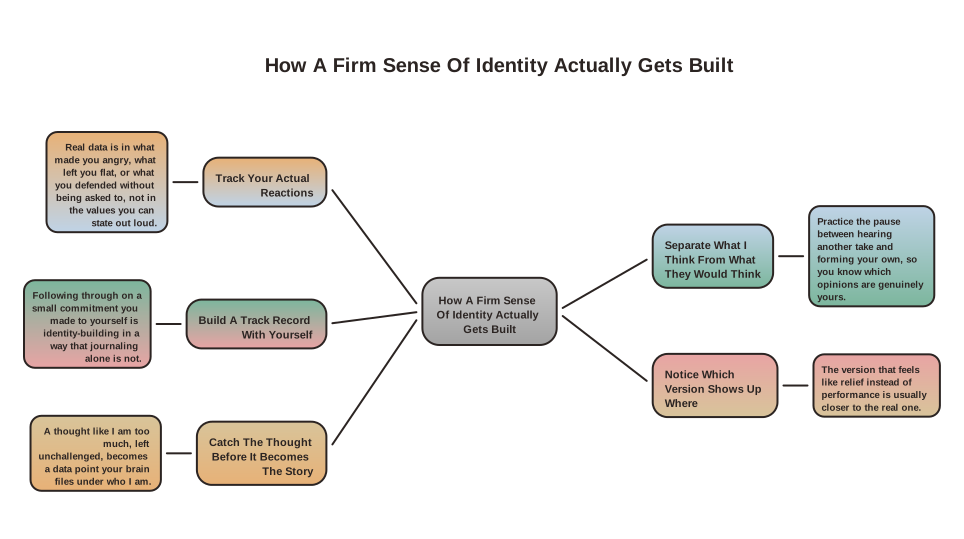
Here's the part most advice skips: you don't find your identity by introspecting harder. You build it the same way you build a relationship with anyone else — through repeated, observed evidence.
1. Track your actual reactions, not your stated opinions
Most people think they know their values because they can state them: I value honesty. I value independence. But values stated in the abstract are cheap — almost everyone would say the same things. The real data is in your reactions: what made you genuinely angry this week? What left you flat when you expected to care? What did you find yourself defending without being asked to?
Try this for two weeks: every time you notice a stronger-than-expected reaction — irritation, relief, a flicker of envy, a "no" that surprised you — write down the moment and the reaction in one line. Patterns emerge fast. This is closer to how identity actually gets known: not through declared values, but through audited behavior.
2. Separate "what I think" from "what they'd think"
In conversation, in conflict, in decisions — practice the pause between hearing someone else's take and forming your own. Even if you end up agreeing, the sequence matters: did you arrive there, or did you just adopt it? A useful internal question is: if I'd heard the opposite opinion first, would I still land here? If the answer is uncertain, that's not a failure — it's just information about which opinions are genuinely yours and which are borrowed.
3. Build a track record with yourself
Identity is built less by thinking and more by doing things you can later point to. Following through on a small commitment to yourself — even something as minor as a workout you almost skipped, or a hard conversation you didn't avoid — is identity-building in a way that journaling alone isn't. You're not just deciding who you are; you're accumulating proof.
4. Notice which version of you shows up where — and ask why
Go back to the opening of this article: different you at work, with family, with your partner, online. That's not necessarily a problem — contextual flexibility is healthy. The question worth asking is which version feels most like relief, and which feels most like performance. The relief version is usually closer to the real one. If you've never looked closely at what's actually shaping how you see yourself, that's a useful place to start.
5. Catch the thought before it becomes the story
This is where it gets hard to do alone, because identity isn't just built in big reflective moments — it's built or eroded in small ones, in real time. The thought "I'm too much" after a friend takes a while to text back. The thought "I always do this" after a small mistake. Each of those thoughts, left unchallenged, becomes a data point your brain files under who I am. String enough of them together and they start to outvote the version of you built more deliberately.
This is the part that doesn't keep office hours. A therapist can help you understand the pattern on Tuesday at 4pm — but the moment that actually shapes your identity might happen on Thursday at 11:47pm, mid-spiral, with no one around to interrupt it. That gap is most of the week. MindLift exists specifically for that gap: you type the exact thought in your own words — "I always ruin things," not a sanitized version of it — and get back three reframes built from your language, not a generic affirmation pulled from a deck. Catching "I'm too much" in the moment it shows up, instead of letting it sit there overnight uncontested, is the small, repeated, unglamorous work that an identity is actually made of.
What a firmer sense of identity feels like (it's quieter than you'd expect)
It's not waking up one day with total clarity. It's smaller and less dramatic: being able to say "I don't want to" without a paragraph of justification. Noticing your opinion before you've checked anyone else's. Feeling a disagreement and not immediately wondering if you're the unreasonable one. Recognizing your own handwriting, so to speak, in your own thoughts.
None of that happens through one conversation, one therapy session, or one article. It happens through the accumulation of moments where you choose the self-generated thought over the borrowed one — especially the moments no one else sees.
Related reading
Frequently asked questions
What does it mean to have a weak sense of identity?
A weak or "diffuse" sense of identity means you don't have a clear, committed, internally consistent sense of who you are — your values, preferences, and beliefs feel borrowed from whoever is nearby rather than self-generated. Psychologist Erik Erikson called this "identity diffusion." It often shows up as not knowing your own opinion until you've heard someone else's, or feeling like a different person depending on who you're with.
Why do I feel like a different person around different people?
Adjusting to context is normal and healthy — everyone does it. It becomes a problem when "who I am" and "who I am to this person" fuse, so there's no stable version underneath the adjusting. If you can't locate the version of you that isn't performing for anyone, that usually points to an identity built from the outside in rather than self-generated.
How do you build a stronger sense of identity?
You don't find it by introspecting harder — you build it through observed evidence. Track your actual reactions (not just stated opinions), practice separating "what I think" from "what they'd think," build a track record by following through on small commitments to yourself, and catch self-defining thoughts ("I'm too much," "I always do this") before they harden into conclusions about who you are. Identity is accumulated proof, not a single realization.
Is not knowing who you are a sign of something serious?
Most of the time it's a common, non-pathological developmental experience — especially in your twenties and thirties — and it's often adaptive, learned from environments that rewarded being agreeable or low-maintenance. It is not a diagnosis. That said, if the uncertainty comes with persistent emptiness, distress, or instability that disrupts your relationships and functioning, it's worth talking to a mental health professional.
Like what you're reading?
Continue your wellness journey
Reframe negative thoughts in 60 seconds — free to start in the MindLift app.


Free to start · no account required
- Erikson, E. H. (1968). Identity: Youth and Crisis. W. W. Norton & Company.
- Marcia, J. E. (1966). Development and validation of ego-identity status. Journal of Personality and Social Psychology, 3(5), 551–558. — DOI (opens in a new tab)
Mental Wellness Writers
The MindLift Wellness Team writes evidence-based content on CBT, self-talk, and everyday mental health tools.
Was this article helpful?