Turn this into a daily habit — free to start in the MindLift app:
“I haven’t even gotten out of bed and I’m already behind.”
If that thought sounds familiar, you’re not alone. For many people, the first few minutes after waking are the loudest of the whole day. Before your feet touch the floor, your mind has already opened twelve tabs: the email you didn’t answer, the meeting you’re dreading, the thing you said last Tuesday that suddenly feels like a disaster.
By the time you’re making coffee, the day already feels heavy, and nothing has even happened yet.
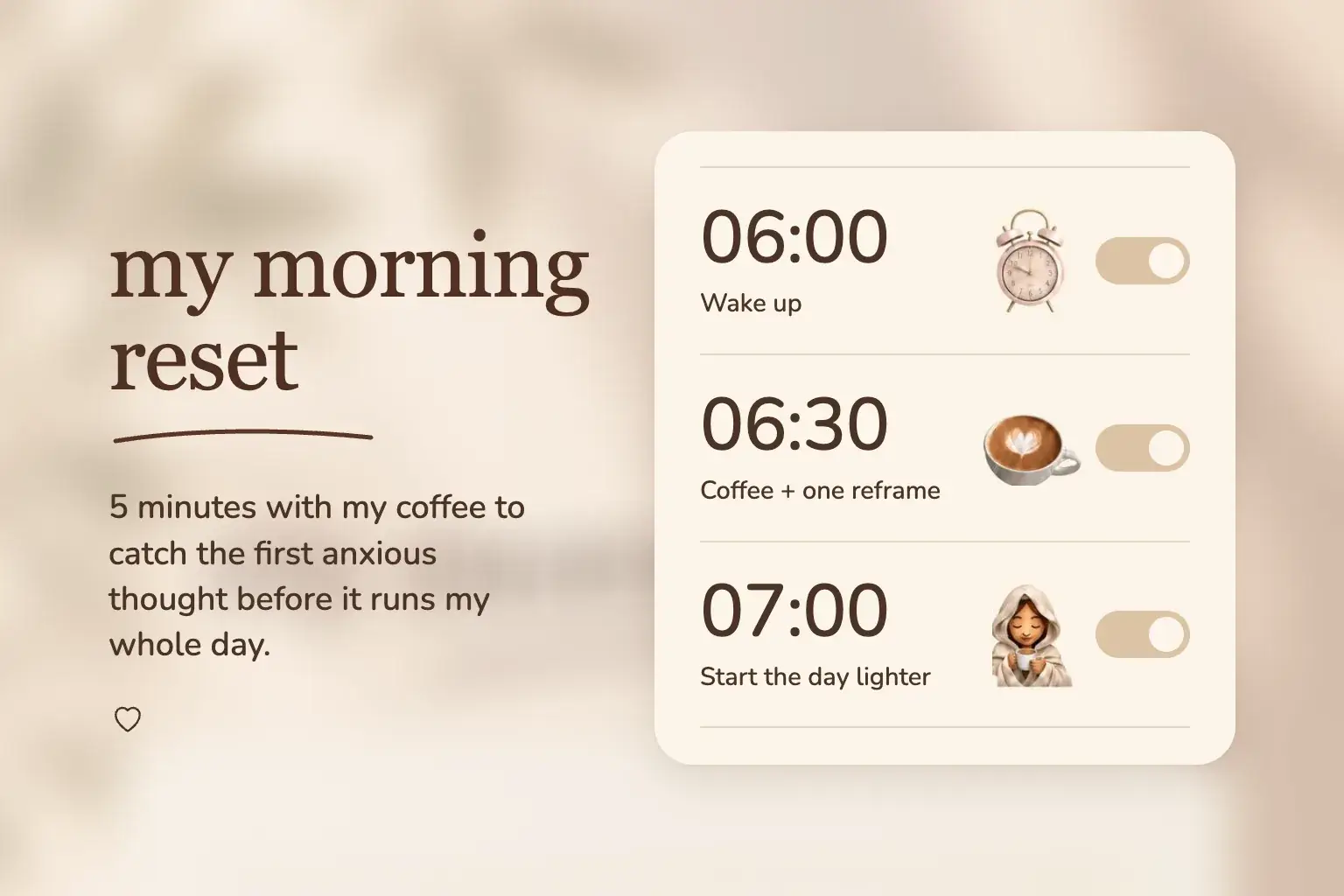
This is a practical guide: a simple five-minute routine, built around the coffee you’re already drinking, that helps you catch the first anxious thought before it runs your whole day. If you want the full mechanism first, read why you wake up already anxious. Below is the short version, then the routine step by step.
The short version: why the routine targets mornings
Your body wakes up on high alert (on purpose)
Shortly after you wake, your body releases a burst of cortisol. Researchers call this the cortisol awakening response: a natural rise that typically peaks within roughly 30–45 minutes of waking.[1] It isn’t a malfunction. It’s your system’s way of getting you alert, mobilized, and ready to deal with the day.
The catch is that physical alertness and anxiety feel very similar from the inside. A faster heartbeat, a slightly tight chest, a mind that’s “on” can all show up whether you’re energized or worried.
An anxious mind reads alertness as a warning
Here’s where interpretation comes in. If you tend to worry, your brain is quick to look for a reason behind that activated feeling, and it usually finds one. “Why do I feel like this? Oh, right, the deadline. The money. That conversation.”
So the sequence often goes:
- Your body ramps up (normal).
- Your mind notices the sensation.
- It assigns a threatening explanation.
- That explanation makes you feel more activated.
- Which seems to confirm the explanation.
Step 5 feeds back into step 1.
It’s worth being precise here: cortisol doesn’t cause your anxiety, and morning anxiety isn’t a sign that something is wrong with your hormones. The point is simpler. Mornings come with a built-in surge of arousal, and an overthinking mind is very good at turning arousal into a story.
You’re meeting your thoughts with no buffer
There’s also a practical reason mornings are hard. During the day, you have distractions: work, people, tasks, movement. In the first minutes after waking, you have none of that. It’s just you, a quiet room, and whatever your brain decides to serve up first. For overthinkers, that’s rarely “what a lovely day.”
The first thought of the day sets the frame
How one worry becomes a whole mood
Psychologists use the term repetitive negative thinking to describe the pattern behind both worry (about the future) and rumination (about the past). The defining feature isn’t any single thought. It’s the loop: the same concern circling back again and again, gathering weight each time.
Mornings are prime time for this loop to start. One unchallenged thought at 6:30, “Today’s going to be a mess,” quietly becomes the lens you look through for the next ten hours. You notice the slow reply from your manager and file it as evidence. You catch every small friction. You remember every misstep. By evening, the day really did feel like a mess, and it’s hard to tell how much of that was the day and how much was the frame.
Why “just don’t think about it” doesn’t work
The natural response is to push the thought away, scroll your phone, or tell yourself to stop being dramatic. Unfortunately, suppression tends to backfire. Thoughts you try not to think have a way of returning louder, and scrolling just swaps one stream of input for another without actually resolving anything.
What helps is not avoiding the thought, but meeting it differently.
Why reframing works
Cognitive restructuring: questioning the thought
Cognitive behavioural therapy (CBT) is built on a simple, well-tested idea: it’s not only events that shape how we feel, but how we interpret them. A core CBT skill, cognitive restructuring (often called reframing), means catching an automatic thought, examining it, and replacing it with a more balanced one.
Reframing is not the same as forced positivity. You’re not telling yourself “Everything is perfect!” when it isn’t. You’re asking whether the thought is accurate and useful, and adjusting it until it is.
The evidence for this approach is strong. A 2025 meta-analysis by Stenzel and colleagues pooled 55 randomized controlled trials of CBT for repetitive negative thinking, with nearly 5,000 participants, and found a moderate effect in favour of CBT, with no significant difference between worry and rumination.[2] In other words, the habit at the heart of morning anxiety is exactly the kind of thinking CBT skills like reframing are designed to target.
Cognitive distancing: you are not your thoughts
A second, related skill is cognitive distancing: stepping back far enough to see a thought as a thought, rather than as a fact.
Compare:
- “I’m going to fail this presentation.”
- “I’m having the thought that I’m going to fail this presentation.”
The second version doesn’t argue with the worry. It just creates a little space around it. That space is often enough to take the edge off, and to make the next step (examining the thought) feel possible.
Kinder self-talk makes it stick
Finally, the tone of your inner voice matters. Research on self-compassion suggests that people who respond to their own struggles with understanding rather than harsh criticism tend to react less intensely to setbacks: they can own their part in what went wrong without being overwhelmed by it.[3] A reframe delivered in the voice of a supportive friend (“This is a lot, and you’ve handled a lot before”) usually lands better than one delivered like a drill sergeant (“Stop being so weak”). That’s the idea behind kinder self-talk.
The 5-minute coffee reframe
You don’t need a 90-minute morning routine, a meditation cushion, or a 5 a.m. alarm. You need five minutes and something you already do every day.
Here’s the routine:
- Let the coffee be your cue30 seconds
- Write the thought down, word for word1 minute
- Check the evidence1.5 minutes
- Write a balanced version1.5 minutes
- Choose one small next step30 seconds
Step 1: Let the coffee be your cue (30 seconds)
As your coffee brews or you take the first sip, pause and ask: “What’s the first thing my mind grabbed onto this morning?”
You don’t need to hunt for it. It’s usually right there, loud and obvious.
Step 2: Write the thought down, word for word (1 minute)
Get it out of your head and in front of you, exactly as your brain phrased it. Don’t clean it up.
“I’m so behind on everything, and today I’ll fall even further behind.”
Seeing it written down is a form of distancing in itself. It’s now something you’re looking at, not something you’re looking through.
Step 3: Check the evidence (1.5 minutes)
Ask two quick questions:
- What supports this thought? “I have a long to-do list. Two tasks are overdue.”
- What doesn’t fit? “I finished three big things last week. One of the ‘overdue’ tasks has no real deadline. I’m usually more productive than I feel at 6:30.”
You’re not trying to win an argument. You’re just widening the picture.
Step 4: Write a balanced version (1.5 minutes)
Now combine both sides into a thought that’s honest and livable:
“I have a lot on my plate, and two things are overdue. I can pick the one that matters most and make real progress on it today.”
Notice: it doesn’t deny the problem. It just stops the problem from becoming the whole story.
Step 5: Choose one small next step (30 seconds)
End with a single action that follows from the reframe. “Start with the client report before opening email.” Small is the point. It turns a thought into momentum.
Then finish your coffee. That’s it.
Prefer evenings? Try the night-in version, for when comparison creeps into a quiet night at home.
Why attaching it to coffee actually works
Most new habits fail not because people don’t care, but because they forget. Behaviour researchers recommend habit stacking: linking a new behaviour to a cue you already have.
Your morning coffee is close to a perfect anchor:
- It happens every day, at roughly the same time.
- It already involves a pause. You’re waiting for it to brew or sitting with it for a few minutes anyway.
- It arrives right when you need it, in that first stretch after waking, when anxious thoughts are most likely to show up.
Over time, the cue does the remembering for you. Coffee starts to mean “check in with my mind,” the same way brushing your teeth means “mornings.”
If you don’t drink coffee, the same principle works with tea, your first glass of water, or the moment you open the curtains. Pick one thing that already happens and attach the reframe to it.
Three common morning thoughts, reframed
Here are three of the most common first-thing worries, with balanced alternatives you can borrow or adapt.
1. “Today is going to be awful.”
Reframe: “I’m predicting the whole day from how I feel in the first ten minutes. Mornings often feel heavier than the day actually turns out.”
2. “I have way too much to do.”
Reframe: “There’s a lot, and I can’t do all of it today. I can do the most important thing first and let the rest wait without it meaning I’ve failed.”
3. “I’m going to mess up that meeting.”
Reframe: “I’m nervous because it matters to me. I’ve prepared, and even if it’s not perfect, one meeting won’t define how people see me.”
Save the one that hits closest to home. Next time that thought shows up with your coffee, you’ll already have an answer waiting.
Make it a daily habit with MindLift
The coffee reframe works best when it’s easy: no blank page, no figuring out which questions to ask, no wondering if you’re “doing it right.”
That’s exactly what MindLift is built for. Type the thought exactly as your brain phrased it, and MindLift turns it into a kinder, more balanced response in about 60 seconds, using the same CBT reframing steps: name the thought, check it, and turn it into something lighter and truer. It fits right next to your coffee, it’s free to start, and it helps you start the day with a clearer head instead of a running list of worries.
One coffee. One reframe. A lighter day.
Frequently asked questions
What is the coffee reframe?
A five-minute CBT routine attached to your first coffee. As it brews, you write down the first anxious thought exactly as your mind phrased it, check what supports it and what does not fit, write a balanced version, and pick one small next step. The coffee is the cue, so the habit does not depend on remembering.
What if I don't drink coffee?
Use any cue that already happens every morning at about the same time: tea, your first glass of water, opening the curtains. The point is habit stacking, linking the new step to something you already do, not the coffee itself.
How long does it take for reframing to feel natural?
Most people find it feels awkward for the first week or two, like any new skill. With daily practice, catching and reframing thoughts becomes quicker and more automatic. Consistency matters more than getting each reframe perfect.
Can reframing replace therapy?
Reframing is a useful self-help skill drawn from CBT, but it isn't a substitute for professional care. If your anxiety is intense, persistent, or getting in the way of work, relationships, or sleep, it's worth speaking with a mental health professional. Apps like MindLift can complement therapy, but not replace it.
What if I can't think of a balanced thought?
That's okay. Start smaller. Even rewriting the thought as "I'm having the thought that…" is a meaningful step. On harder mornings, simply noticing and naming the worry is enough.
Like what you're reading?
Continue your wellness journey
Reframe negative thoughts in 60 seconds — free to start in the MindLift app.


Free to start · no account required
- Fries, E., Dettenborn, L., & Kirschbaum, C. (2009). The cortisol awakening response (CAR): Facts and future directions. International Journal of Psychophysiology, 72(1), 67–73. — DOI (opens in a new tab)
- Stenzel, K., Keller, J., Kirchner, L., Rief, W., & Berg, M. (2025). Efficacy of cognitive behavioral therapy in treating repetitive negative thinking, rumination, and worry – a transdiagnostic meta-analysis. Psychological Medicine, 55, e31. — DOI (opens in a new tab)
- Leary, M. R., Tate, E. B., Adams, C. E., Batts Allen, A., & Hancock, J. (2007). Self-compassion and reactions to unpleasant self-relevant events: The implications of treating oneself kindly. Journal of Personality and Social Psychology, 92(5), 887–904. — DOI (opens in a new tab)
CBT & Self-Talk Researchers
MindLift content is grounded in cognitive behavioral therapy principles and designed to help you shift harsh self-talk in real time. Our guides focus on practical, evidence-based techniques you can use in the moment.
Was this article helpful?