
Turn this into a daily habit — free to start in the MindLift app:
Overthinking is one of the most searched mental health topics online. Millions of people type variations of "how to stop overthinking" every day — before bed, mid-anxiety spiral, after a conversation they can't stop replaying.
Most of the advice they find is useless. "Think positive." "Be present." "Just stop." This guide is different. It's based on CBT — cognitive behavioral therapy, the most research-supported psychological approach to treating overthinking and anxiety. And it gives you 12 specific techniques, not 12 variations of "stop worrying."
This is a complete guide. You don't need to read it all at once. Use the section headers to find what's relevant to you right now.
Part 1: What Overthinking Actually Is (And Why Most Advice Fails)
Overthinking is the everyday name for two clinical patterns, rumination (replaying the past) and worry (rehearsing the future), both forms of repetitive negative thinking that consume attention without producing useful outcomes. Most advice fails because it treats an automatic process as a choice.
The Clinical Definition
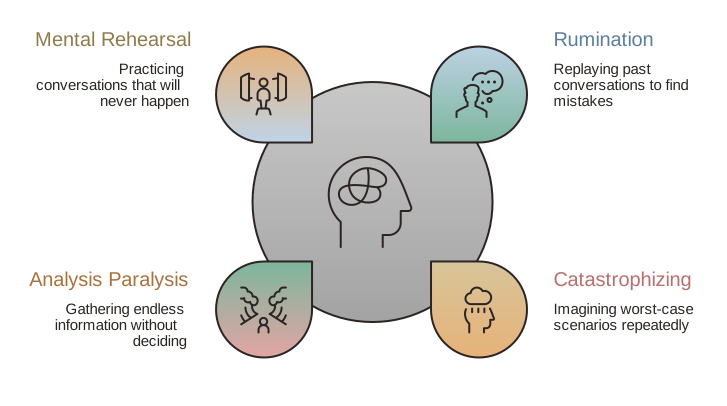
Overthinking has two clinical siblings: rumination and worry.
Rumination is past-focused — the repetitive mental review of past events, mistakes, and disappointments. "Why did I say that?" "What did they mean by that look?" "Why didn't I handle it differently?" The brain revisits the same events looking for resolution that never arrives.
Worry is future-focused — repetitive mental rehearsal of potential future threats. "What if I fail?" "What if they don't respond?" "What if something goes wrong?" The brain simulates catastrophic outcomes as if preparing for them, even when the probability is low.
Both are forms of repetitive negative thinking — mental loops that consume attention and cognitive resources without producing useful outcomes. "Overthinking" is the everyday term that covers both.
What Overthinking Is Not
Overthinking is not:
- A personality trait. Being "an overthinker" is a description of a current behavioral pattern, not an identity. Patterns change.
- High intelligence. Smart people overthink, but overthinking does not indicate intelligence. It indicates a particular response to uncertainty — which anyone can develop and anyone can modify.
- Anxiety. Overthinking and anxiety are related but distinct. Anxiety is primarily physiological — the body's threat response. Overthinking is primarily cognitive — the mental loop that runs in response. They frequently co-occur, but treating one doesn't automatically resolve the other. Full comparison here.
- Caring deeply. It can feel like overthinking means you care — and caring may be part of it — but overthinking consistently produces worse decisions, not better ones. It's not protective.
Why Overthinking Advice Fails
Most overthinking advice fails for one of three reasons:
- It treats overthinking as a choice. "Just stop thinking about it" implies you chose to think about it, and can choose to stop. But overthinking is automatic — generated by neural patterns that don't respond to willpower.
- It prescribes suppression. Telling yourself not to think about something reliably increases how often you think about it. Daniel Wegner's "white bear" experiments demonstrated this decades ago: active suppression produces a rebound effect.
- It's too abstract. "Be more present" doesn't tell you what to do when you're mid-spiral at 2am. Effective techniques need to be concrete and immediately applicable.
CBT works because it doesn't ask you to stop thinking or think differently by force of will. It gives you a specific procedure to follow when a thought arrives — which eventually rewires the automatic response.
Part 2: The Neuroscience Behind Overthinking
Overthinking has a recognisable neural pattern: the brain's default mode network keeps generating self-referential review, the amygdala keeps flagging an ambiguous threat, and the prefrontal cortex keeps analysing without reaching resolution. CBT works because it changes what happens after the trigger, not by force of will.
Why the Brain Generates Overthinking Loops
The brain has a default mode network (DMN) — a set of regions active when you're not focused on an external task. The DMN is associated with self-referential thought: thinking about yourself, your past, your future, other people's perceptions of you. Overthinking is, in part, an overactive DMN — the brain defaulting to self-focused mental review in the absence of task engagement.
The brain also has a threat detection system centered on the amygdala. When the amygdala flags something as potentially threatening, the prefrontal cortex (rational thinking) tries to analyze the threat and resolve it. In overthinking, this analysis never reaches resolution — because the threat is ambiguous, the future is uncertain, or the past is unchangeable. The amygdala keeps flagging; the prefrontal cortex keeps analyzing; the loop runs.
This is not pathological — it's the normal brain trying to protect you using the wrong tool for the job. Analysis is excellent for concrete problems with knowable solutions. It is nearly useless for ambiguous situations, social dynamics, and catastrophic futures that may never occur.
The Habit Loop of Overthinking
Overthinking also has a habit component. The sequence is:
- Trigger: An uncertainty or perceived threat (an unanswered message, a comment someone made, a decision pending)
- Routine: Mental replay and analysis of the trigger
- Reward: Temporary reduction in anxiety (because doing something — even thinking — feels more controlled than doing nothing)
Over time, the brain associates "trigger → analyze → temporary relief" as a reliable sequence. The analysis itself becomes rewarding, even though it rarely produces genuine resolution. CBT disrupts this loop by introducing a different routine after the trigger.
What CBT Does in the Brain
Neuroimaging studies have shown that CBT produces measurable changes in brain function — including reduced amygdala reactivity, increased prefrontal cortex engagement with emotional stimuli, and changes in default mode network activity. These are not just subjective improvements in how you feel; they are physical changes in how the brain processes threat.
The changes are not instant — they build gradually with consistent practice. But they are durable: unlike medication, which requires continued use, CBT's changes persist after the intervention ends because they reflect learned skills rather than biochemical adjustment.
Part 3: The 12 CBT Techniques for Stopping Overthinking
The 12 techniques below are organized from fastest to most involved. They work at different points in the overthinking cycle, which is why different people find different ones most effective. The goal is not to master all 12 — it's to find the 2–3 that work for your specific pattern.
Thought Labeling
30 seconds · The fastest first step
Why it works
Activates the prefrontal cortex (rational processing) and reduces amygdala reactivity by translating an emotional experience into language. Research by Matthew Lieberman showed that affect labeling reduces subjective distress and changes neural activation patterns.
When an overthinking loop starts, name what you're doing before engaging with its content:
- "That's a future-catastrophizing thought."
- "That's a mind-reading thought about what they meant."
- "That's rumination about the meeting."
The label doesn't need to be sophisticated. Any label that identifies the thought as a mental event rather than a fact creates the distance you need.
Best for: Any overthinking thought — use this first, before any other technique
5-4-3-2-1 Grounding
60–90 seconds · Physiological interruption via sensory focus
Why it works
Redirects attentional resources from internal mental activity to external sensory experience. Reduces physiological arousal that fuels the thought loop. Works best when overthinking is accompanied by physical anxiety symptoms.
Name, out loud or in writing:
- 5 things you can see right now
- 4 things you can physically feel (temperature, texture, weight)
- 3 things you can hear
- 2 things you can smell
- 1 thing you can taste
This is not a cognitive technique — it doesn't address the thought's content. It reduces the physiological arousal that makes the thought harder to examine. Use it as a first step when anxiety is high, before any cognitive intervention.
Best for: Acute anxiety spirals with physical symptoms; high-arousal states where rational thinking is difficult
Evidence Examination
3–5 minutes · The core cognitive restructuring technique
Why it works
Forces comparison between emotional certainty (how strongly a thought feels true) and evidential certainty (what you can actually verify). Overthinking thoughts feel certain because they are emotionally intense — this technique reveals that intensity is not the same as accuracy.
Write the specific thought: "I'm going to fail this presentation."
List the evidence FOR the thought (actual, verifiable evidence — not feelings or interpretations):
- "I felt underprepared in the prep session."
List the evidence AGAINST:
- "I've delivered presentations before, including difficult ones."
- "I know this material well — I've worked on it for weeks."
- "I felt underprepared before the last one too, and it was fine."
Write a revised thought based on the actual evidence balance: "I'm nervous about this presentation. I've prepared. Feeling nervous doesn't mean I'll fail."
Best for: Fortune-telling, catastrophizing, emotional reasoning; any thought where emotional intensity is masking low evidential support
Decatastrophizing
2–3 minutes · Worst-case/realistic-case distinction
Why it works
Overthinking loops often run on an implicit assumption that the worst-case scenario is the most likely one. Decatastrophizing separates these — making explicit that the worst case exists, the most likely case is different, and you could cope with the worst case if it occurred.
Identify the worst-case scenario your thought is running on.
Ask three questions:
- What is the actual probability of this worst case? (be specific)
- If it did happen, could you cope? What would you actually do?
- What is the most realistic outcome — not the best, not the worst?
Write the realistic-case outcome. This is the thought your brain should be processing, not the worst case.
Best for: Catastrophizing loops, anxiety about outcomes, worst-case thinking that has taken over from realistic thinking
The Double Standard Technique
2 minutes · Self-compassion via consistency
Why it works
Most people apply a significantly harsher standard to themselves than to others in identical situations. This discrepancy reveals that the self-critical thought is not a universally reasonable position — it's a selective one. Applying the consistent standard produces a reframe that feels more accurate, not just more positive.
Write the overthinking thought as you're applying it to yourself.
Imagine a close friend came to you and said those exact words about their own situation. What would you actually say to them?
Write what you would say to your friend. Apply that response to yourself.
Best for: Self-critical overthinking; 'I should have...'; 'I'm so stupid for...'; any harsh self-judgment
Containment Scheduling (Worry Period)
2 minutes setup; 15–20 minutes daily · Postponing rather than suppressing
Why it works
Suppression increases intrusive thoughts. Postponement — genuine postponement, to a specific time — does not. The worry period technique works because it validates the concern (you will address it) while creating a time boundary that protects the rest of the day.
Choose a fixed 15–20 minute worry period each day — same time, not before bed. When an overthinking thought arrives outside this window:
- Write the thought or concern briefly
- Tell yourself: "I'll address this at [time]. Right now I'm returning to [current activity]."
- When the worry period arrives, review your list and apply other CBT techniques to the items that remain bothersome
Most items on the list feel less urgent by the time the worry period arrives. The brain learns over time that it doesn't need to resolve everything immediately.
Best for: Pervasive, recurring overthinking that interrupts daily life; thoughts that intrude during work or sleep
Socratic Questioning
3–5 minutes · Interrogating the thought's logic
Why it works
Entrenched overthinking thoughts often contain logical gaps that are invisible when the thought is accepted as fact. Systematic questioning exposes these gaps without directly contradicting the thought — making it harder for the brain to maintain the thought as unquestionable.
Apply these questions to the specific thought:
- "Is this thought absolutely true, or is it partly true?"
- "Am I using extreme language — always, never, everyone, no one?"
- "What evidence contradicts this thought?"
- "What's a more precise version of this thought that removes the extremes?"
- "If someone I trusted disagreed with this thought, what might they say?"
Best for: Long-standing, entrenched beliefs; thoughts with extreme language (always/never); thoughts that feel unquestionable
Behavioral Experiments
Days to weeks (low-stakes tests) · Testing predictions against reality
Why it works
Overthinking loops often rest on predictions that are never tested — making them unfalsifiable and therefore persistent. A behavioral experiment transforms an abstract prediction into a testable hypothesis. When the prediction doesn't come true (which it usually doesn't, for social anxiety predictions), the thought loses evidential support.
Identify the specific prediction your overthinking thought is making:
"If I speak up in the meeting, people will think I'm incompetent."
Design a low-stakes test: make one comment in the next meeting.
After the experiment, record what actually happened and compare it to the prediction. Keep the record — it becomes evidence you can return to when the same thought recurs.
Best for: Social anxiety thinking loops; avoidance-based overthinking; fortune-telling about social situations
Cognitive Defusion
30 seconds · Creating distance from the thought
Why it works
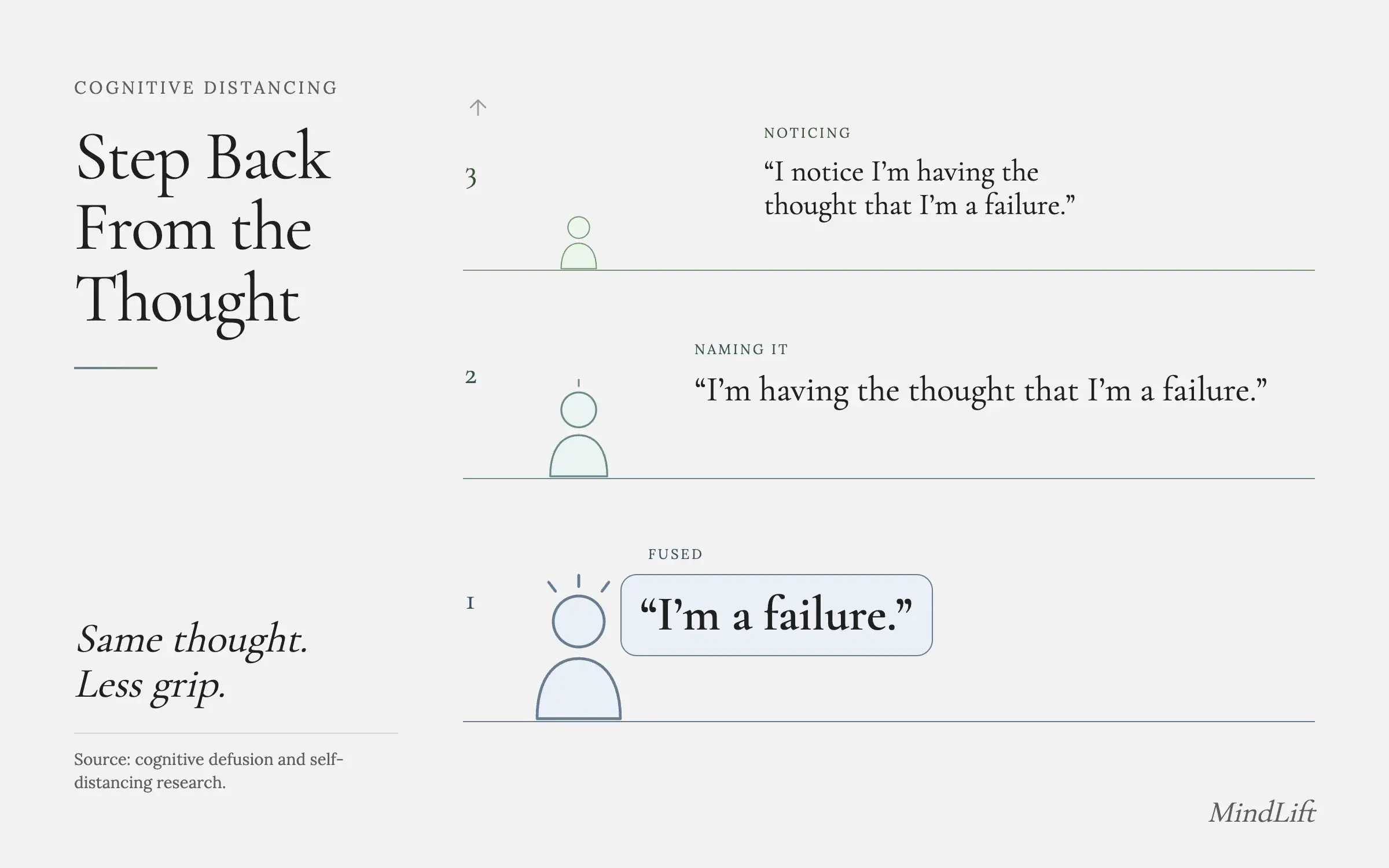
Defusion adds linguistic distance between the thinker and the thought, preventing automatic fusion — the state where you and the thought are identical. This ACT (Acceptance and Commitment Therapy) technique complements CBT restructuring by creating psychological space without requiring direct evidence examination.
Add these words before the overthinking thought:
"I notice I'm having the thought that..."
Instead of: "I'm going to fail."
Say: "I notice I'm having the thought that I'm going to fail."
The thought is still there. Your relationship to it has changed.
Best for: High-intensity thoughts where direct examination feels too close; acute anxiety; any thought you're fused with
Thought-Action Defusion
1 minute · Thoughts are not plans or intentions
Why it works
Intrusive thoughts feel alarming because the brain conflates having a thought with intending to act on it. This technique — from CBT for OCD and intrusive thoughts — separates the thought's content from its meaning, reducing the distress that comes from taking a thought too seriously.
When an intrusive or alarming thought arrives, ask:
- "Is this a thought, or is this a plan/intention?"
- "Having this thought does not mean I will act on it, or that it reflects my values."
- "Everyone has intrusive thoughts. The thought arising does not make me dangerous, bad, or at risk."
Best for: Intrusive thoughts that feel alarming or morally distressing; thoughts you're afraid of having; OCD-type thought loops
Behavioral Activation
5–15 minutes · Breaking the inaction-overthinking loop
Why it works
Overthinking and inaction reinforce each other: when you're overthinking, you don't take action; when you're not taking action, your mind fills the vacuum with more overthinking. Behavioral activation interrupts this loop by introducing action — not because you're ready, but because action changes the brain's input.
Identify one small, concrete action related to the thing you're overthinking. Small and concrete matters — "research one thing about the decision" rather than "solve the entire problem."
Do the action before you feel ready.
Motivation follows action — not the other way around. The brain generates more options and less anxiety when it has behavioral data to process rather than just hypothetical analysis.
Best for: Decision paralysis; overthinking about something you've been avoiding; inaction loop reinforcing anxiety
The 60-Second Structured Reframe
60 seconds · The complete CBT cycle in one minute
Why it works
Combines thought labeling, distortion identification, and evidence-based reframing into a single rapid process. This is the technique MindLift's Mini-Reframe automates — applying all CBT steps to your specific thought in one focused session.
- Name the thought (write it exactly): What is the specific thought running?
- Label the distortion: Which category is this? (Catastrophizing? Mind-reading? Fortune-telling?)
- Challenge it: What evidence exists against it? What's actually true?
- Reframe it: Write one sentence that is more accurate than the original thought and believable enough to hold.
Best for: In-the-moment intervention; any overthinking thought; the go-to technique for daily practice
Part 4: The Cognitive Distortions Behind Overthinking
Overthinking thoughts are not random — they follow predictable patterns called cognitive distortions. Understanding which distortions drive your specific overthinking helps you choose the right technique.
| Distortion | Sounds like | Best antidote |
|---|---|---|
| Catastrophizing | "This will be a complete disaster" | Decatastrophizing (Technique 4) |
| Fortune-telling | "I know exactly how this will go wrong" | Evidence Examination (Technique 3) |
| Mind-reading | "They think I'm incompetent" | Survey Method / Behavioral Experiment (Technique 8) |
| All-or-nothing | "Either I do it perfectly or I've failed" | Socratic Questioning (Technique 7) |
| Overgeneralization | "I always mess things up" | Socratic Questioning (Technique 7) |
| Emotional reasoning | "I feel like a failure, so I must be one" | Evidence Examination (Technique 3) |
| Personalization | "The meeting went badly because of me" | Evidence Examination (Technique 3) |
| Should statements | "I should have handled that better" | Double Standard Technique (Technique 5) |
| Magnification | "This mistake will follow me forever" | Decatastrophizing (Technique 4) |
| Mental filtering | "Everything went wrong" (ignoring what went right) | Evidence Examination (Technique 3) |
For a deeper look at each distortion with reframe examples, see: Thinking Traps and Cognitive Distortions and 40 Negative Self-Talk Examples with Reframes.
Part 5: Matching Techniques to Your Overthinking Pattern
Overthinking comes in four main patterns, future-focused worry, past-focused rumination, social mind-reading and decision paralysis, and each responds best to a different starting technique. Match your dominant pattern below to the techniques listed for it rather than trying all twelve at once.
If Your Overthinking Is Mostly Future-Focused (Worry)
You catastrophize about things that haven't happened. You imagine worst-case scenarios in detail. You rehearse possible conversations. You plan for emergencies that are unlikely.
Start with: Decatastrophizing (4), Evidence Examination (3), Worry Period (6)
The worry period is particularly effective for future-focused overthinking because it validates the concern without letting it dominate. Decatastrophizing helps because worst-case thinking is usually the dominant distortion.
If Your Overthinking Is Mostly Past-Focused (Rumination)
You replay conversations. You analyze what you said or should have said. You review past mistakes or failures. You wonder how things would have gone differently.
Start with: Thought Labeling (1), Double Standard Technique (5), Behavioral Activation (11)
Rumination is fueled by the belief that more analysis of the past will produce a different understanding. Behavioral activation is counterintuitive here — it works by giving the brain something to process in the present rather than the past.
If Your Overthinking Is Mostly Social (Mind-Reading)
You worry about what others think of you. You replay interactions for signs of disapproval. You assume others are judging you negatively. You avoid situations to avoid potential negative judgment.
Start with: Thought Labeling (1), Behavioral Experiments (8), Cognitive Defusion (9)
Social overthinking is particularly resistant to evidence examination because the evidence is often unavailable — you can't read others' minds. Behavioral experiments are uniquely effective because they generate actual data rather than continued analysis.
If Your Overthinking Is About Decisions (Analysis Paralysis)
You can't make decisions because you keep analyzing options. You fear making the wrong choice. You gather more information indefinitely. You delay action waiting for certainty that never arrives.
Start with: Behavioral Activation (11), Worry Period (6), Decatastrophizing (4)
Decision overthinking is driven by uncertainty intolerance — the belief that more analysis will produce certainty. It usually won't. Behavioral activation interrupts the loop by making the decision and generating actual information from the outcome.
Part 6: Building a Practice That Sticks
A CBT practice for overthinking sticks when it is small enough to repeat: one technique applied to one specific thought, written down, every day the thought comes. Consistency produces more lasting change than occasional intensive sessions, and most techniques need several applications before the effect is noticeable.
The Minimum Viable Habit
The research on CBT adherence consistently shows that more sessions are not always better — what matters is consistency. One deliberate application of a technique each day produces more lasting change than sporadic intensive sessions.
The minimum viable practice: when a significant overthinking episode occurs, apply one technique to one specific thought. Write it down if possible — writing increases the efficacy of cognitive restructuring.
That's it. One thought, one technique, written. Every day the thought comes.
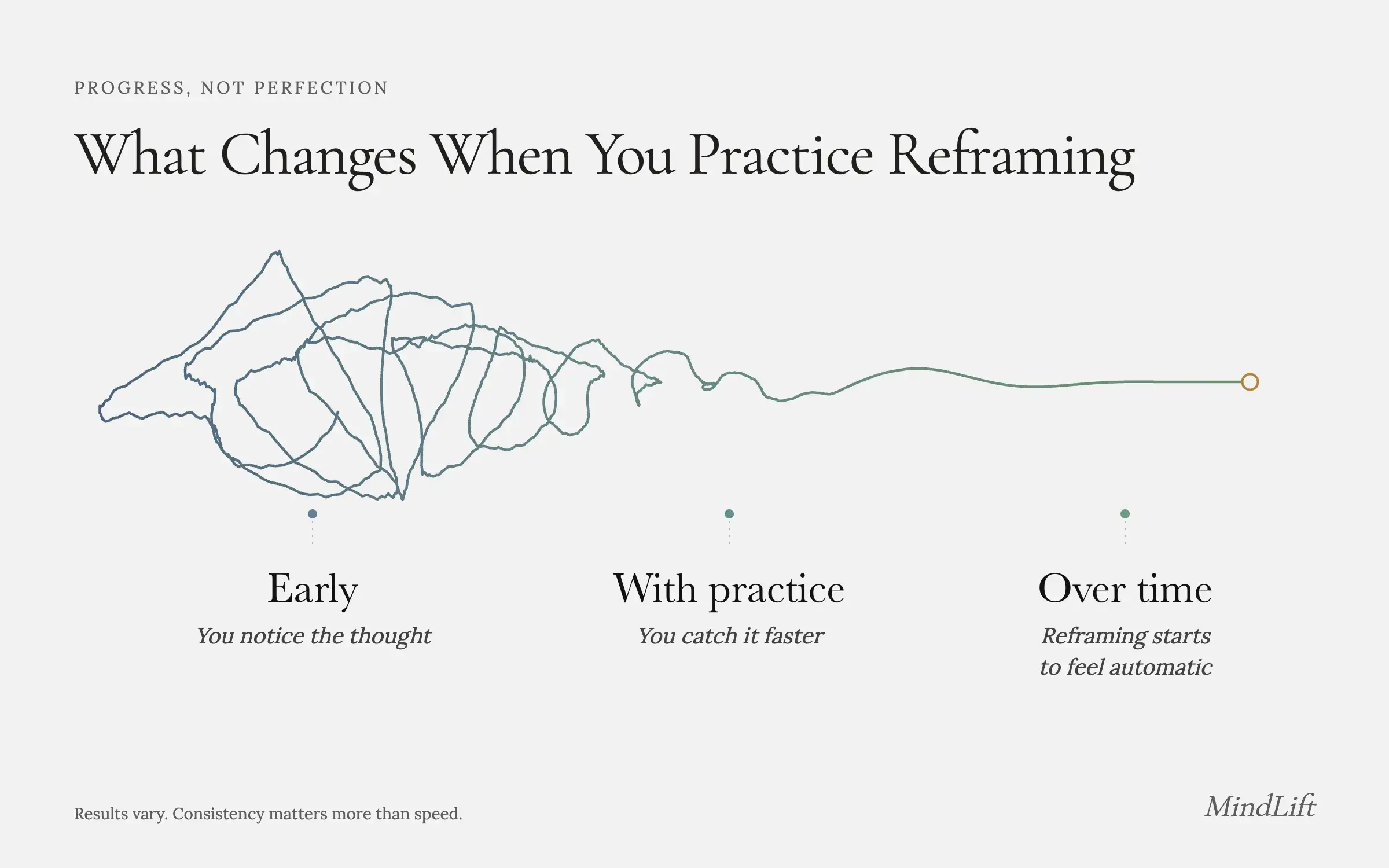
What Progress Looks Like
Progress in CBT for overthinking doesn't look like "I don't have overthinking thoughts anymore." It looks like:
- The thoughts come — but they don't pull as hard
- You recognize the thought type faster than before
- The time between the thought arriving and you recovering from it gets shorter
- Techniques that required conscious effort start feeling more automatic
- You catch yourself mid-loop earlier, rather than after hours of spiraling
With consistent practice, the shift you're looking for is qualitative. The thoughts still arrive — but the chain that used to run from thought to spiral to hours of distress is shorter and weaker.
When to Add More Techniques
Start with one or two techniques. Give them 2 weeks of consistent application. Then ask: is this working for my specific pattern? If yes, continue and deepen the practice. If not, add a second technique or switch to one from a different category.
The most common mistake is cycling through techniques too quickly — trying each one once and concluding it doesn't work. Most CBT techniques require 5–10 applications before the effect becomes noticeable.
Part 7: When Overthinking Doesn't Respond to Self-Directed CBT
Self-directed CBT is effective for mild-to-moderate overthinking, but some patterns need professional support: loops that persist despite consistent practice, thoughts with a compulsive quality, or overthinking tied to trauma, panic or depression. The signs below are the ones worth taking seriously.
Signs You Might Need More Support
Self-directed CBT is effective for mild-to-moderate overthinking. Consider seeking additional support if:
- Overthinking is significantly interfering with work, relationships, or daily function despite consistent practice over 8+ weeks
- Overthinking is accompanied by severe anxiety, panic attacks, or depression
- The thoughts have a compulsive quality that feels impossible to interrupt (possible OCD presentation)
- Overthinking is related to trauma, abuse, or significant life disruption
- You're engaging in safety behaviors that maintain the anxiety (constant reassurance-seeking, checking, avoidance of large categories of situations)
What Professional CBT Adds
A CBT therapist brings several things a self-directed practice can't replicate: the ability to identify patterns you can't see yourself, real-time feedback on technique application, exposure therapy work for avoidance-based anxiety, and a therapeutic relationship that is itself a corrective experience.
For mild-to-moderate overthinking, self-directed CBT (with or without an app) can be genuinely effective. For moderate-to-severe, professional CBT is the more reliable path — with self-directed tools as a supplement.
Part 8: CBT vs Other Approaches to Overthinking
CBT, meditation, medication and journaling target different mechanisms in overthinking: CBT restructures the content of a thought, meditation changes your relationship to it, medication lowers the arousal underneath it, and journaling processes the emotion around it. The comparisons below show when each one helps.
CBT vs Meditation
Meditation apps (Calm, Headspace) and CBT apps target different mechanisms. Meditation builds present-moment awareness and reduces physiological arousal — it changes your relationship to thoughts by training you to observe them without fusing. CBT changes the content of thoughts through restructuring — it examines specific thoughts and generates more accurate alternatives.
For most overthinkers, CBT produces faster and more specific relief because it works at the level of the thought's content. Meditation works better as a long-term baseline-reduction practice. Many people find they benefit from both. Full comparison here.
CBT vs Medication
SSRIs and SNRIs can reduce the anxiety that fuels overthinking by lowering the overall arousal baseline. They don't change thought patterns directly — they make CBT easier to apply by reducing the signal-to-noise ratio. For many people with anxiety, the combination of medication and CBT is more effective than either alone. For overthinking without clinical anxiety, CBT alone is often sufficient.
CBT vs Journaling
Journaling (free-writing, gratitude, reflection) can be valuable but has a different mechanism from CBT. Journaling processes emotions — it can clarify what you're feeling. CBT restructures cognitions — it changes what you're thinking. Journaling without structure can reinforce rumination rather than interrupt it. CBT-informed journaling (writing the thought, labeling the distortion, examining evidence, writing the reframe) combines both.
Part 9: Using Apps for CBT-Based Overthinking Relief
Several apps apply CBT techniques to overthinking. Not all are created equal — the key test is whether the app responds to your specific thought or provides a generic response.
For detailed comparison: Free CBT Apps Compared: Which One Actually Does CBT?
For AI-powered CBT specifically: How AI-Powered CBT Works
MindLift's Mini-Reframe applies Technique 12 (the 60-second structured reframe) automatically — you type the thought, and it generates a CBT-based response using the Realist, Growth, and Compassionate reframe frameworks. Free to start.
Summary: The Overthinking Toolkit
The overthinking toolkit below pairs each state you might be in with the numbered technique from Part 3 that fits it best, so you can find the right tool mid-spiral without rereading the guide. Bookmark this section for quick reference and match your current state to the right tool:
- Thought just arrived, need to interrupt it now: Thought Labeling (1) → 60-Second Reframe (12)
- High physical anxiety accompanying the thought: 5-4-3-2-1 Grounding (2) → Evidence Examination (3)
- Catastrophizing about a possible outcome: Decatastrophizing (4)
- Harsh self-criticism: Double Standard Technique (5)
- Thought keeps returning, can't stop: Worry Period (6)
- Thought feels unquestionable, deeply held: Socratic Questioning (7)
- Social anxiety, fear of others' judgment: Behavioral Experiment (8)
- Thought too intense to examine directly: Cognitive Defusion (9)
- Intrusive or alarming thought: Thought-Action Defusion (10)
- Stuck in inaction loop: Behavioral Activation (11)
- General overthinking, want a complete process: 60-Second Structured Reframe (12)
Find your pattern in 2 minutes
A MindLift quiz is a short, free self-assessment that names the thinking pattern this guide’s techniques work best against. Each quiz below takes about two minutes, needs no sign-up, and ends with a result page you can act on straight away.
- What's Your Overthinking Pattern?Discover your dominant overthinking style — future catastrophizer, past ruminator, decision paralysis, or deep analyst. CBT-informed, 2 minutes.
- Which Thought Distortion Runs Your Brain?Everyone has a default. Eleven quick moments name yours — catastrophizing, mind reading, should statements and eight more — plus the co-pilot that rides along.
Related Reading: The Complete Cluster
The articles below form the complete overthinking cluster on MindLift: immediate techniques, cognitive reframing methods, the difference between overthinking and anxiety, self-talk examples with reframes, and comparisons of CBT apps. Each one goes deeper on a single part of this guide.
- How to Stop Overthinking Immediately: 7 Techniques for Right Now
- Cognitive Reframing Techniques: 8 CBT Methods That Actually Work
- Overthinking vs Anxiety: What's the Difference and Why It Matters
- Negative Self-Talk Examples: 40 Examples with CBT Reframes
- AI-Powered CBT: How It Works and Whether It Helps
- CBT Apps vs Meditation Apps: Which One Helps With Overthinking?
- How to Control Anxious Thoughts: 8 CBT Techniques
- Free CBT Apps Compared: Which One Actually Does CBT?
- The Overthinking Hub: every guide, quiz, and technique in one place
- The CBT Techniques Hub
Frequently asked questions
Can CBT stop overthinking permanently?
CBT does not stop overthinking thoughts from arising — the brain will continue to generate repetitive thoughts in response to uncertainty and perceived threat. What CBT changes is the relationship to those thoughts: how quickly you recognize them, how automatically you disengage from them, and how strongly they pull your attention. With consistent practice, many people find their default response shifts — the thoughts come with less intensity and pass more quickly.
How long does it take to stop overthinking?
It varies from person to person, and there is no fixed timeline. What helps is consistent practice — one deliberate application of a CBT technique each time a significant overthinking episode occurs. The shift is not all-or-nothing: early on, the techniques require conscious effort and feel slow; over time they become more automatic.
What is the root cause of overthinking?
Overthinking is driven by uncertainty intolerance — the brain's attempt to achieve certainty about an uncertain situation through repeated mental processing. The problem is that certainty rarely comes from analysis alone. Additionally, once the brain associates overthinking with temporary anxiety reduction (because analyzing feels like "doing something"), it becomes a reinforced habit. CBT targets both the thought content and the habit loop.
Is there a difference between overthinking and rumination?
Rumination is the clinical term for what is commonly called overthinking — the repetitive, passive focus on distress and its causes rather than solutions. In CBT research, rumination is distinguished from worry: rumination is past-focused ("why did that happen," "what's wrong with me") while worry is future-focused ("what if this happens," "what could go wrong"). Both are types of repetitive negative thinking that respond to CBT, but slightly different techniques work best for each.
What triggers overthinking?
Overthinking is typically triggered by uncertainty (an unresolved situation), perceived threat (real or imagined), perfectionism (the belief that continued analysis will produce the "right" answer), low distress tolerance (difficulty sitting with uncomfortable feelings), and past negative experiences (sensitizing the brain to similar cues). Understanding your specific trigger helps you choose the most effective CBT technique.
Like what you're reading?
Stop the spiral in real time
MindLift gives you a gentle CBT-based reframe the moment your thoughts start looping.


Free to start · premium optional