
Turn this into a daily habit — free to start in the MindLift app:
There was a time when we believed that thoughts were instructions.
If something appeared in your mind, you were meant to examine it, fix it, act on it, or obey it. A worried thought demanded reassurance. A critical one demanded improvement. A catastrophic one demanded immediate planning. Thinking, we were taught, was a form of responsibility.
But somewhere between constant notifications, endless self-optimization, and a culture that treats anxiety as foresight, thinking became less like insight and more like noise.
Most of us are no longer overwhelmed by events.
We are overwhelmed by our commentary on events.
The modern mind narrates relentlessly. It predicts outcomes before they arrive, reviews conversations that are already over, rehearses disasters that never happen, and critiques decisions that cannot be undone. And because the voice is internal, it carries authority. We assume it must be listened to. We assume it must be answered.
What if it doesn't?
The Quiet Shift
One of the quietest psychological shifts happening right now is not about confidence or motivation or self-love. It is about editing. About learning that not every mental sentence requires a reply.
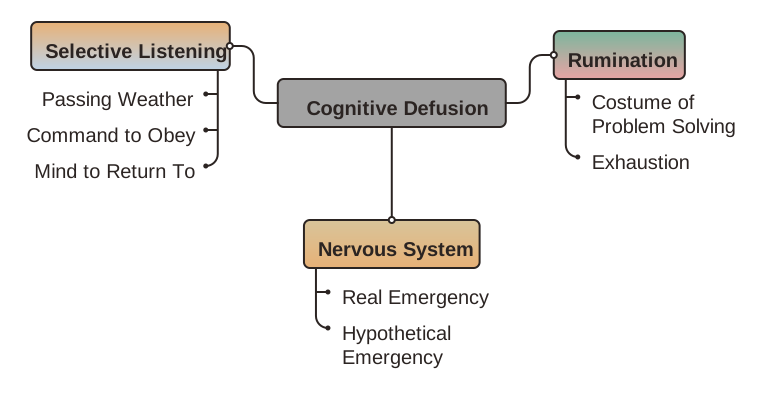
This idea runs against everything we were praised for growing up. We learned to "figure things out," to "talk it through," to "get to the bottom of it." But rumination wears the costume of problem-solving. It feels active while quietly draining us. The brain circles the same material, not because it is useful, but because it is familiar.
Thoughts repeat not because they are true, but because they are practiced.
And here is the uncomfortable truth: engaging with every thought does not make us more responsible. It makes us more tired.
Permission Not to Engage
Relief does not come from replacing every negative thought with a positive one. That approach often fails because the mind knows when it's being lied to. Relief comes from something subtler and far more humane: permission not to engage.
You can notice a thought without chasing it.
You can hear it without debating it.
You can let it pass without solving it.
This is not avoidance. It is discernment.
How do I stop responding to every thought?
You don't suppress thoughts — you simply don't engage with every one. Notice it exists, recognize it as mental content (not a command), and let it pass. Like hearing background noise without investigating every sound. This is cognitive defusion: observing thoughts without being controlled by them.
The Nervous System Problem
Children learn early that not every sound deserves attention. Adults forget this skill internally. We treat every worry like a fire alarm, every doubt like a warning signal. And the body's stress response can fire for a hypothetical threat, not just a real one.
So we live in a state of permanent readiness. Always braced. Always responding.
What Changes
What changes when you stop responding to every thought is not that life becomes easier. It becomes quieter. And in that quiet, something important returns: proportion.
A thought like "What if I mess this up?" stops feeling like a command and starts feeling like weather. Present, noticeable, but not directive. You learn that the mind produces content the way lungs produce air. Automatically. Constantly. Not all of it meaningful.
The most emotionally mature people are not the ones with the most positive thoughts. They are the ones with the least entanglement.
They do not argue with their minds all day. They listen selectively.
A Cultural Shift
This shift is showing up everywhere now. In how people talk about burnout. In how they approach anxiety. In the growing rejection of loud motivation and forced optimism. More and more, mental health is less about changing who you are and more about changing how urgently you respond to yourself.
Sometimes the most stabilizing sentence is not inspirational at all. It is something like:
"This doesn't need my attention right now."
What You Don't Owe
Practices built around this idea don't promise transformation. They offer something quieter and, paradoxically, more sustainable: a way out of mental loops. A pause. A moment where the mind is allowed to stand down.
- You do not owe every thought your time.
- You do not owe every worry a solution.
- You do not have to attend every meeting your mind schedules.
Some thoughts are signals.
Some are habits.
Some are just noise passing through.
Learning the difference is not a productivity skill.
It is an emotional one.
And in a world that asks us to be alert at all times, selective listening may be the most radical form of care we have left.
Building the Practice
Some people are beginning to build small rituals around this idea. Not to fix their thinking, but to interrupt it. Tools like MindLift are less about motivation and more about moderation: a way to step out of mental loops, to hear a steadier sentence instead of the usual internal commentary, to remember that not every thought requires action.
In a culture that equates constant self-interrogation with self-awareness, choosing a calmer voice — even briefly — is not passive. It is deliberate. And for many, it is enough to restore the sense that the mind can be a place to return to, not one that must be managed all day.
Frequently asked questions
How do I know which thoughts to ignore?
Thoughts that are repetitive without producing new insights, catastrophizing about hypotheticals, or reviewing events you cannot change are typically safe to let pass. The key is noticing whether engaging with the thought produces action or just more thinking.
Isn't ignoring thoughts the same as avoidance?
No. Avoidance means suppressing or fighting thoughts. Selective listening means acknowledging a thought exists without feeling obligated to engage with it. You notice it, recognize it as mental content, and let it pass — like hearing background noise without investigating it.
Will this make me less self-aware?
The opposite, actually. Constant engagement with every thought creates noise that drowns out genuine insight. Selective listening creates space for the thoughts that actually matter to surface more clearly.
Like what you're reading?
Take control of your mental wellness
Reframe the thought that started it — personalized CBT reframes in the MindLift app.


Free to start · premium optional