
Turn this into a daily habit — free to start in the MindLift app:
You've probably been told to "just think positive" whenever anxiety or overthinking takes over. The idea sounds simple, but anyone who's been caught in a 2am thought spiral knows — it rarely works. Forcing yourself to replace anxious thoughts with overly optimistic ones can backfire, making your mind push back even harder. Here's what actually works instead.
Why Positive Thinking Often Backfires
The "positive vibes only" approach can feel invalidating when your anxiety is real. Research on thought suppression shows that when people try to force negative thoughts away, those same thoughts tend to rebound even stronger. Here's why:
- Your brain resists unrealistic affirmations. Telling yourself "I'm totally calm" while your heart races feels false, and your mind rejects it.
- Thought suppression increases stress. Trying to block out fear often creates more focus on it.
- Perfection pressure. When you can't stay positive 24/7, you end up feeling guilty — adding another layer of stress.
What is the main difference between positive thinking and CBT?
CBT treats thoughts as hypotheses to test, not facts to fight or replace. Instead of forcing positivity, CBT encourages curiosity about your thoughts and uses behavioral experiments to gather real evidence about your fears and assumptions. This approach reduces anxiety by replacing fear with curiosity.
Based on cognitive-behavioral therapy research and clinical practice
The CBT Shift: From Controlling to Curious
Instead of battling thoughts, CBT treats them like hypotheses, not facts. This small reframe — "What if my thought is just a theory?" — creates space to test your beliefs instead of being ruled by them.
Old mindset vs. CBT mindset
Old mindset: "This thought is true, and I must fight it."
CBT mindset: "This thought might be exaggerated. Let's see what happens if I test it."
The result? Anxiety lowers because curiosity replaces fear.
A Simple CBT Behavioral Experiment You Can Try Today
One of CBT's most powerful tools is the behavioral experiment — a real-life test of your anxious prediction. Here's an example:
- The thought: "If I make a mistake at work, everyone will think I'm incompetent."
- Prediction: "If I speak up with an idea, people will criticize me."
- Experiment: Share one small idea in a meeting, even if it's not perfect.
- Result: Notice reactions. Did everyone really judge you, or were they more supportive than you expected?
This small shift from "avoiding" to "testing" weakens the power of catastrophic thoughts. Over time, your brain learns: not every thought equals danger.
Affirmations That Actually Work (Because They're Believable)
Affirmations are not useless — when they are realistic and values-based, they can help rewire your self-talk. The most effective ones are emotionally believable and tied to your core values, not generic positivity. Here are CBT-informed affirmations you can try:
- "Not every thought needs solving."
- "I don't have to chase every thought."
- "I can handle uncertainty, one step at a time."
- "Mistakes don't define me — they help me grow."
- "I'm learning to be kinder to myself."
Notice how these affirmations are gentle, not forced. They reduce pressure and create space for self-compassion — the same approach behind reframing negative self-talk.
Why This Approach Works Better Than "Just Be Positive"
- Grounded in reality. You're not faking calm — you're building it step by step.
- Backed by research. CBT has a large, well-established evidence base for anxiety, depression, panic, and more.
- Believable self-talk. When affirmations feel true, your brain accepts them instead of rejecting them.
- Breaks the cycle of overthinking. Testing thoughts shows they're less threatening than they feel.
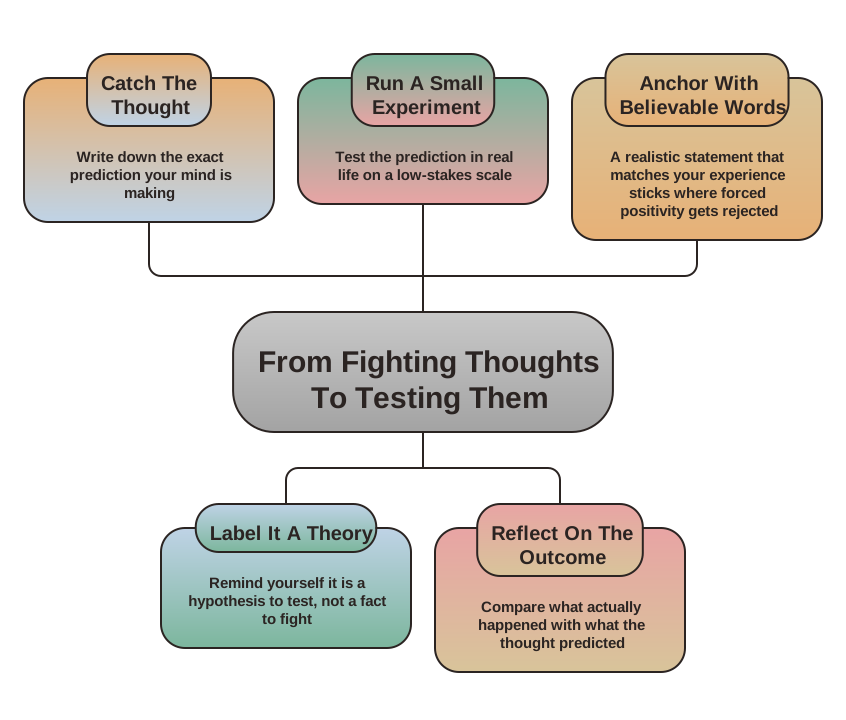
How to Start Using CBT + Affirmations in Daily Life
A 5-step routine for testing thoughts instead of fighting them
Catch the thought
Write it down as soon as you notice it.
Label it as a theory
Remind yourself: "This is not fact, it's just a thought."
Design a small experiment
Test the prediction in real life, at low stakes.
Reflect on the outcome
What really happened? Was your thought accurate?
Anchor with a realistic affirmation
Repeat one that matches your experience.
Pro Tip: Example: after noticing people didn't criticize your idea, you might repeat, "I can share my thoughts without everything falling apart."
Final Thoughts
The next time you feel stuck in a thought spiral, skip the pressure of "be positive." Instead, get curious. Test your thoughts, gather evidence, and remind yourself with grounded affirmations that you don't need to fight every idea that crosses your mind. If anxiety itself is what's driving the spiral, pairing this with a few breathing techniques for anxiety relief can help calm the body while you work on the thought.
This blend of CBT and affirmations is more than positive thinking — it's practical mental training that helps you calm anxiety and build long-term resilience.
MindLift is built for the moment a thought needs testing, not fighting — name it and get a Realist, Growth, and Compassionate reframe in about 60 seconds. Free to start, premium available. Try MindLift — free to start →
Frequently asked questions
Why doesn't positive thinking work for anxiety?
Positive thinking often backfires because your brain resists unrealistic affirmations. When you tell yourself 'I'm totally calm' while your heart races, it feels false and your mind rejects it. Research on thought suppression shows that pushing thoughts away can actually make them rebound stronger.
What is CBT and how is it different from positive thinking?
CBT (Cognitive Behavioral Therapy) treats thoughts as hypotheses to test, not facts to fight. Instead of forcing positivity, CBT encourages curiosity about your thoughts and uses behavioral experiments to gather real evidence about your fears and assumptions.
What is a behavioral experiment in CBT?
A behavioral experiment is a real-life test of your anxious prediction. For example, if you think 'Everyone will judge me if I speak up,' you might test this by sharing one small idea in a meeting and observing the actual reactions versus your predicted catastrophe.
How are CBT affirmations different from regular positive affirmations?
CBT-informed affirmations are realistic, believable, and values-based rather than overly optimistic. Examples include 'I can handle uncertainty, one step at a time' or 'Mistakes don't define me—they help me grow.' They reduce pressure instead of creating it.
Like what you're reading?
Take control of your mental wellness
Reframe the thought that started it — personalized CBT reframes in the MindLift app.


Free to start · premium optional