
Turn this into a daily habit — free to start in the MindLift app:
Quick Answer
Why am I so hard on myself?
Being hard on yourself is a learned pattern, not a personality trait. The inner critic developed as a coping mechanism to prevent mistakes — but it applies the same harsh standards to everything, including things that don't deserve that level of scrutiny.
What Is the Inner Critic?
The inner critic is the internal voice that judges, criticizes, and second-guesses your actions — often harshly, and often automatically. It's not a personality flaw. It's a learned pattern, usually developed as a coping mechanism, that became the default way your mind responds to uncertainty or perceived failure.
A harsh inner voice doesn't just notice mistakes — it turns them into evidence of something being fundamentally wrong with you. "That was awkward" becomes "I'm always awkward." "I didn't do that well" becomes "I'm not good enough."
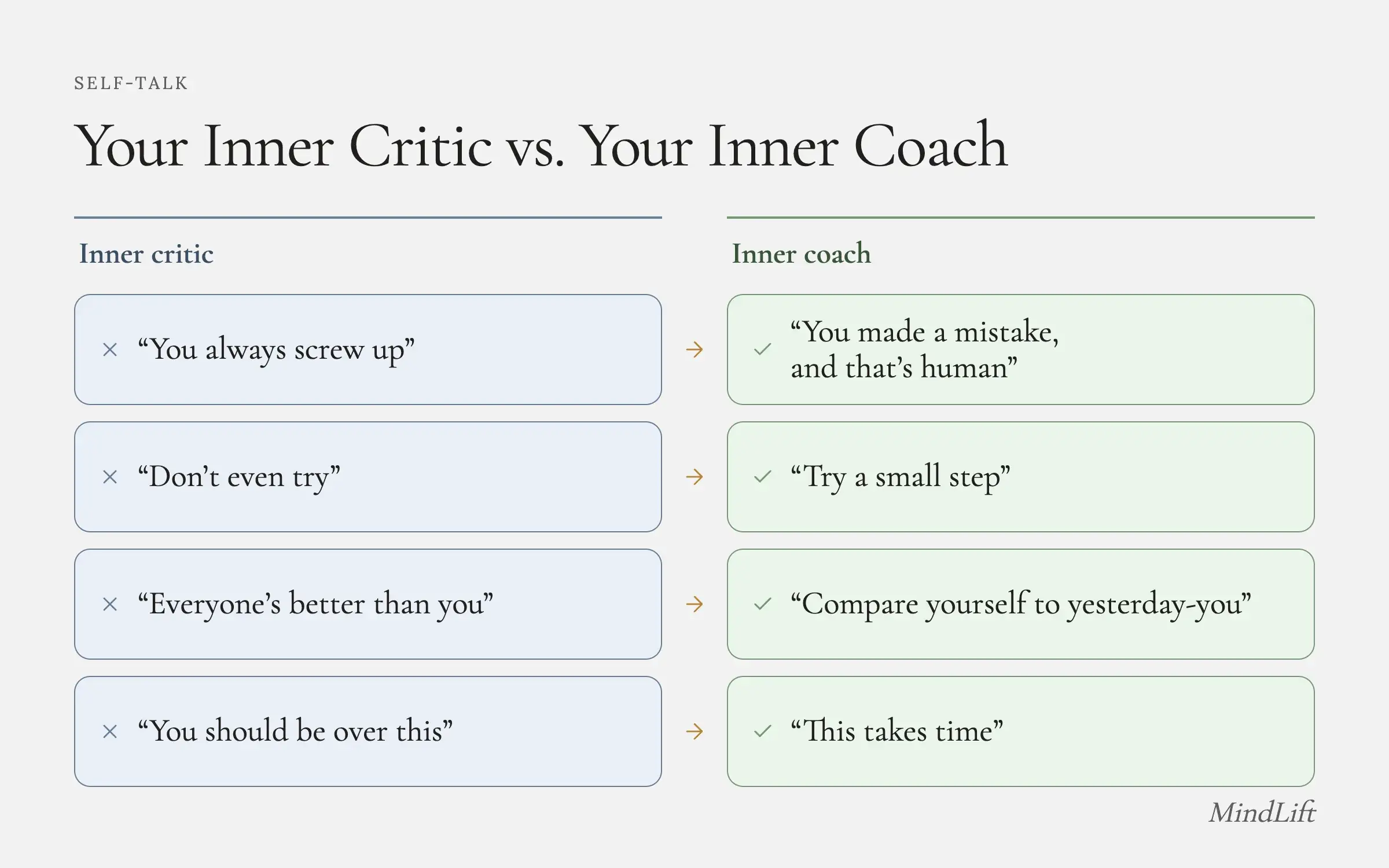
You already know how to give good advice. You just lose access to it the moment the problem is yours.
When a friend spirals, you're calm, wise, almost therapeutic. When you spiral, your inner voice suddenly sounds like an unqualified prosecutor.
This isn't a personality flaw. It's a well-documented psychological effect called Solomon's Paradox.
Why Your Inner Critic Sounds So Convincing
Solomon's Paradox describes a strange asymmetry in human thinking: we reason wisely and calmly about other people's problems, but emotionally and narrowly about our own. If your default voice is especially sharp, the Inner Critic Quiz can help you name how intense it is. This is also why you keep replaying conversations — the critic is running commentary on top of the memory, adding a verdict the original moment never had.
The name comes from King Solomon, legendary for his wisdom when advising others, yet famously reckless in his own life.
The reason is not lack of insight. It's emotional immersion.
When the problem is yours:
- Emotions flood working memory
- Threat systems light up
- Perspective collapses into "this is urgent and personal"
Your inner critic isn't evil. It's your brain stuck in close-up mode.
The Language Trick That Changes Everything
Here's the surprisingly simple intervention:
Stop talking to yourself as "I". Start talking to yourself as "you" (or by your name).
Instead of:
- "Why am I always like this?"
- "I'm messing everything up."
Try:
- "You're overwhelmed right now."
- "Alex, you've handled harder things than this."
This is called distanced self-talk.
It sounds small. It's not. This works even better when you combine it with supportive coach language.
Why This Works (The Brain Science, Simply)
Language is not just expression. It's a control lever.
When you use "I":
- The brain treats the situation as immediate threat
- Emotion dominates reasoning
- Rumination loops tighten
When you use "you" or your name:
- The brain subtly shifts perspective
- Emotional intensity drops
- The reasoning system for friends comes back online
Psychologists describe this as a move from immersed to observer perspective.
You are no longer inside the storm. You're standing just far enough away to think.
That distance is where wisdom lives.
From Inner Critic to Inner Coach
Notice the difference in tone.
Inner Critic (immersed):
"You're failing. This proves you're not good enough."
Inner Coach (distanced):
"You're discouraged because this matters to you. Let's slow this down and take the next step."
Same facts. Different voice. Different outcome.
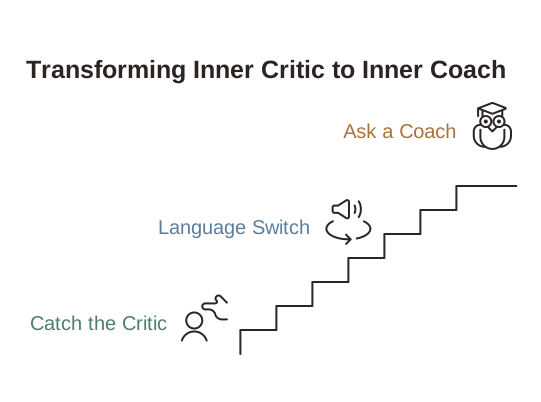
Distanced self-talk doesn't sugarcoat reality. It organizes it.
A 30-Second Exercise You Can Try Right Now
- Think of a problem that's bothering you.
- Write one sentence your inner critic says (using "I").
- Rewrite the same sentence using:
- "You", or
- Your own name.
Example:
- "I'm completely stuck and running out of time."
- "You're feeling stuck because you're under pressure. Let's figure out the first move."
Notice what shifts. Most people feel a drop in intensity, not motivation.
That's the paradox: calm makes action easier.
This Is Not Positive Thinking
Important distinction.
This is not affirmations like "I am amazing" when you don't believe it. It's cognitive repositioning.
You're not lying to yourself. You're changing where you're speaking from.
- From judge → coach
- From panic → perspective
- From noise → signal
Why This Matters for Mental Health
Unchecked inner criticism:
- Fuels anxiety and overthinking
- Shrinks perceived options
- Turns normal stress into identity attacks
Distanced self-talk:
- Reduces emotional reactivity
- Improves problem-solving
- Builds self-trust over time
It's one of the rare tools that works in the moment, not just in reflection.
How MindLift Uses This Principle
MindLift trains this exact shift.
Instead of forcing positivity, it helps you:
- Step out of emotional immersion
- Reframe thoughts in a realistic, compassionate voice
- Turn your inner dialogue into something that actually helps
Not louder motivation. Clearer thinking.
Final Thought
You don't need a new mind. You need a little distance from the one you already have.
And sometimes, the difference between an inner critic and an inner coach is just one word.
"You."
Frequently asked questions
What is Solomon's Paradox?
Solomon's Paradox is the psychological finding that we reason more wisely and calmly about other people's problems than our own. Named after King Solomon who was wise for others but reckless in his own life.
What is distanced self-talk?
Distanced self-talk is speaking to yourself using 'you' or your own name instead of 'I'. This creates psychological distance, reduces emotional reactivity, and activates the same reasoning you'd use to help a friend.
Why does saying 'you' instead of 'I' help with negative thoughts?
When you use 'I', your brain treats the situation as an immediate threat. Using 'you' or your name subtly shifts perspective, drops emotional intensity, and brings back the reasoning system you use for friends.
How is distanced self-talk different from positive affirmations?
Distanced self-talk isn't about lying to yourself with unrealistic positivity. It's cognitive repositioning—changing where you speak from, moving from judge to coach, from panic to perspective.
Like what you're reading?
Take control of your mental wellness
Reframe the thought that started it — personalized CBT reframes in the MindLift app.


Free to start · premium optional