
Turn this into a daily habit — free to start in the MindLift app:
There's a particular kind of exhausting that doesn't have a good name yet. It's not sadness. It's not anxiety exactly, though it lives close to it. It's the feeling of being in something good — genuinely good, the kind of relationship you used to want — and spending most of your energy waiting for it to end.
You watch for signs. You interpret silences. You notice when they seem slightly less warm than yesterday and you file it away. You have full conversations in your head about things that haven't happened. You brace, constantly, for the version of events where this turns out to have been a mistake. And the cruelest part is that you know you're doing it. You can see yourself doing it. You just can't stop.
This isn't a character flaw. It's not proof that you're broken, or too damaged, or incapable of healthy love. It's what a nervous system does when it learned, at some point, that love comes with a catch.
What Anxious Attachment Actually Is
Attachment theory — developed by psychologist John Bowlby and expanded by researchers like Mary Ainsworth — describes the different ways people relate to closeness based on their earliest experiences of it. When caregiving was consistent and responsive early in life, people tend to develop a secure attachment style: comfortable with intimacy, able to tolerate distance without catastrophizing, trusting that relationships can survive conflict.
When caregiving was inconsistent — sometimes warm, sometimes withdrawn, sometimes loving and sometimes frighteningly unavailable — something different gets wired in. The nervous system learns that love is unpredictable, that closeness can be withdrawn without warning, and that the right response to connection is not relaxation but vigilance.
This is anxious attachment. And it doesn't stay in childhood — it follows you into every adult relationship, running quietly in the background, filtering every interaction through one question: is this about to be taken away? For some it looks like constant reassurance-seeking. For others, hypervigilance — scanning messages for tone, reading into response times. For others, self-sabotage: pulling away first, creating conflict to test the relationship's durability. All of it comes from the same place — a nervous system that learned the threat of losing love is real, and that staying alert is the only way to survive it. (If you're not sure this is your pattern, the anxious attachment quiz can help you see it clearly, and the full write-up of the anxious attachment style covers what it looks like day to day.)
Why Your Current Partner Is Paying for Someone Else's Behavior
Here's the part that's hard to sit with: the person you're waiting to hurt you is usually not the person who hurt you. The ex who disappeared. The parent who was emotionally unpredictable. The person who told you they loved you and then behaved in ways that made you doubt everything. They're gone — but your nervous system didn't get the update.
Threat responses aren't rational. They're pattern-matching. Your brain learned a pattern —closeness leads to pain — and applies it to every subsequent experience of closeness, regardless of whether the new person has given you any evidence to support it. So your partner sends a short reply because they're in a meeting, and your brain reads abandonment. They seem distracted at dinner and your brain reads withdrawal. None of this is about them. All of it is about a story your nervous system wrote a long time ago and hasn't updated since.
Psychologists call this a core belief schema — a foundational assumption about how relationships work that filters incoming information to confirm itself. If your schema is people I love will eventually leave, you'll unconsciously find evidence for that wherever you look, and dismiss evidence to the contrary as temporary. It's not manipulation or weakness. It's how traumatized nervous systems stay safe. The problem is that safety, here, means never fully arriving in the relationship you're actually in. It often overlaps with low self-esteem in relationships — the quiet belief that you're not enough to keep them.
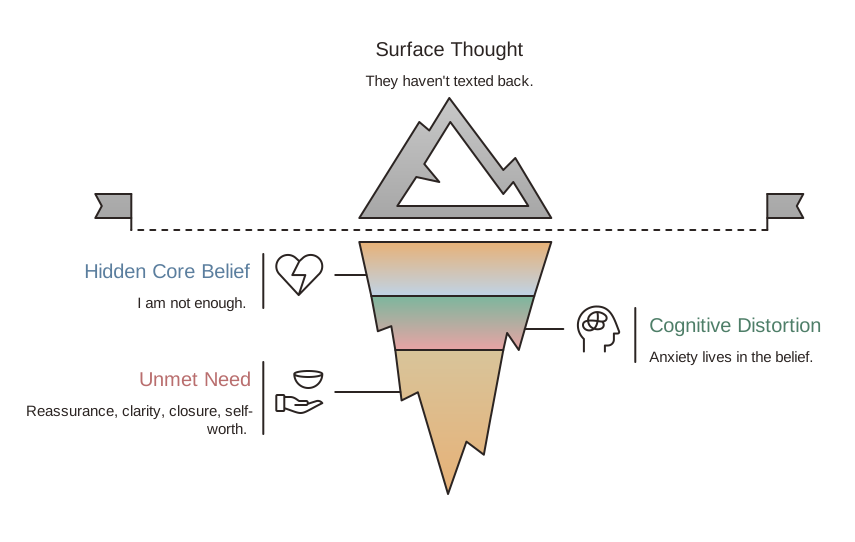
The Spiral, Step by Step
Understanding the mechanics helps. Here's what's usually happening when the waiting takes over:
- The trigger. Something ambiguous happens — a short text, a cancelled plan, a moment of distance. In a secure relationship this registers as minor. In an anxiously attached nervous system, it registers as a potential threat.
- The story. Your brain constructs a narrative — not the most likely explanation, the most feared one. They're pulling away. This is how it started last time. It feels like insight, like you're being realistic. That's what makes it hard to interrupt.
- The scan. You look for evidence. You reread messages, replay interactions for what you missed. Everything that confirms the story gets weight; everything that contradicts it gets explained away.
- The behavior. Now you act from the story, not reality. You go quiet or demanding. You test. You ask questions designed to get reassurance while pretending they're casual. Your partner, sensing something is wrong but not understanding what, responds in ways that can be read as confirmation.
- The loop. That response — confusion, mild frustration, distance — feeds back into the original fear. See, I knew something was wrong. The spiral completes and starts again.
The tragedy is that anxious attachment is one of the few self-fulfilling prophecies that actually works. The behaviors that come from the fear of losing the relationship are often the ones most likely to strain it.
What You Can Actually Do
There's no version where you read one article and the pattern dissolves. Attachment styles were built slowly and shift slowly. But they do shift. This is not a life sentence.
Name the trigger, not the story
When the spiral starts, separate what happened from what you added. They took three hours to reply is what happened. They're losing interest and this is probably ending is what you added. Naming it — I'm in a spiral right now, triggered by X — activates the prefrontal cortex and pulls processing away from the amygdala's alarm. You're not suppressing the feeling; you're refusing to let the story run unchecked.
Ask what a secure person would think
Once you've identified the story, ask: what would someone who trusted this relationship think about the same situation? Not a fantasy person — just someone whose baseline is that their partner probably isn't abandoning them over a slow reply. Their interpretation is usually boring. And boring is usually correct.
Interrupt the reassurance-seeking loop
Reassurance feels like relief. It isn't. Every time you seek it and receive it, you train your brain that the threat was real and that checking was necessary — the relief is temporary, and the need returns faster and stronger. This doesn't mean don't communicate. It means notice the difference between communicating genuinely ("I'm feeling anxious and I don't fully know why") and seeking reassurance as an anxiety-management strategy. One builds intimacy; the other erodes it quietly.
Get the thought outside your head
Anxious thoughts get louder in isolation — they loop, gather detail and weight. One of the most effective things you can do mid-spiral is externalize the thought: write it down, say it out loud, put it somewhere you can look at it. This is the core mechanic behind tools like MindLift. You take the exact thought — he's been distant all week and I think he's losing feelings— and get back reframes built from what you actually said: a realistic one, a growth-oriented one, a compassionate one. Not affirmations. Just the more complete version of the story your brain is only telling you halfway. The cognitive restructuring worksheet walks through the same process in full. It doesn't fix the attachment pattern — it interrupts the spiral before it takes the next two hours from you, and that interruption, repeated, builds a different reflex.
Consider that safety might not look like you think
People with anxious attachment often describe security as a feeling they're waiting to arrive — something they'll feel once their partner proves trustworthy enough. It doesn't work that way. Security isn't something your partner gives you; it's something you build in yourself through the repeated practice of not letting the spiral finish. Every time you catch the story early, question it, and choose not to act from it, you build evidence that you can tolerate uncertainty without catastrophizing. That's what security actually is. Not certainty. Tolerance of uncertainty.
On Punishing Good Relationships for Old Wounds
The person you're with has probably done something to earn your trust — shown up consistently, or tried to. Been patient with your spirals, or tried to. And you've probably, at least occasionally, made them prove it over and over in ways that exhaust both of you.
That's not something to feel guilty about — guilt doesn't help here, and you've probably spent enough of it on yourself already. But it's something to be honest about. The work of anxious attachment isn't just about your own relief; it's also an act of fairness toward someone who is present, who chose you, who is not the person who taught you to wait for everything to fall apart.
You learned to protect yourself from a threat that existed. The threat is gone. The protection is still running. Updating it is slow — it takes patience with yourself on the days the spiral wins, tools, practice, and probably some professional support alongside both. But it's possible. And the relationship you're already in might be better than your nervous system is currently letting you experience it. That's worth something. That's worth starting.
Frequently asked questions
Why do I always wait for my relationship to fall apart?
Usually it's anxious attachment. When early caregiving was inconsistent — sometimes warm, sometimes withdrawn — the nervous system learns that love is unpredictable and that closeness can be taken away without warning. So instead of relaxing into a good relationship, it stays vigilant: scanning for signs, interpreting silences, bracing for the end. It's not a flaw or proof you're broken; it's a protection pattern that made sense once and is still running now.
What is anxious attachment?
Anxious attachment is one of the attachment styles described in attachment theory (Bowlby, Ainsworth). It develops when early caregiving was inconsistent, wiring the nervous system to treat closeness as something that could be withdrawn at any moment. In adult relationships it shows up as reassurance-seeking, hypervigilance (reading into tone, response times, micro-expressions), or self-sabotage (pulling away first, testing the relationship). All of it traces to one background question: 'is this about to be taken away?'
Why do I sabotage good relationships?
Anxious attachment is one of the few self-fulfilling prophecies that actually works: the behaviors that come from the fear of losing the relationship — testing, withdrawing, demanding reassurance — are often the behaviors most likely to strain it. Your brain runs a learned pattern ('closeness leads to pain') and acts from the feared story rather than reality. The partner, sensing something is wrong but not understanding what, responds in ways that can be read as confirmation, completing the loop.
How do I stop anxious attachment spirals?
Attachment styles shift slowly, but they do shift. What moves the needle: name the trigger, not the story (separate what happened from what you added); ask what a secure person would think about the same situation (the boring interpretation is usually correct); interrupt the reassurance-seeking loop (relief is temporary and trains the brain that checking was necessary); get the thought outside your head; and reframe security as tolerance of uncertainty you build, not certainty a partner gives. Repetition, plus professional support, is what rewires it.
Like what you're reading?
Build kinder inner dialogue
The way you talk to yourself shapes every relationship. MindLift helps you soften that voice.


Free to start · no account required
Mental Wellness Writers
The MindLift Wellness Team writes evidence-based content on CBT, self-talk, and everyday mental health tools.
Was this article helpful?