
Turn this into a daily habit — free to start in the MindLift app:
For many people, texting should be simple.
But if you have an anxious attachment style, a single unanswered message can quickly spiral into worry.
You might notice thoughts like:
- "Did I say something wrong?"
- "Why are they taking so long to reply?"
- "Maybe they're losing interest."
Within minutes, your brain may start replaying the conversation or imagining worst-case scenarios.
This experience is called texting anxiety, and it's especially common in people with anxious attachment patterns. See how it plays out in real life in this before/after story about anxious attachment in a good relationship. If the spiral tends to hit hardest at night, pair this with overnight affirmations for anxious attachment.
The good news is that once you understand why it happens, it becomes much easier to manage.
What Is Anxious Attachment?
Anxious attachment is a relationship pattern where people become highly sensitive to signs of rejection or distance.
Instead of feeling secure that the connection is stable, the brain stays alert for signals that something might be wrong.
This can lead to:
- Overanalyzing messages
- Worrying about response time
- Rereading texts repeatedly
- Feeling emotional highs and lows based on replies
Texting amplifies these patterns because communication happens with delays and ambiguity.
Your brain fills the silence with stories.
Why Texting Triggers Overthinking
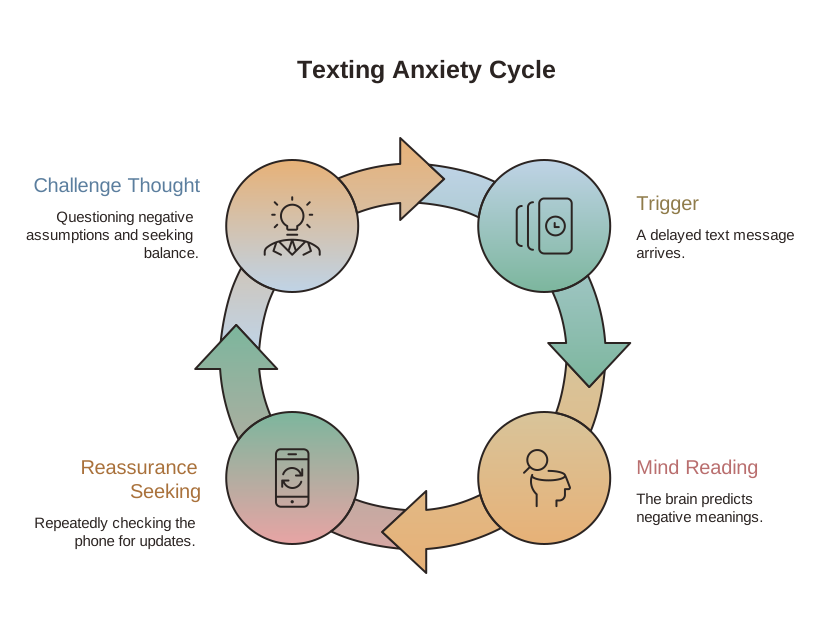
Text messages remove many social cues that help us feel secure in conversation.
You can't see:
- Facial expressions
- Tone of voice
- Body language
When the brain lacks information, it tries to predict meaning.
If you have anxious attachment, the brain often predicts the most threatening explanation. That's a close cousin of the mind-reading distortion described in CBT.
For example:
Delayed reply → "They must be annoyed with me."
In CBT, this pattern is called mind reading — assuming you know what someone else is thinking without evidence.
5 Signs You're Experiencing Texting Anxiety
1You Check Your Phone Repeatedly
You might open the chat multiple times even when you know there's no new message.
Your brain is searching for reassurance.
2You Replay Your Message Over and Over
After sending a text, you may reread it repeatedly wondering if it sounded awkward.
Small details suddenly feel important.
3You Assume the Worst
A delayed response quickly turns into thoughts like:
"Maybe they're losing interest."
This is a classic example of catastrophizing.
4Your Mood Changes Based on Replies
A quick response can make you feel calm and connected.
A slow response can create anxiety or self-doubt.
5You Draft and Redraft Messages
You might spend a long time editing texts to avoid sounding "too much" or "too needy."
This happens when the brain is trying to prevent rejection.
How to Calm Texting Anxiety
You can't control when someone replies, but you can change how your brain responds during the waiting period.
1Challenge Mind-Reading Thoughts
When your brain says: "They're ignoring me."
Pause and ask: "What other explanations are possible?"
Often the answer is simple: they're busy, they're driving, they haven't seen the message yet.
2Set a "Phone Check Boundary"
Constantly checking your phone keeps the anxiety loop active.
Try giving yourself a rule like: "I'll check messages again in 15 minutes."
This helps break the habit of reassurance seeking.
3Shift Attention to the Present Moment
Instead of waiting and watching the screen, redirect attention:
- Take a short walk
- Start a small task
- Listen to music
- Focus on your breathing
This interrupts the rumination cycle.
4Normalize the Pause
Not every message needs an immediate reply.
Healthy communication includes space between responses.
A delay does not automatically signal rejection.
5Use Supportive Self-Talk
Instead of thinking: "They must be upset with me."
Try a more balanced thought:
"Right now I don't have enough information."
This reduces emotional intensity while staying realistic.
A Small Tool That Helps Interrupt Texting Spirals
When texting anxiety starts, the hardest part is interrupting the thought loop.
The MindLift app was designed to help with moments like this.
It offers short, grounded mindset resets such as:
- "Not every pause means rejection."
- "A message doesn't define the relationship."
- "My mind is filling gaps with stories."
These gentle reframes help your brain step out of rumination faster.
Final Thought
Texting anxiety isn't a sign that you're "too sensitive."
It's often a reflection of how the brain tries to protect important relationships.
Learning to notice these patterns and respond with more balanced thinking can make communication feel much calmer.
And over time, those spiraling thoughts lose their power.
A delayed reply is not a verdict. It's just a pause.
Not sure which attachment style is driving the spiral? The free attachment style test sorts you into one of the four types in 10 questions — no email, instant results. If you'd rather read first, here's what anxious attachment actually looks like day to day, and how it compares to the other three attachment styles.
If you want gentle support when texting anxiety hits, you can try MindLift — free to start and see how it feels.
Frequently asked questions
What is texting anxiety?
Texting anxiety is the stress and overthinking triggered by sending or waiting for text messages. It often involves repeatedly checking your phone, rereading messages, catastrophizing about delayed replies, and mood shifts based on response speed. It's especially common in people with anxious attachment styles.
Why does waiting for a text reply cause anxiety?
Text messages remove social cues like tone, facial expressions, and body language. When the brain lacks information, it tries to predict meaning. For people with anxious attachment, the brain often predicts the most threatening explanation — a pattern called mind-reading in CBT.
What is anxious attachment style?
Anxious attachment is a relationship pattern where people become highly sensitive to signs of rejection or distance. Instead of feeling secure that a connection is stable, the brain stays alert for signals that something might be wrong, leading to overanalyzing, worrying about response times, and emotional highs and lows.
How do I stop overthinking about texts?
Challenge mind-reading thoughts by asking 'what other explanations are possible?' Set phone-check boundaries (e.g., wait 15 minutes), redirect attention to the present moment, normalize pauses in conversation, and use balanced self-talk like 'I don't have enough information right now.'
Is texting anxiety a sign of being too sensitive?
No. Texting anxiety is a reflection of how the brain tries to protect important relationships. It's driven by attachment patterns and cognitive distortions, not character flaws. Understanding the pattern makes it much easier to manage.
Like what you're reading?
Build kinder inner dialogue
The way you talk to yourself shapes every relationship. MindLift helps you soften that voice.


Free to start · no account required
- Hazan, C., & Shaver, P. (1987). Romantic love conceptualized as an attachment process. Journal of Personality and Social Psychology, 52(3), 511–524. — DOI (opens in a new tab)
- Mikulincer, M., & Shaver, P. R. (2003). The attachment behavioral system in adulthood: Activation, psychodynamics, and interpersonal processes. Advances in Experimental Social Psychology, 35, 53–152. — DOI (opens in a new tab)
Mental Wellness Writers
The MindLift Wellness Team writes evidence-based content on CBT, self-talk, and everyday mental health tools.
Was this article helpful?