
Turn this into a daily habit — free to start in the MindLift app:
You've been "thinking about it" for three days.
You've made mental lists, run through scenarios, weighed options.
You feel mentally exhausted.
But here's the question: Are you any closer to a solution?
If the answer is no, you're not problem-solving.
You're overthinking.
And the difference between the two determines whether you move forward or stay stuck.
Understanding the Difference
1. Problem Solving Has a Destination. Overthinking Just Circles.
Here's how to tell them apart:
| Problem solving | Overthinking | |
|---|---|---|
| Where it goes | ✅ Moves toward action | ❌ Loops back to the same thoughts |
| What it produces | ✅ Generates new insights or options | ❌ Rehashes information you already have |
| How it feels | ✅ Productive, even if difficult | ❌ Draining and circular |
| What it decides | ✅ Leads to decisions or next steps | ❌ Avoids making a choice |
| Where it ends | ✅ Has a clear goal | ❌ Has no clear endpoint |
If you're re-thinking the same thing for the 12th time without new information or action, you're spiraling — not solving.
2. Overthinking Feels Like Work, But It's Actually Avoidance
Here's the trap:
Overthinking creates the illusion of progress.
You're mentally active. You're engaged. You're "processing."
But nothing is actually changing.
CBT calls this mental avoidance — your brain stays busy to avoid the discomfort of deciding or acting.
Because as long as you're still thinking about it, you don't have to:
🎯 Make a choice (and risk regretting it)
🎯 Take action (and risk failing)
🎯 Face uncertainty (and risk losing control)
Overthinking keeps you in a comfortable holding pattern.
Problem-solving forces you into the unknown.
Practical Application
3. The 5-Minute Test: Am I Overthinking or Problem-Solving?
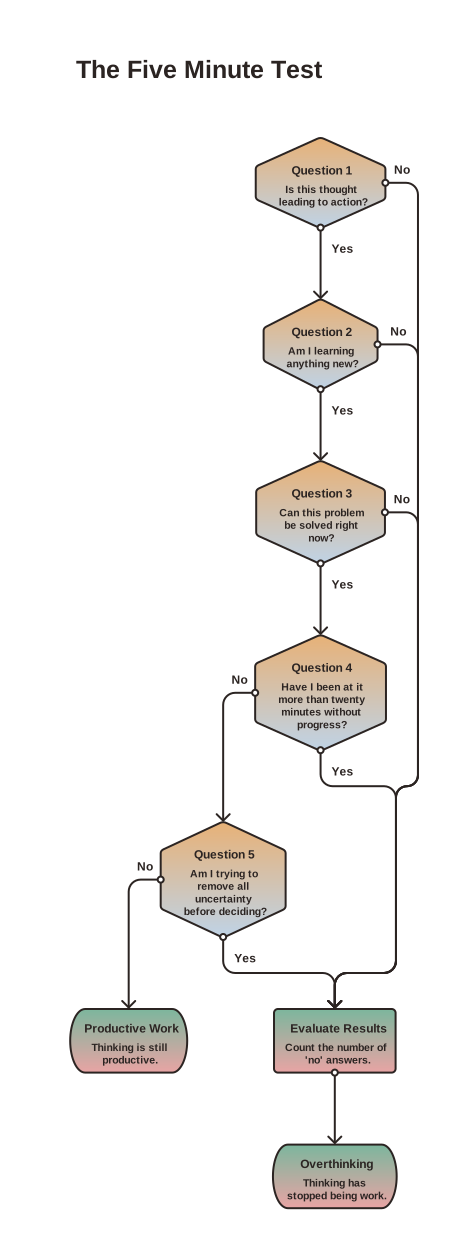
When you catch yourself spinning, ask:
✨ 1. "Is this thought leading to action?"
If yes → problem-solving.
If no → overthinking.
✨ 2. "Am I learning anything new?"
If yes → problem-solving.
If no → overthinking.
✨ 3. "Can this problem be solved right now?"
If yes → solve it or take the next step.
If no → you're ruminating, not solving.
✨ 4. "Have I been thinking about this for more than 20 minutes without progress?"
If yes → you've crossed into overthinking territory.
✨ 5. "Am I trying to eliminate all uncertainty before deciding?"
If yes → overthinking. (Uncertainty is unavoidable.)
4. How to Shift from Overthinking to Problem-Solving
Once you've identified you're overthinking, here's how to redirect:
Step 1: Name it
"I'm overthinking this. This thought pattern isn't helping."
Step 2: Ask a solution-focused question
Instead of: "What if this goes wrong?"
Ask: "What's one small step I can take right now?"
Step 3: Time-box it
"I'll think about this for 10 more minutes, then I'm deciding."
Step 4: Externalize the problem
Write it down. Talk it out. Get it out of your head.
Mental loops thrive in isolation.
Step 5: Choose action over perfection
Pick the best available option and commit.
You can adjust later if needed.
5. Why People Prefer Overthinking to Problem-Solving
Harsh truth incoming:
Overthinking feels safer than solving.
Because when you solve a problem, you have to:
🔥 Accept that you don't have perfect information
🔥 Tolerate the discomfort of uncertainty
🔥 Take responsibility for the outcome
🔥 Risk being wrong
Overthinking lets you avoid all of that.
But it keeps you stuck in a holding pattern where nothing changes.
6. The Bottom Line
Problem-solving asks: "What's the next step?"
Overthinking asks: "What if?"
One moves forward.
The other keeps you frozen.
If your thinking isn't leading to action or new insights, it's not productive — it's a distraction from the discomfort of deciding.
Final Thought
Overthinking masquerades as diligence.
Problem-solving requires courage.
The difference isn't intelligence or thoroughness —
it's whether you're moving toward resolution or just circling to avoid it.
When in doubt: take action.
Even imperfect action beats perfect paralysis.
Frequently asked questions
What's the difference between overthinking and problem solving?
Problem-solving has a destination—it moves toward action, generates new insights, and leads to decisions. Overthinking loops back to the same thoughts, rehashes what you already know, and avoids making a choice. If your thinking isn't producing new information or next steps, it's overthinking.
How do I know if I'm overthinking?
Ask these 5 questions: Is this thought leading to action? Am I learning anything new? Can this problem be solved right now? Have I been thinking about this for more than 20 minutes without progress? Am I trying to eliminate all uncertainty before deciding? If most answers are 'no,' you're overthinking.
Why do people prefer overthinking to problem-solving?
Overthinking feels safer because it delays the discomfort of deciding. Problem-solving requires accepting imperfect information, tolerating uncertainty, taking responsibility for outcomes, and risking being wrong. Overthinking lets you avoid all of that while feeling mentally engaged.
How do I shift from overthinking to problem-solving?
Name it first ('I'm overthinking this'). Then ask a solution-focused question instead of 'What if?' Try 'What's one small step I can take right now?' Set a time limit, externalize the problem by writing it down, and choose action over perfection.
Like what you're reading?
Take control of your mental wellness
Reframe the thought that started it — personalized CBT reframes in the MindLift app.


Free to start · premium optional