
Turn this into a daily habit — free to start in the MindLift app:
You send the text. Then you watch the three dots appear, disappear, appear again. By the time the reply comes — "yeah, all good!" — you've already read it four times, and somehow it's not enough. You ask again, in a different way. "Are you sure everything's okay between us?" They say yes. You feel better. For about twenty minutes.
Then the thought creeps back in, and you're searching for the next thing to ask.
If this feels familiar, you've probably noticed the pattern but maybe never had a name for it: reassurance-seeking. It's one of the most common — and most misunderstood — anxiety behaviors, especially in relationships. It feels like communication. It feels like closeness. It feels, in the moment, like the only thing that will make the anxious feeling stop.
But here's the part that doesn't get talked about enough: reassurance doesn't actually make the anxiety go away. It just rents you a little peace, on a payment plan with terrible interest.
What Reassurance-Seeking Actually Looks Like
Reassurance-seeking isn't always as obvious as "do you still love me?" It shows up in smaller, sneakier forms:
- Asking "was that okay?" after a conversation that already seemed fine
- Re-reading your own texts before sending, then asking a friend to read them too
- Asking the same question in slightly different ways, hoping a different phrasing will produce a more convincing answer
- Apologizing repeatedly for something the other person already said was fine
- Checking in on the relationship's status — "we're good, right?" — especially after small conflicts or silences
- Needing someone to confirm a decision you've already made, multiple times, before you feel able to act on it
What ties all of these together is the function they serve, not the form they take. Each one is an attempt to get external proof that things are okay, because internally, the uncertainty feels unbearable.
And to be clear — none of this makes you "too much," needy, or broken. Reassurance-seeking is a completely understandable response to anxiety. The problem isn't that you're seeking comfort. The problem is that the specific kind of comfort you're reaching for doesn't do what it promises.
Why It Feels Like It Helps (Because, Briefly, It Does)
To understand why reassurance is so hard to stop asking for, it helps to understand why it works at all — at least for a little while.
When you're anxious about something — "did I upset them?", "are they pulling away?", "did I make the wrong call?" — your brain registers that uncertainty as a kind of threat. Not a dramatic, life-or-death threat, but a background hum of something is unresolved and I need it resolved. Asking for reassurance and getting a reassuring answer closes that loop, even temporarily. Your nervous system gets the signal: threat over, you can stand down. The anxious feeling drops. That drop feels like relief, and relief feels like the question worked.
This is the same mechanism behind compulsions in OCD, which is why reassurance-seeking is often described using the same framework: it's a form of checking. The checking behavior — whether it's asking a partner, re-reading a message, or googling a symptom — produces short-term relief, which teaches your brain that the behavior is necessary for relief to happen. The relief becomes the reward. The behavior gets reinforced. Next time the uncertainty shows up, your brain reaches for the same tool, because it "worked" last time.
This is negative reinforcement — a behavior gets repeated not because it leads to something good, but because it makes something uncomfortable go away. And negative reinforcement is one of the most powerful forms of learning there is. It's exactly why reassurance-seeking, once it starts, tends to escalate rather than fade. (It's the same engine behind the read-receipt spiral.)
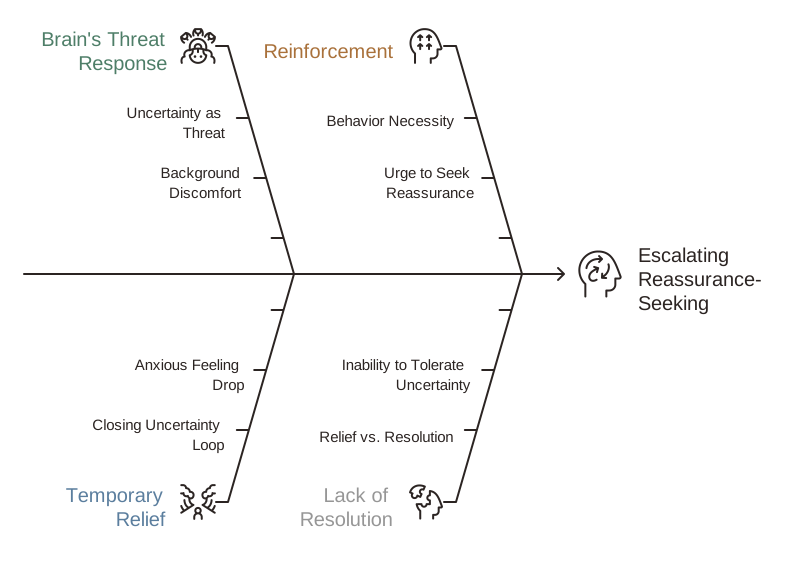
The Catch: Relief Isn't the Same as Resolution
Here's the part that's easy to miss in the moment: the relief you feel after getting reassurance has almost nothing to do with the original question being answered. It has to do with the uncertainty being temporarily closed.
But uncertainty doesn't stay closed. It's not a door you can lock — it's more like a door with no latch, that swings back open the second a new gust of doubt comes through. A new ambiguous text. A slightly different tone of voice. A memory of a past relationship where things seemed fine right before they weren't. Each of these reopens the same uncertainty, and because your brain has learned that reassurance closes it, you go looking for reassurance again.
Researchers who study anxiety disorders describe this as the difference between threat reduction and threat tolerance. Reassurance reduces the feeling of threat right now. It does nothing to build your capacity to tolerate the feeling of threat the next time it shows up — which, inevitably, it will. Each round of reassurance-seeking is a small vote for "I cannot handle this feeling on my own," and over time, that vote shapes how much you trust yourself to handle it.
This is part of why reassurance-seeking tends to get worse, not better, the longer it continues. Not because you're getting "more anxious" as a person, but because the skill that would actually help — tolerating the discomfort of not knowing — never gets a chance to develop. The reassurance keeps arriving just before that skill would need to kick in.
The Relationship Cost Nobody Mentions
There's another layer to this, and it's the one that often hurts the most: reassurance-seeking can quietly strain the relationships it's meant to protect.
From the outside, repeated reassurance requests can start to feel less like connection and more like an audit. The person being asked — "we're okay, right?" for the fifth time this week — often does love you, and does want to reassure you, and also starts to feel a low hum of pressure every time the question comes up. Not because your feelings aren't valid, but because reassurance, by its nature, never feels like enough. There's no answer that permanently satisfies an anxious question, because the question was never really about the specific thing being asked.
Over time, this can create a strange dynamic where the anxious partner feels increasingly unreassured despite getting more reassurance than almost anyone, and the reassuring partner feels increasingly unable to "get it right," despite trying. Both people can end up exhausted, and both can end up feeling like the relationship itself is the problem — when really, it's the strategy that's the problem. (If you tend to brace for the worst in good relationships, waiting for the relationship to fall apart covers the attachment pattern underneath.)
Reassurance-seeking is one of the clearest signatures of a particular attachment pattern — and knowing which pattern you run makes the strategy easier to interrupt. The free attachment style test sorts you into secure, anxious, dismissive-avoidant, or fearful-avoidant in 10 questions — no email, instant results.
This is worth sitting with, because it reframes things in an important way: reducing reassurance-seeking isn't about "needing less" from your relationships. It's about getting the kind of support that actually works, instead of the kind that feels like it works for twenty minutes.
So What Actually Helps?
This is where CBT — cognitive behavioral therapy — offers something genuinely useful, because reassurance-seeking is one of the most well-studied anxiety behaviors out there. The alternatives aren't about gritting your teeth through anxiety alone. They're about building a different relationship with uncertainty itself.
1. Naming the loop, not just the worry
Instead of focusing on the content of the worry ("are they mad at me?"), notice the pattern: "I'm having the urge to ask for reassurance about this." Naming the loop creates a tiny bit of distance between you and the urge — enough space to choose, rather than react automatically.
2. Delaying, not denying
A core CBT technique for compulsive checking is to delay the behavior rather than ban it outright. If the urge is to text "are we okay?", try waiting 20 minutes first. Often, the intensity of the urge drops on its own — which is itself useful evidence that the feeling, left alone, doesn't actually escalate forever. It peaks and comes down, with or without reassurance.
3. Becoming your own source of evidence
A lot of reassurance-seeking is really asking someone else to do a job your own mind could do: weighing the evidence. "Is there actually anything in this conversation that suggests they're upset, or am I responding to a feeling and treating it as a fact?" This is the heart of cognitive restructuring — separating what happened from what your anxiety is telling you it means.
4. Practicing "sitting with" uncertainty on purpose
This sounds uncomfortable because it is, at first. But uncertainty tolerance is a skill, and like any skill, it builds with repetition. Each time you notice the urge to seek reassurance and choose a different response — even a small one — you're providing your nervous system with new evidence: I can feel unsure and still be okay. That evidence is what actually reduces anxiety over time, in a way that reassurance never does.
5. Redirecting the question inward — in the moment it happens
This is the part that's hardest to do alone, because the urge for reassurance often hits at inconvenient moments — late at night, mid-spiral, in the fifteen minutes between sending a text and getting a reply. In therapy, this is the work of a session. In real life, it's the gap between the urge and the 3am text.
Where MindLift Fits In
This is exactly the gap MindLift was built for. When the urge to ask "are we okay?" for the third time hits — or you're rereading a message for the tenth time trying to find the hidden meaning — MindLift gives you somewhere to put that thought immediately, in your own words. It reframes it through a Realist lens (what's the actual evidence here?), a Compassionate lens (what would you say to a friend feeling this?), or a Growth lens (what's a more useful way to hold this?) — all in about 60 seconds.
It doesn't replace the deeper work of therapy, and it's not designed to. But therapy happens once a week, and the urge to seek reassurance happens in real time — at 11pm, mid-spiral, in the space between sending a message and waiting for a reply. MindLift is there for that gap: a way to interrupt the loop before you reach for your phone to ask the question again, so the skill of tolerating uncertainty has a chance to actually build, one moment at a time.
Frequently asked questions
What is reassurance-seeking?
Reassurance-seeking is repeatedly looking for external proof that things are okay because the internal uncertainty feels unbearable. It isn't always obvious — beyond "do you still love me?", it shows up as re-reading your own texts, asking "was that okay?" after a fine conversation, apologizing for things already forgiven, or needing a decision confirmed several times before you can act. What ties them together is the function (closing uncertainty), not the form.
Why doesn't reassurance make the anxiety go away?
Because the relief has little to do with the question being answered — it comes from uncertainty being temporarily closed, and uncertainty doesn't stay closed. A new ambiguous text or tone reopens it. Reassurance reduces the feeling of threat now (threat reduction) but never builds your ability to tolerate the feeling next time (threat tolerance), so the pattern escalates rather than resolves.
How do I stop seeking reassurance in my relationship?
Name the loop, not just the worry ("I'm having the urge to ask for reassurance"). Delay rather than deny — wait 20 minutes before asking, and watch the urge usually drop on its own. Become your own source of evidence (is there anything here that suggests they're upset, or am I treating a feeling as a fact?). And practice sitting with uncertainty on purpose — each time you don't act on the urge, you give your nervous system evidence that you can feel unsure and still be okay.
Is reassurance-seeking the same as OCD?
It's not OCD, but it runs on the same mechanism — it's a form of checking. Like a compulsion, it produces short-term relief that reinforces the behavior, which is why CBT for anxiety treats reassurance-seeking with similar tools (delaying the behavior, tolerating uncertainty). If checking and reassurance-seeking are severe or pervasive, that's worth raising with a professional.
Like what you're reading?
Build kinder inner dialogue
The way you talk to yourself shapes every relationship. MindLift helps you soften that voice.


Free to start · no account required
Mental Wellness Writers
The MindLift Wellness Team writes evidence-based content on CBT, self-talk, and everyday mental health tools.
Was this article helpful?