
The safest ChatGPT prompts for anxiety ask it to help you question one specific thought, not to tell you everything will be fine. Below are 12 prompts built on CBT: a thought record, an evidence check, decatastrophizing and a kinder rewrite. Each one comes with a safety note. Copy them, fill in the brackets, and keep the final word for yourself.
A chatbot is not a therapist, and these prompts don’t turn it into one. They are a way to practice the same steps a CBT worksheet walks you through. For what general chatbots can and can’t do, and what the research says, read can ChatGPT do CBT?
Before you paste anything: protect your privacy
Whatever you type into a general chatbot is recorded by the company that runs it, under that company’s privacy policy. The American Psychological Association advises being extremely cautious with sensitive information, avoiding personally identifiable details, and using settings that limit data sharing or let you delete your data[1].
- Replace names with roles: “my manager,” “my sister,” “a friend.”
- Leave out workplaces, schools, addresses, dates of birth and account or record numbers.
- Don’t paste screenshots of messages or emails. Summarize them in a sentence.
- Describe the thought, not your whole history. The prompts below only need one situation.
- Check the app’s data controls, and delete conversations you don’t want kept.
Five rules for using these prompts safely
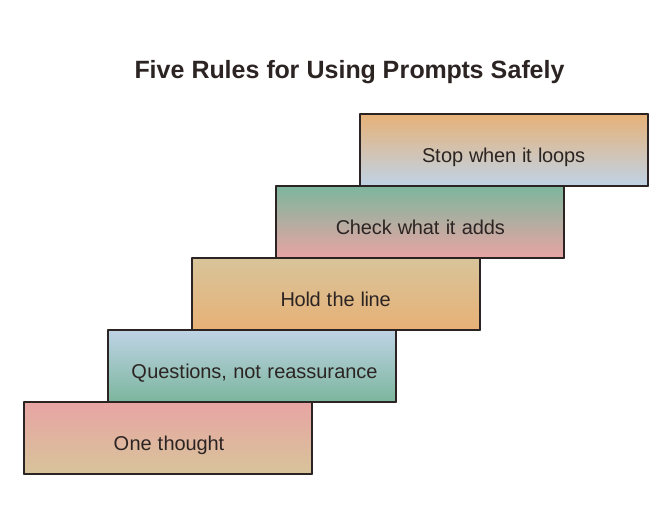
Use one prompt for one thought, ask the chatbot to question rather than reassure, tell it to hold its position, check any fact it adds, and stop when you notice you are asking the same thing again. Language models tend to agree with users and can give way when pushed[3].
- One thought at a time. “I’ll freeze in tomorrow’s meeting” works. “My whole life is falling apart” is too big to test.
- Questions, not reassurance. Every prompt below asks the chatbot to help you check the thought, not to promise you it’s wrong.
- Hold the line. Ask it to stay neutral and keep its position unless you give it new facts.
- Check what it adds. Models can produce fluent text that isn’t supported by anything, a problem known as hallucination[4]. Delete any “fact” you didn’t give it.
- Stop when it loops. If you are on your third version of the same question, close the chat. More talking won’t settle it.
Prompts 1 to 3: catch the thought
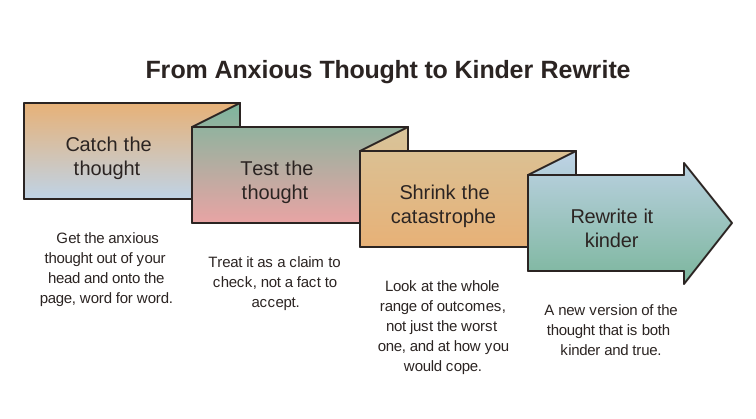
The first step in CBT is to get the anxious thought out of your head and onto the page, word for word. These three prompts turn a vague feeling into a specific thought you can work with, using the structure of a CBT thought record.
1. Build a thought record
Use this when you feel anxious but can’t yet say what the thought is.
Act as a CBT worksheet, not a therapist. Ask me one question at a time to fill in a thought record: the situation, the automatic thought (in my exact words), the emotion and how strong it is from 0 to 100, and the body sensations. Don’t give advice or reassurance yet. When we’re done, show the filled-in record as a short table.
Safety note. Describe the situation in general terms. “A message from my manager” is enough; you don’t need names, places or screenshots.
2. Separate facts from the story
Use this when one event has turned into a long chain of conclusions.
Here is what happened and what I’m telling myself about it: [describe the situation and your thought]. Split this into two lists. List 1: only what a camera would have recorded. List 2: my interpretations, predictions and judgments. Don’t tell me which list is right. Just sort them.
Safety note. If a fact involves your health, money or legal situation, check it with a qualified person. A chatbot can sort what you tell it, but it can’t verify it.
3. Name the thinking trap
Use this to spot the pattern behind the thought, such as catastrophizing or mind reading.
Here is an anxious thought: “[your thought]”. Which common CBT thinking traps (cognitive distortions) might be in it? Name up to two, explain in one sentence each why they might fit, and say how confident you are. If none clearly fit, say so instead of guessing.
Safety note. A label is a hypothesis, not a diagnosis. If the suggested trap doesn’t fit, trust your own read. The cognitive distortions glossary lists all of them.
Prompts 4 to 6: test the thought
Testing a thought means treating it as a claim to check, not a fact to accept. Cognitive restructuring of this kind is a core part of CBT, one of the best-studied treatments for anxiety[2]. These prompts are written to stop the chatbot from simply agreeing with you.
4. Evidence for and against
Use this when a thought feels completely true.
My anxious thought is: “[your thought]”. Help me build two lists: evidence that supports it and evidence that doesn’t. Ask me questions to fill in both lists; don’t invent evidence about my life. Stay neutral. If I push back without giving you new facts, keep your position and say so.
Safety note. Language models tend to give way when the user pushes back, which is why the prompt asks it to hold its position. Notice if it starts agreeing just because you insisted.
5. The neutral observer
Use this when you’re too close to the situation to see it clearly.
Describe this situation from the point of view of a fair, neutral observer who doesn’t know me: [describe the situation in general terms]. What would they notice that I might be missing? What would they say is still uncertain? Keep it to five sentences.
Safety note. Asking a model to take a third-person view reduced its tendency to cave to the user in one 2025 test, but it doesn’t remove it. You are still the judge of what fits.
6. What would you tell a friend?
Use this when your inner voice is much harsher with you than with anyone else.
A close friend tells me: “[your thought, word for word]”. Help me write what I would honestly say back to them: kind, but not dishonest. Then ask me whether the same words could apply to me, and why or why not.
Safety note. If the thought is about not wanting to be here, or about harming yourself, stop and talk to a person. Call or text 988 in the US, or find a local line at findahelpline.com.
Prompts 7 to 9: shrink the catastrophe
Decatastrophizing means looking at the whole range of outcomes, not just the worst one, and at how you would cope. These prompts are for the catastrophizing spiral, and for the overthinking loop where the mind keeps replaying the same problem without solving it.
7. Worst, best and most likely
Use this when your mind has jumped straight to disaster.
I’m worried that [the outcome you fear]. Ask me to describe the worst realistic outcome, the best realistic outcome and the most likely one, one at a time. Don’t tell me the worst won’t happen. Then help me rate how likely each one is, based only on what I tell you.
Safety note. Don’t ask the chatbot to predict real-world odds for medical, legal or money outcomes. It can produce confident numbers that aren’t based on anything.
8. If the worst happened
Use this when “what if” keeps going without an answer.
Suppose the outcome I fear does happen: [the outcome]. Help me write a short, practical coping plan: the first thing I would do, who I could ask for help, and what I have handled before that was similar. Ask me questions rather than filling in details about my life.
Safety note. A plan on paper is not a safety plan. If the outcome you fear involves your safety or someone else’s, talk to a professional or call 988 in the US.
9. Problem-solving or going in circles?
Use this when you’ve been thinking about the same thing for a long time.
I keep thinking about [topic]. Ask me three questions to work out whether I’m solving a problem (there’s a next step I can take) or going in circles (asking the same question with no new information). If it’s a loop, suggest I write the worry down and return to it at a set time, and then end the conversation.
Safety note. The prompt tells the chatbot to end the conversation on purpose. Talking a loop through at length can feed rumination instead of easing it.
Prompts 10 to 12: rewrite it kinder
The last step is a new version of the thought that is both kinder and true. Positive statements you don’t believe can backfire: in one study, people with low self-esteem felt worse after repeating one[6]. These prompts aim for believable, not cheerful.
10. A self-compassionate rewrite
Use this when the thought is a harsh verdict on yourself.
Rewrite this thought in three versions that are kinder but still honest: “[your thought]”. Don’t use toxic positivity, don’t deny the problem, and keep each version under 25 words. After each one, ask me how believable it feels from 0 to 100.
Safety note. If none of the versions feels believable, that is useful information, not failure. Make the thought smaller and truer rather than more positive.
11. Believable, not cheerful
Use this after prompts 4 to 9, when you have the facts in front of you.
Based only on the evidence I listed above, help me write one balanced thought that includes both sides, for example “X is true, and Y is also true.” Don’t add facts I didn’t give you. Then ask me to rewrite it in my own words.
Safety note. Check the balanced thought against what actually happened. If the chatbot slipped in a detail you never mentioned, delete it.
12. One small next step
Use this when the thought has eased and you want to act, not keep thinking.
Given this balanced thought: “[your balanced thought]”, suggest three small actions I could take in the next 24 hours that would take less than 10 minutes each. Make them concrete. Then stop. Don’t ask follow-up questions.
Safety note. Keep actions small and ordinary. If a suggestion involves stopping a medication or changing a treatment, ignore it and ask your doctor.
Prompts to avoid
Avoid prompts that ask a chatbot to reassure you, judge you, diagnose you or advise on medication. The APA warns that chatbots can feed reassurance-seeking, worry and rumination in people with anxiety or OCD, and that they cannot diagnose or treat psychological disorders[1].
- “Tell me it’s going to be okay.” Reassurance helps for a minute and then the doubt returns. See why reassurance doesn’t help.
- “Am I a bad person?” A yes-or-no verdict on your worth isn’t a question a chatbot can answer, and either answer keeps the loop going.
- “Do I have an anxiety disorder?” Only a qualified professional can assess you.
- “Should I stop taking my medication?” Ask the doctor or pharmacist who prescribed it.
- “Pretend to be my therapist.” A role-play doesn’t add training, accountability or the ability to act in a crisis.
When a prompt isn’t enough
Talk to a licensed mental health professional or your doctor if anxiety disrupts your sleep, work or relationships for weeks, or if these exercises stop helping. If you are in danger or thinking about harming yourself, contact emergency services or call or text 988 in the US.
Don’t use a chatbot as a crisis line. In a 2025 study that asked three popular chatbots 30 suicide-related questions, each 100 times, the chatbots avoided direct answers to the highest-risk questions but did not reliably tell apart questions at intermediate levels of risk[5]. If cost is the barrier to getting help, see can’t afford therapy? What actually helps.
A purpose-built option: MindLift
MindLift is a CBT reframing app that does one of these jobs without a prompt. You type one harsh thought, MindLift names the thinking pattern behind it and gives you a kinder, more believable reframe in a Realist, Growth or Compassionate tone, in about 60 seconds.
There’s no open-ended conversation, so there’s nothing to drift into a reassurance loop, and no prompt to get right at 2am. You save the reframes that land to your Favorites and come back to them when the same thought returns. Your thoughts aren’t sold or used for advertising. Read how MindLift AI works for what it does and what it doesn’t.
MindLift isn’t therapy and it isn’t a crisis service. It is a quick tool for the moment a thought hits, alongside, not instead of, professional care when you need it. To practice the same steps by hand, try the 3-step method for reframing a negative thought.
Turn your next anxious thought into a kinder response with MindLift. Free to start, on iOS 15+ and Android 8+.
Download MindLift for iOS and Android
This article is for general information and is not medical advice. The prompts are self-help exercises, not treatment. MindLift is a self-help tool and not a substitute for professional care.
Frequently asked questions
What is a good ChatGPT prompt for anxiety?
A good prompt names one specific anxious thought and asks ChatGPT to help you test it, for example by listing evidence for and against it, rather than to reassure you. It should also ask the chatbot to stay neutral and not just agree with you.
Can I use ChatGPT for a CBT thought record?
Yes, ChatGPT can lay out the columns of a thought record and ask you for the situation, the thought, the feeling and the evidence. You still fill in the answers and judge the balanced thought yourself, because it only knows what you tell it.
Is it safe to tell ChatGPT about my anxiety?
Describing an anxious thought in general terms is lower risk than sharing your full story, because what you type is recorded under the company’s privacy policy. Leave out names and identifying details, check your data settings, and never rely on a chatbot in a crisis.
Why should I not ask ChatGPT for reassurance?
Reassurance eases anxiety for a moment and then the doubt comes back, so you ask again and the worry grows stronger. The American Psychological Association warns that chatbots can feed this kind of reassurance-seeking and rumination in people with anxiety or OCD.
Can ChatGPT replace therapy for anxiety?
No. ChatGPT can help you practice CBT exercises, but it cannot assess you, plan treatment or reliably respond to risk the way a licensed professional can.
How is MindLift different from using ChatGPT prompts?
MindLift is a CBT reframing app built for one task: you type a harsh thought, it names the thinking pattern and returns a kinder, believable reframe in about 60 seconds. There is no open-ended chat, so there are no prompts to write and no conversation to drift into reassurance.
if this one hit close, I'm here next time it happens.
Reframe negative thoughts in 60 seconds — free to start in the MindLift app.


Free to start · premium optional