
Turn this into a daily habit — free to start in the MindLift app:
You sent the message at 7:43pm. By 7:44, you could see it had been read.
It's now 8:12. No reply.
And just like that, your brain is off to the races. Did I say something wrong? Are they mad at me? Maybe they're with someone else. Maybe they're deciding how to end things. Maybe I'm overthinking — but then again, they usually reply fast, so this must mean something...
You haven't moved from the couch. You've checked your phone eleven times. And the conversation playing out in your head has grown into something unrecognizable from a single, unanswered message.
Welcome to the read receipt spiral — one of the most common, most painful, and least talked-about ways that modern technology is quietly feeding relationship anxiety.
The Tiny Feature That Changed Everything
Read receipts were introduced as a convenience. You'd know your message landed. No more wondering if it got lost in the void.
But for anyone who already carries anxiety about relationships — about being too much, not enough, too needy, too distant — read receipts didn't create convenience. They created a real-time window into being ignored.
And the brain doesn't treat that window neutrally.
The moment you see "Read 7:44pm" without a reply, your nervous system doesn't think they're probably just busy. It scans for threat. It pattern-matches against every time you've been left on read before, every relationship that ended quietly, every moment someone pulled away. It starts generating explanations — and anxiety doesn't generate balanced ones. It generates worst-case ones.
This isn't a character flaw. It's threat detection doing its job. The problem is that in relationships, threat detection almost always overshoots.
Why Your Brain Treats Silence Like Danger
Here's what's actually happening neurologically when you're waiting for a reply that doesn't come.
Uncertainty is deeply uncomfortable for an anxious mind. When something important is unresolved — and for people with anxious attachment, a relationship interaction is almost always "important" — the brain doesn't rest. It searches for information to resolve the ambiguity.
In the absence of real information, it manufactures it.
This is why the spiral feels so real. You're not making things up out of nowhere — you're filling an information gap with the most emotionally plausible stories your brain can construct. And those stories are built from your past: the relationships that went cold without warning, the times silence meant something was wrong, the moments where you read the situation right and saved yourself.
The brain thinks it's helping. It's trying to prepare you for a bad outcome so it won't blindside you. But there's a crucial problem with this: the anxiety loop feels like problem-solving, but it isn't. You're not getting closer to the truth. You're just running the same story on repeat, slightly more distressed each time. (This is the same engine behind replaying conversations in your head — a brain stuck in a loop it mistakes for analysis.)
The Four Stages of the Read Receipt Spiral
Most people who experience this recognize the pattern, even if they've never named it:
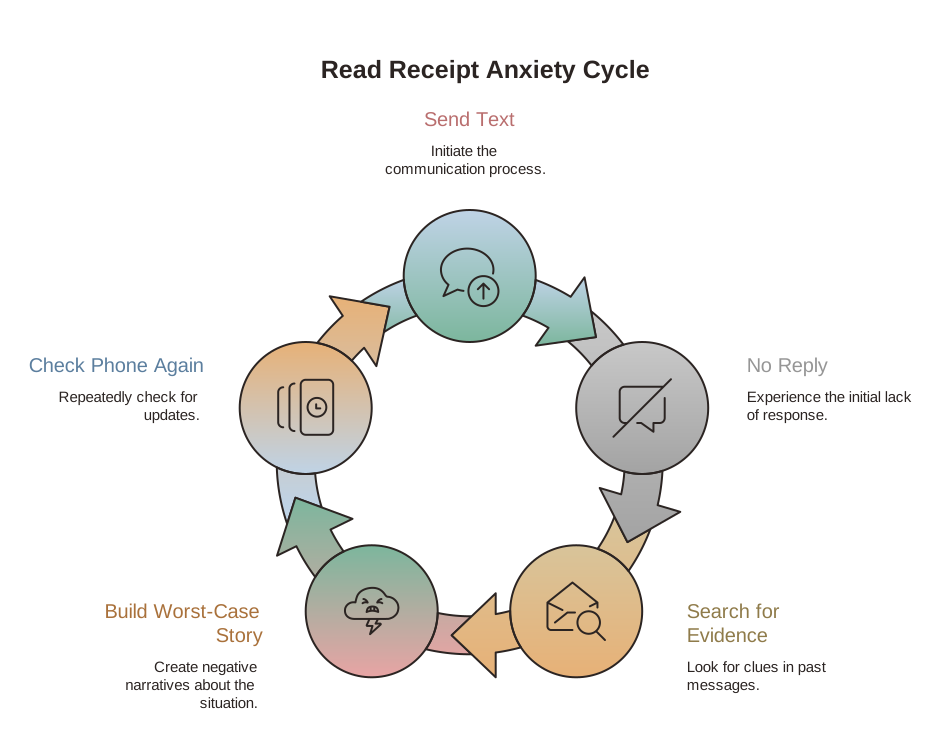
- Stage 1: The trigger. Message read, no reply. Your brain registers the gap between expectation and reality.
- Stage 2: The search. You start reviewing the conversation. Did something you say cause this? You re-read your own words with fresh suspicion. You check their social media to see if they're active. Each data point becomes evidence in a case you're building against yourself.
- Stage 3: The narrative. A story solidifies. It usually centers on something being wrong with you, something being wrong with them, or the relationship being in danger. This story can feel very convincing — not because it's true, but because anxiety gives it emotional weight that feels like certainty.
- Stage 4: The compulsion. You want to resolve the discomfort. So you check again. Or you draft a follow-up message. Or you bring it up when they do reply — in a way that starts a conflict about a conflict that never actually happened.
The cycle can run in minutes or stretch across hours. And the more it runs, the more grooved the pathway becomes. Eventually, read receipts aren't just notification features — they're anxiety triggers with their own conditioned response.
It's Not Just Read Receipts
Read receipts are the most visible version of this, but the same loop runs through a dozen other features we use without thinking.
- Last seen timestamps. They were online four minutes ago and didn't reply. Why? The brain can't let that sit.
- Story views. They watched your story but haven't texted back. Now the silence feels pointed — deliberate.
- Typing indicators. They started typing, then stopped. They were going to say something. What was it? Why did they stop?
- Delivery confirmation. The message delivered but not read. Are they avoiding it? Or just not on their phone?
Every one of these features was designed to add information. And they do — technically. But for an anxious brain, more information doesn't mean less anxiety. It means more data points to interpret, more ambiguity to resolve, more material for the spiral.
The app shows you that something happened. It can never show you why. And "why" is what the anxious mind is always actually asking.
The Hidden Cost Nobody Talks About
Relationship anxiety fed by technology doesn't just feel bad in the moment. It shapes behavior in ways that compound over time.
- You start to pre-edit yourself. If you know your message will show as "read," you choose words more carefully, hedge more, second-guess your own tone before you've even sent anything. The relationship becomes a performance you're constantly monitoring.
- You test without realizing it. You wait before replying to see if they'll notice. You go quiet to see if they'll reach out. You're not trying to manipulate — you're trying to get data. But the tests create the distance they're meant to measure.
- You confuse correlation with meaning. He always replies fast when things are good. He replied slow today. Therefore things aren't good today. This logic feels airtight in the spiral. It's almost never actually causal.
- You exhaust yourself — and sometimes the relationship. By the time they do reply, you've processed a whole emotional crisis they don't know happened. You're either relieved to the point of feeling embarrassed, or you've been in the spiral so long that their perfectly normal reply doesn't land as reassurance. The anxiety moved the goalposts.
What the Spiral Is Actually Asking For
Here's the thing that CBT-based approaches to relationship anxiety make very clear: the spiral isn't really about the read receipt.
It's asking a much older question — one that most anxious people have been asking since long before smartphones existed: Am I safe here? Am I wanted? Will I be left? Read receipts just handed that question a live data feed. (If that question feels familiar, it often traces back to anxious attachment, and to waiting for a good relationship to fall apart.)
Not sure which of the four attachment styles is running your loop? The free attachment style test settles it in 10 questions — no email, instant results. Or read the four styles first: anxious attachment is the one that reads silence as a verdict, while fearful avoidant wants the reply and dreads it at the same time.
When you can interrupt the spiral at the thought level — before it becomes a narrative, before the narrative becomes certainty — you're not just calming yourself down. You're addressing the actual question. And the actual answer is almost always: you don't have enough information yet, and the worst-case story your brain generated isn't evidence.
That reframe sounds simple. In the middle of the spiral, it's genuinely hard. Which is exactly why it helps to have something that can do it with you, using your own words, in real time — rather than trying to logic yourself out of a feeling while the anxiety is still running.
How to Break the Loop Before It Runs
You won't stop noticing read receipts. But you can change what happens next.
Name the spiral when it starts
"I'm in the loop" is enough. Labeling what's happening activates the prefrontal cortex and takes a small amount of fuel from the amygdala. It creates just enough distance to work with.
Delay the search
The urge to check their social media, re-read the conversation, or draft a follow-up message is the anxiety looking for more data to spiral with. Set a ten-minute rule before doing any of those things. Often, the urgency fades.
Challenge the assumption behind the story
The spiral is usually built on an unstated premise: silence means something bad. Is that premise actually true for this person, in this relationship, right now? What else could explain the same data?
Reframe the thought, not just the feeling
Telling yourself to "calm down" doesn't address the thought driving the anxiety. What needs to shift is the interpretation: from this means something is wrong to I don't know what this means yet, and that's okay.
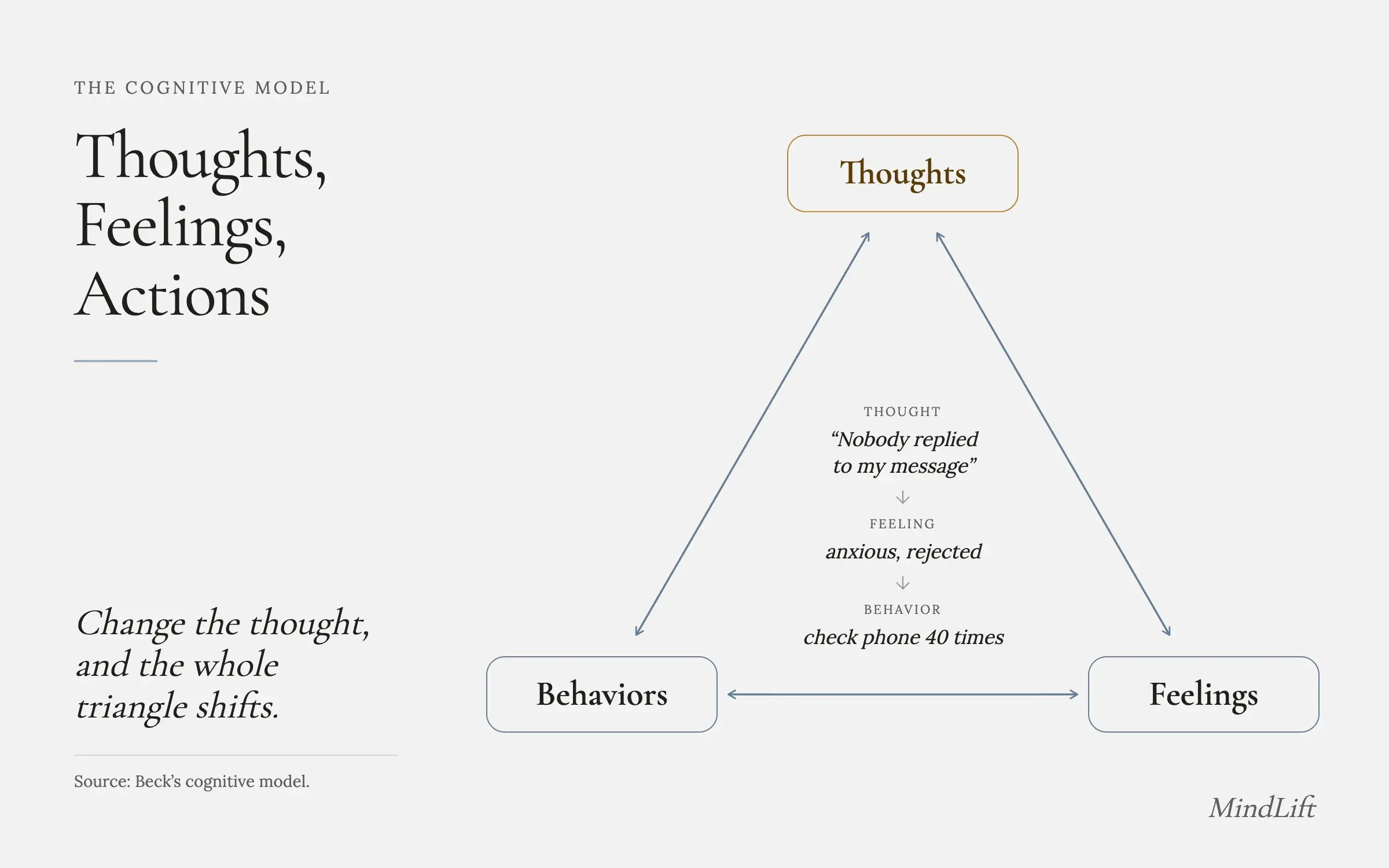
This is exactly where MindLift can help. When you're mid-spiral — three phone checks in, story drafted and deleted, running the worst-case scenario for the fifth time — MindLift takes the exact thought you're stuck in and reframes it across three lenses: realistic, growth-oriented, and compassionate. Not generic affirmations. Your actual thought, reframed. It's the kind of interruption that's hard to do alone when the anxiety already has momentum. That's what it's there for.
A Note on Turning Features Off
Some people find that turning off read receipts — or asking partners to — reduces the anxiety significantly. This is worth trying, especially if the feature is a consistent trigger.
But it's also worth knowing: if the anxiety is driven by attachment patterns, removing one data source often just shifts the spiral to another. The read receipts get replaced by response-time analysis, by story views, by some other form of surveillance the brain finds.
The goal isn't to eliminate all ambiguity from a relationship — that's not possible. The goal is to build enough security that ambiguity doesn't automatically activate the threat system. That's slower work. But it's the work that actually moves the needle.
The Spiral Isn't the Problem — The Loop Is
Feeling anxious when a message goes unanswered isn't something to be ashamed of. It's a very human response to uncertainty in something that matters to you.
The problem isn't the initial feeling. It's the loop — the way anxiety keeps searching for resolution in a place it can never find it, using tools that add data but not clarity, building stories that feel true but aren't.
Breaking that loop starts with recognizing it for what it is: not insight, not instinct, not evidence. Just a brain trying to protect you by running a bad algorithm on incomplete information.
You can interrupt it. You can reframe it. And the more you do, the quieter it gets — until a read receipt is just a notification again, and not a verdict.
Frequently asked questions
Why do I overthink when someone leaves me on read?
Because an unanswered message is ambiguous, and the brain treats unresolved ambiguity in something important as a potential threat. The moment you see "Read" with no reply, your nervous system doesn't default to "they're probably busy" — it scans for danger and pattern-matches against every time you've been left on read before. In the absence of real information, it manufactures the most emotionally plausible explanation, which anxiety makes a worst-case one. It's not a character flaw; it's threat detection overshooting.
What is the read receipt spiral?
It's the loop that runs after a message is read but not answered. It has four stages: the trigger (read, no reply — the gap between expectation and reality), the search (rereading the conversation, checking their activity for evidence), the narrative (a convincing story solidifies, usually that something is wrong with you, them, or the relationship), and the compulsion (you check again, draft a follow-up, or bring it up in a way that starts a conflict that never actually happened). The more it runs, the more grooved the pathway becomes.
Should I turn off read receipts?
It's worth trying — if read receipts are a consistent trigger, removing them can reduce the anxiety noticeably. But if the anxiety is driven by attachment patterns, removing one data source often just shifts the spiral to another: last-seen timestamps, response-time analysis, story views. The deeper goal isn't to eliminate every source of ambiguity (that's impossible) but to build enough security that ambiguity doesn't automatically activate the threat system.
How do I stop spiraling when someone doesn't text back?
Name the spiral when it starts ("I'm in the loop") to create distance. Delay the search — set a ten-minute rule before checking their socials or drafting a follow-up, and the urgency often fades. Challenge the unstated premise that silence means something bad: is that actually true for this person, right now? Then reframe the interpretation, not just the feeling — shift from "this means something is wrong" to "I don't know what this means yet, and that's okay."
Like what you're reading?
Build kinder inner dialogue
The way you talk to yourself shapes every relationship. MindLift helps you soften that voice.


Free to start · premium optional