
Turn this into a daily habit — free to start in the MindLift app:
You already know the reframe.
You have read that catastrophizing is a distortion. You have been told to ask yourself what you would say to a friend. Maybe you have written it in a notebook: He didn’t reply because he’s busy, not because he’s done with me. And for about four minutes, it worked.
Then Tuesday came, and your manager used the word “chat” in a calendar invite, and the whole machine started up again from scratch.
This is the part almost nobody explains properly. A reframe is not a fix. A reframe is one rep. What changes how you think is not any single good sentence you produce at 2am — it is what happens to that sentence afterwards, and whether you ever get to see the shape of the thing you keep doing.
MindLift is built as a loop for exactly that reason. Five steps, and each one hands something to the next. Here is the whole thing, in order, and how to run it.
Why one reframe never sticks
Your anxious thoughts are not random. They run on a small number of grooves, worn deep by repetition. Cognitive behavioural therapy calls these cognitive distortions — catastrophizing, mind-reading, all-or-nothing thinking, personalization, and a handful of others. Most people who spiral are only really using two or three of them, over and over, in different costumes.
That is good news, because it means the target is smaller than it feels. You are not fighting a thousand different thoughts. You are fighting maybe two habits of interpretation.
But you cannot fight what you cannot see. And you cannot see your own pattern from inside a single bad night. In the moment, the thought does not present itself as “mind-reading, episode 47.” It presents itself as the truth about what just happened. That is the whole trick of a distortion: it does not feel like a distortion, it feels like clarity.
So the job splits into two halves that most apps only do one of. Half one: handle the thought in front of you right now, so tonight is survivable. Half two: keep enough of a record that after three weeks you can look at the thing from above and say — oh. It is this one. It has always been this one.
A journaling app gives you the first half and a pile of unreadable text. A meditation app gives you neither, just a gentler nervous system to have the same thought in. The loop gives you both, and connects them, so each pass makes the next one easier.
Step 1: Catch it — the reframe
You open the Reframe tab with whatever is actually in your head. Not the tidy version. The raw one. The box asks one question — what’s spiraling? — and tells you nobody else will read the answer.
A reframe, start to finish
I’m going to get fired on Monday.
Spiral caught · Fortune telling
What specifically happened, before your mind explained it?
What is the evidence for the conclusion — and what is the evidence you are skipping past?
If this were happening to someone you like, what would you actually think?
She put a meeting in my calendar with no subject line. Last time that happened it was about a project handover. Nobody has said anything about my work.
Your reframed thought
She scheduled a meeting without a subject line. That’s all I actually know. I’ll find out at 11.
What happens in the middle is the part people do not expect from an app. It does not tell you that is not true. It does not tell you to breathe, or remind you that you are doing great. Reassurance is the fastest-acting and shortest-lasting drug in mental health — it drops the anxiety for a minute and teaches your brain that the thought needed answering by somebody else.
Instead it names the mechanism — fortune telling, mind-reading, all-or-nothing — and then asks the questions a good therapist would: what actually happened, what supports the conclusion, what would you think if it were someone else. You answer. You do the work. The app’s job is to hold the structure so you do not drift back into the spiral halfway through, which is what happens every single time you try to do this in your head. If you want the method on paper first, it is the same three-step CBT reframe.
At the end, you get one line. Not an affirmation — a sentence you would genuinely say out loud, with the pattern it caught written above it.
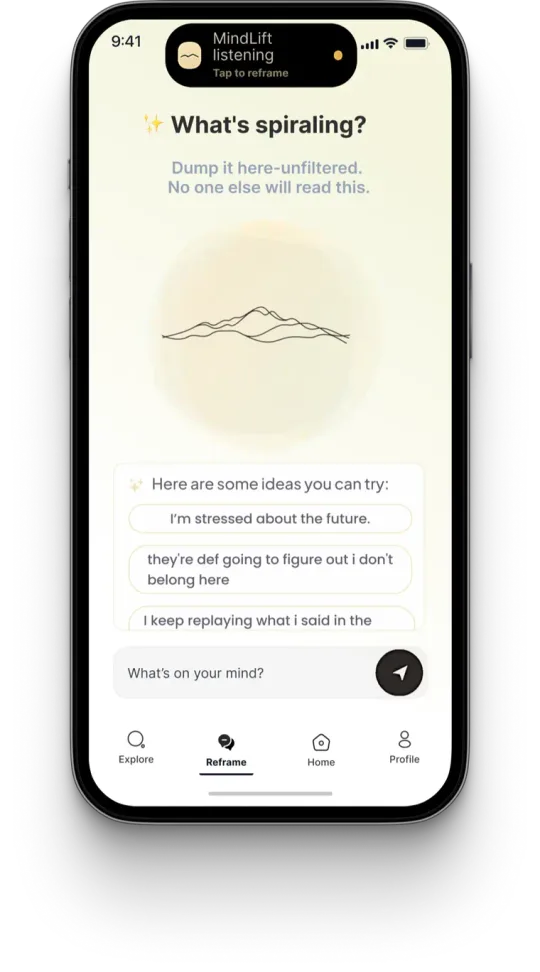
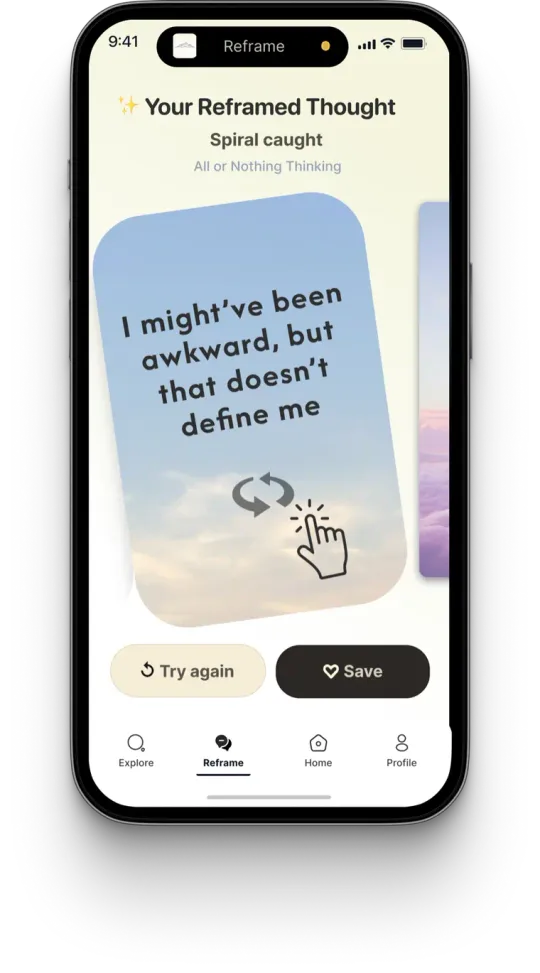
How to use it well: type the thought in the words you are really using, including the ugly ones. The specificity is what makes the reframe fit. “I’m a failure” produces a generic answer, because it is a generic input. “I froze in the standup and now Anna thinks I don’t know my own project” produces something you can use.
Step 2: It gets logged — the invisible step
Step two asks nothing of you, and it is the step the whole loop depends on: every reframe you save is kept with the distortion it caught and the day it happened — not as a paragraph of prose you will never re-read, but as a data point.
This is the difference between a diary and a record. A diary is for the day you write it. A record is for the month you look back on it. Traditional CBT has always known this — the thought record is one of the oldest tools in the discipline, and clinicians have clients fill them out on paper columns for exactly this reason. The problem is that paper thought records have an abandonment rate that would make any product manager weep. They ask you to do admin while you are upset.
Here the admin is free, because the reframe already contains the structured information. You talk; the structure comes out the other side.
Step 3: See the shape — this week’s reframes
Seeing the shape of your own thinking is the step that changes people, and it is the one that takes the longest to earn — give the weekly reframes card two weeks of use before you judge it.
On the home screen, the This week’s reframes card shows you what your mind has actually been doing. Not a streak. Not a score. A picture:
- Which distortion dominates. The card names your Top Pattern — Should Statements, Catastrophizing, Mind Reading — the one distortion showing up most often, in your own words. Suddenly the enemy has a name.
- When it happens. The bars show reframes by day, Monday to Sunday, and the peak is rarely where people expect. For a lot of users it is Sunday evening. For others it is the day of a specific recurring meeting.
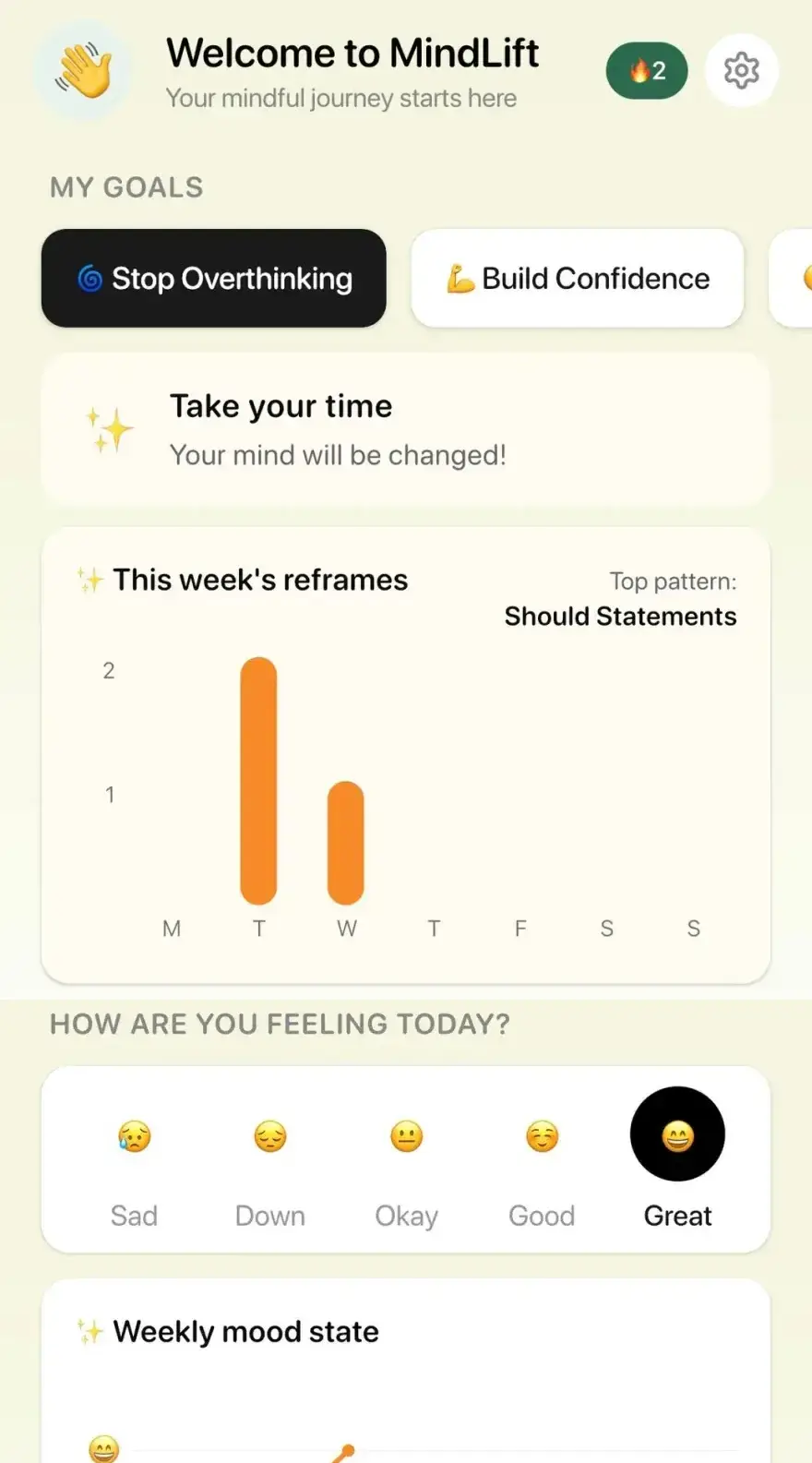
The first time you see it, the usual reaction is a quiet, slightly annoyed recognition. You thought you had a hundred worries. You have one worry with a large wardrobe.
How to use it well: read it weekly, not daily. Daily checking turns it into another metric to feel bad about, which is the opposite of the point. Once a week, ideally the same slot — Sunday morning works well — spend two minutes on it and pick one thing to watch. That is the entire assignment.
Step 4: Aim the practice — affirmations matched to your pattern
Now you know your groove is, say, mind-reading in social situations. So you stop practising in general and start practising the specific counter.
MindLift’s daily affirmations live in the Explore tab, organised by category — the goals you picked on the home screen, such as stopping overthinking or building confidence, plus a Daily Reset set with a Morning Routine and an Evening Calm. Every line is written to a rule that rules out most of what the genre offers. No line claims something you do not believe. Nothing is written in the voice of a poster.
Compare:
The poster
“I am confident and everyone loves me.”
Your brain rejects it on contact. The rejection becomes evidence.
The friend who knows CBT
“I don’t actually know what she was thinking. I know what I felt. Those are different.”
Just true. Holdable without flinching. The only kind that gets internalised.
The first one, if you are anxious, your brain rejects on contact — and worse, the rejection itself becomes evidence that you are broken. The second one is just true. It is a sentence you can hold without flinching, which is the only kind that ever gets internalised. There is a longer argument for this in why affirmations don’t work — and what to say instead.
The tone standard we write to is a trusted friend at 2am who happens to know CBT. Grounded, specific, on your side, not selling you anything about yourself.
How to use it well: let the card pick your category. If the Top Pattern is mind-reading, spend a fortnight in the lines about other people’s opinions. Aiming at your real pattern beats volume by an enormous margin.
Step 5: Install it early — the Morning Routine
The last step moves the practice from reactive to preventative: the reframe is for the thought that already has you, while the Morning Routine is for the day before it starts — a few minutes, a short set of the lines you chose, before your first scroll. It sits under Daily Reset in Explore, next to Evening Calm.
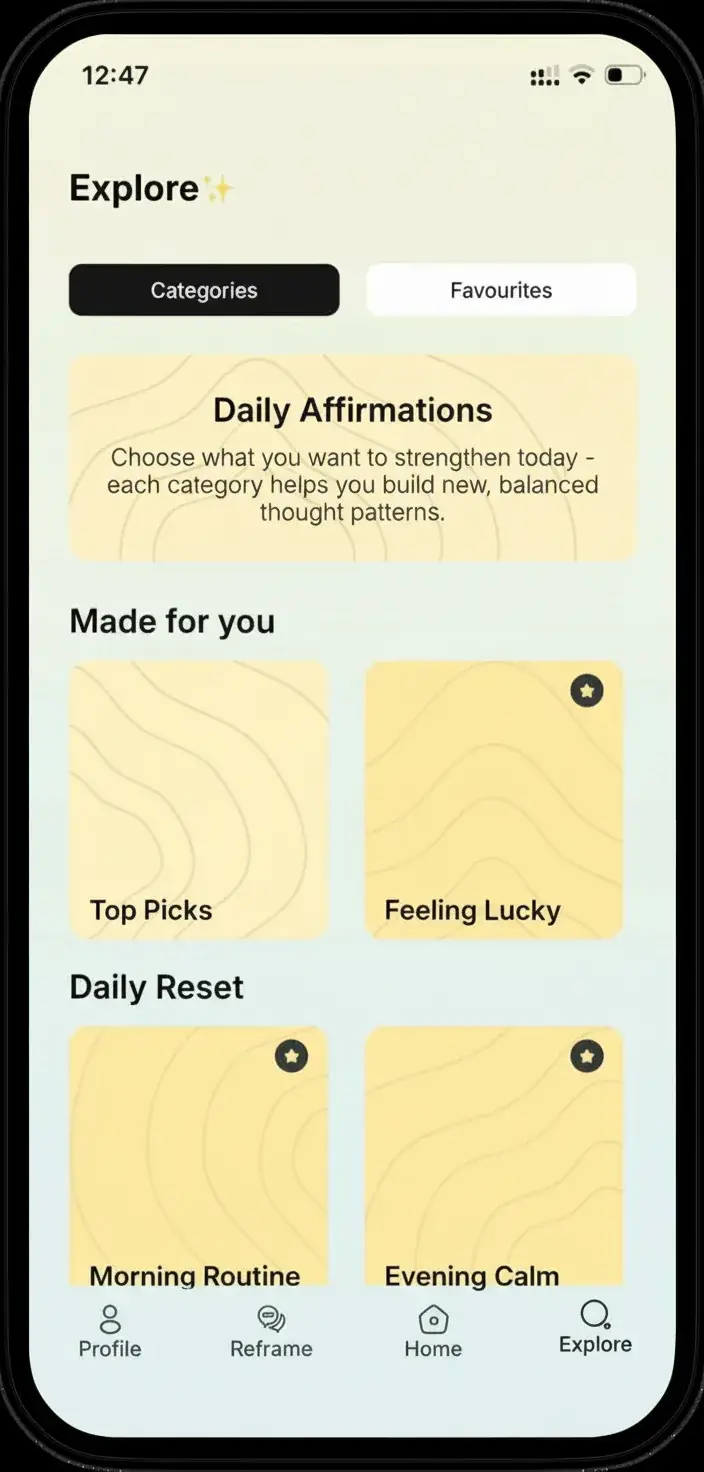
The mechanism is boring and effective: you are rehearsing the counter-thought while you are calm, so it is within reach when you are not. Every skill works this way. You do not learn the exit from a spiral during the spiral.
How to use it well: habit-stack it onto something that already happens without your permission — the kettle, the shower, the walk to the bus. Start with three lines. A four-minute routine you actually do beats a twenty-minute one you resent by Thursday.
What the loop looks like after 30 days
Here is a composite of the first month with the loop, drawn from how the pattern usually runs rather than from any one person’s account — week by week, from fire-fighting to a flatter chart.
Week 1. Six reframes, all of them fire-fighting, all at night. It feels like using an app to argue with yourself. Something is slightly better at bedtime and it is hard to say what.
Week 2. The card has enough to speak. Top Pattern: Mind Reading, and the bars stack up on Tuesdays, the day of the standup. The realisation is not comfortable and it is extremely useful.
Week 3. Social-anxiety lines go into the Morning Routine. Reframes drop to four — not because the thoughts stopped, but because two of them got caught early enough not to need the full sixty seconds.
Week 4. The chart has a different shape. The Tuesday bar has shrunk. The thought still arrives before the standup. It just does not get to run the whole day any more.
That last sentence is the honest promise. Nothing here deletes anxious thoughts. What changes is the gap between the thought and your response to it — and how long the thought gets to stay.
The loop, in one line each
The whole MindLift loop fits in five lines, and the order matters: each step hands something to the next, and the last one feeds the first.
- Catch it in the Reframe tab, in your own words.
- It logs itself, with the distortion named.
- Read the card once a week and find your Top Pattern.
- Pick the affirmation category that matches the pattern.
- Play it in the morning, before the day makes its case.
Then round again. Every pass through makes the next one shorter.
Start anywhere in the loop
You do not need a plan or a good week to begin. Open the Reframe tab with the thought you have been circling for the last hour, and let it be one rep.
The pattern shows up on its own after that. If you would rather know your groove before you start, the free cognitive distortion quiz names it in about ninety seconds.
MindLift is free to start, on iOS 15+ and Android 8+. Download MindLift — or start with the CBT techniques hub if you would rather read first.
MindLift is a wellness and self-reflection tool, not a replacement for professional mental-health care. If you are experiencing severe or persistent symptoms, or are in crisis, seek support from a qualified mental-health professional or your local emergency or crisis service.
Frequently asked questions
How is this different from journaling?
A journal captures the thought. It does not structure it, name the distortion, or let you see across entries. After a month of journaling you have a lot of pages; after a month here you have a named Top Pattern and a day of the week. Journaling is expression. This is training.
Is MindLift therapy?
No. It is a self-guided tool built on CBT methods, for people dealing with everyday overthinking, self-criticism and social anxiety. It is useful alongside therapy and no substitute for it. If you are struggling in a way that is affecting your ability to function, please talk to a professional.
How long until the card shows me anything?
The weekly bar chart fills in from your first reframe. The Top Pattern needs a run of them before it means much — give it about two weeks of ordinary use before you judge it. One bad night is a data point, not a pattern.
What if I do not know which distortion my thought is?
That is the app's job, not yours. You bring the thought; naming it is part of what the reframe does. If you want a head start, the free cognitive distortion quiz sorts your usual pattern in about ninety seconds.
Do I have to do all five steps?
No, and most people do not start there. Nearly everyone comes in through the reframe and adds the rest later. But steps 3 to 5 are where the compounding happens — the reframe alone treats episodes; the loop changes the pattern.
Does it work if my worries are about real problems?
Yes, and this matters. Reframing is not about pretending a real problem is fine. It is about separating the part that is happening from the part your mind added — so the energy goes to the actual problem instead of the imagined version of it.
Like what you're reading?
Continue your wellness journey
Reframe negative thoughts in 60 seconds — free to start in the MindLift app.


Free to start · no account required
CBT & Self-Talk Researchers
MindLift content is grounded in cognitive behavioral therapy principles and designed to help you shift harsh self-talk in real time. Our guides focus on practical, evidence-based techniques you can use in the moment.
Was this article helpful?