
Turn this into a daily habit — free to start in the MindLift app:
Understanding Cognitive Behavioral Therapy
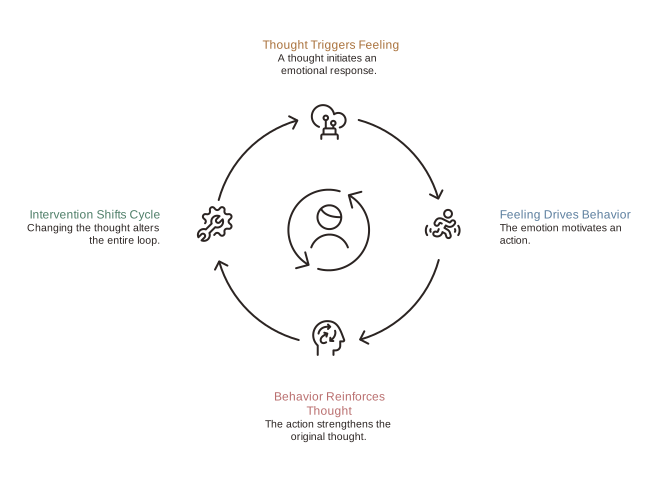
Cognitive Behavioral Therapy (CBT) is a goal-oriented, time-limited psychotherapy built on one idea: thoughts, feelings and behaviors are interconnected, so changing one of them can shift the others. Unlike talk therapy that explores the past, CBT works on the thoughts and behaviors you are running right now.
Cognitive Behavioral Therapy (CBT)
A goal-oriented, time-limited psychotherapy that addresses dysfunctional emotions, behaviors, and cognitions through a systematic, structured approach. CBT is based on the concept that thoughts, feelings, and behaviors are interconnected, and changing one element can influence the others.
Unlike traditional talk therapy that explores your past, CBT focuses on your present thoughts and behaviors. The goal is not to eliminate negative thoughts entirely—that is impossible—but to develop a healthier relationship with them.
of people with anxiety or depression see significant improvement with CBT—comparable to medication but with longer-lasting results
Source: American Psychological Association, 2024
"The greatest discovery of my generation is that human beings can alter their lives by altering their attitudes of mind. CBT provides the practical tools to make that transformation concrete and measurable."
William James, adapted for modern CBT practice
Core CBT Techniques You Can Practice Daily
The five core CBT techniques below, thought challenging, behavioral activation, an exposure hierarchy for anxiety, thought records and core belief work, are practical exercises you can run on your own thoughts without a therapist in the room. Each one comes with step-by-step instructions and an example of what it looks like in practice.
1. Thought Challenging (Cognitive Restructuring)
The cornerstone of CBT. When you notice a negative thought, challenge its accuracy using evidence-based questions.
Step 1: Identify the thought
I am terrible at my job and everyone knows it.
Step 2: Find the evidence FOR and AGAINST
For: I made a mistake in the last presentation.
Against: I received positive feedback last month. My manager promoted me 6 months ago. Colleagues ask for my advice regularly.
Step 3: Create a balanced thought
I made a mistake in one presentation, but my overall job performance is solid. Everyone makes mistakes sometimes, and it does not define my entire competence.
✓ Practice 3x daily • ✓ Write it down for better results • ✓ Quiets anxious thoughts over time
2. Behavioral Activation
When you are depressed, you avoid activities—which makes you more depressed. Behavioral activation breaks this cycle by scheduling meaningful activities regardless of motivation.
1. List activities you used to enjoy (even if they do not sound appealing now)
2. Rate each activity for pleasure (P) and achievement (A) on 0-10 scale
3. Schedule 1-2 activities daily, starting with easiest ones
4. Do them regardless of motivation (action precedes motivation)
5. Record actual P/A scores afterward (usually higher than expected)
✓ Most effective for depression • ✓ Combats avoidance patterns
3. Exposure Hierarchy (for Anxiety)
Avoidance makes anxiety worse. Gradual exposure to feared situations (while using anxiety management techniques) reduces fear over time.
Example: Social Anxiety Hierarchy
- Make eye contact with cashier (anxiety: 2/10)
- Say hello to neighbor (anxiety: 4/10)
- Ask store employee for help (anxiety: 5/10)
- Initiate small talk with coworker (anxiety: 6/10)
- Attend small social gathering (anxiety: 8/10)
- Give presentation to team (anxiety: 9/10)
✓ Start with lowest anxiety item • ✓ Stay until your anxiety noticeably drops • ✓ Well-established approach for phobias
4. Thought Records (CBT Journaling)
A structured way to track and analyze your thoughts, making patterns visible.
Situation
What happened?
Emotion
How did you feel?
Thought
What went through your mind?
Evidence
For/against the thought?
Alternative
Balanced thought?
5. Core Belief Work
Negative automatic thoughts stem from deeper core beliefs (I am unlovable, I am incompetent, I am unsafe). Identifying and modifying these beliefs creates lasting change. MindLift AI helps you uncover your core beliefs through pattern analysis of your recurring negative thoughts.
Common Cognitive Distortions to Watch For
Cognitive distortions are habitual thinking errors, such as all-or-nothing thinking, catastrophizing, mind reading and overgeneralization, that make a situation look worse than the evidence supports. Learning to spot them by name is the first step in every CBT technique above, because a distortion you can label is one you can answer.
All-or-Nothing Thinking
Seeing things in black and white. If I am not perfect, I am a total failure.
Catastrophizing
Assuming the worst possible outcome. One mistake means I will get fired and lose everything.
Mind Reading
Assuming you know what others think. They are definitely judging me right now.
Overgeneralization
One negative event means everything is terrible. I failed once, so I always fail.
How MindLift Makes CBT Accessible
Traditional CBT requires weekly therapy sessions costing $100-200 each. MindLift brings evidence-based CBT techniques to your pocket—free to start, 24/7, and personalized to your specific thought patterns.
- ✓AI identifies your cognitive distortions in real-time
- ✓Personalized thought challenges based on your patterns
- ✓Guided behavioral activation scheduling
- ✓Mood tracking to measure progress objectively
These CBT techniques are designed to become easier with a couple of weeks of daily practice.
For every CBT guide, quiz, and exercise on this site in one place, start at the CBT techniques hub.
Find your pattern in 2 minutes
A MindLift quiz is a short, free self-assessment that names the thinking pattern this guide’s techniques work best against. Each quiz below takes about two minutes, needs no sign-up, and ends with a result page you can act on straight away.
- Which Thought Distortion Runs Your Brain?Everyone has a default. Eleven quick moments name yours — catastrophizing, mind reading, should statements and eight more — plus the co-pilot that rides along.
- Negative Self-Talk Test — What Does Your Inner Critic Sound Like?Discover which of the 6 inner critic types runs your thinking — Catastrophizer, Perfectionist, Comparer, Labeler, Mind Reader, or Dismisser. A free 3-minute CBT-informed test.
Frequently asked questions
Can I do CBT on my own without a therapist?
Yes, self-directed CBT can be effective for mild to moderate anxiety and depression. Guided self-help CBT, including apps like MindLift, can deliver much of the benefit of therapist-led CBT for many people. However, severe symptoms or complex trauma typically require professional guidance.
How long does it take for CBT to work?
It varies from person to person, and there is no fixed timeline — with consistent practice, the shift builds gradually. Full treatment courses last 12-20 weeks for optimal results. Unlike medication, CBT provides lasting skills that continue working after treatment ends.
What's the difference between CBT and regular therapy?
CBT is structured, goal-oriented, and focuses on present thoughts and behaviors rather than past experiences. It's time-limited (usually 12-20 sessions) and teaches specific skills you can use independently. Traditional talk therapy often explores childhood and deeper emotional processing without structured techniques.
Is CBT effective for severe anxiety?
Yes, CBT is the gold-standard treatment for severe anxiety disorders including panic disorder, OCD, and social anxiety. Most people with severe anxiety who complete a course of CBT see significant symptom reduction. It's considered as effective as medication but with lower relapse rates.
Like what you're reading?
Continue your wellness journey
Reframe negative thoughts in 60 seconds — free to start in the MindLift app.


Free to start · premium optional