
Turn this into a daily habit — free to start in the MindLift app:
Most men don't talk much about mental health. Not because they don't have struggles. Not because they don't feel stress, anxiety, self-doubt, loneliness, or burnout. But because many have learned to keep moving. To keep working. To keep providing. To keep performing.
And somewhere along the way, the conversation happening inside their heads became private. Very private.
This Men's Mental Health Month, let's talk about the thoughts many men carry but rarely say out loud — because sometimes the hardest battles are the ones nobody else can see.
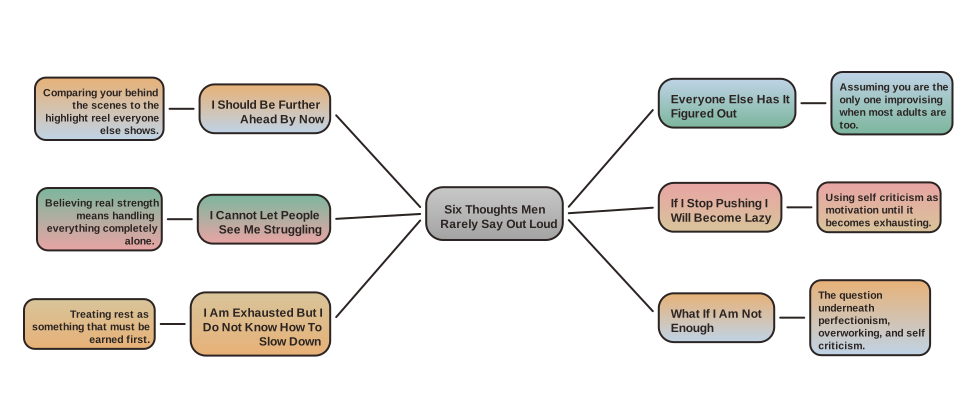
Thought #1: "I should be further ahead by now."
This thought often shows up in your late 20s, 30s, 40s, and beyond. You scroll social media. Someone bought a house. Someone launched a business. Someone got promoted. Someone seems to have everything figured out. Meanwhile, you're looking at your own life wondering: What happened? Why am I behind? Did I waste too much time?
What's actually happening?
Your brain is comparing your behind-the-scenes footage to everyone else's highlight reel. You're measuring your entire life against carefully selected moments from someone else's. This comparison creates a distorted view of reality — and you stop noticing what you've survived, what you've learned, what you've built, and how far you've already come.
A better question
Instead of asking "Why am I not there yet?", ask "Am I moving in the direction I want?" Progress isn't a race. It's a direction.
Thought #2: "Everyone else seems to know what they're doing."
Many men secretly believe they're the only one struggling. The only one unsure. The only one making it up as they go. The truth? Most adults are improvising far more than they admit. The successful colleague, the confident entrepreneur, the guy at the gym, the friend who seems to have life figured out — most of them have doubts too. You just don't see them.
What this thought creates
When you assume everyone else is confident, capable, and certain, you ask fewer questions, you seek less support, you isolate yourself, and you feel more alone. This is one of the patterns behind imposter syndrome — the quiet conviction that you're the exception who hasn't been found out yet.
Reality check
Confidence is rarely the starting point. It's usually the result of taking action despite uncertainty.
Thought #3: "I can't let people see me struggling."
This may be one of the most common hidden thoughts among men. Many grow up believing strength means handling everything alone. No complaints. No vulnerability. No weakness. Just push through.
But emotional suppression has a cost. When stress stays trapped inside, it doesn't disappear — it often turns into irritability, burnout, exhaustion, anxiety, or emotional numbness. It's one of the most common — and most missed — signs of low self-esteem in men.
What real strength looks like
Real strength is not pretending everything is fine. Real strength is being honest enough to admit when things are hard. You don't have to share everything with everyone — but everyone needs someone.
Thought #4: "If I stop pushing myself, I'll become lazy."
This thought hides inside many ambitious men. It sounds like: "If I'm not hard on myself, I'll lose my edge. If I relax, I'll fall behind. If I stop grinding, someone else will pass me." The problem? Constant pressure creates constant stress — and stress isn't an unlimited resource.
The hidden trap
Many men use self-criticism as motivation. The voice becomes "Do better. Work harder. That's not enough. You should be doing more." At first it works. Then it becomes exhausting.
What high performers learn
Discipline and self-attack are not the same thing. The most sustainable form of discipline sounds more like "Let's keep going" than "You're failing." Learning to turn that inner critic into an inner coach is one of the highest-leverage shifts a man can make.
Thought #5: "I'm exhausted, but I don't know how to slow down."
This is becoming one of the defining challenges of modern life. The pressure never fully stops. Work follows you home. Notifications never end. Responsibilities pile up. Goals keep moving. And even when you're resting, part of your brain still feels guilty.
Burnout doesn't always look like collapse
Sometimes burnout looks like feeling numb, losing motivation, constant fatigue, increased frustration, or going through the motions. You may still be functioning. You may still be succeeding. But internally, you're running on empty.
A reminder
Rest is not something you earn after becoming worthy. Rest is part of staying healthy enough to continue.
Thought #6: "What if I'm not enough?"
Underneath many forms of anxiety, perfectionism, overworking, and self-criticism lies one question: "Am I enough?" Enough as a father. Enough as a husband. Enough as a provider. Enough as a leader. Enough as a man.
This question quietly influences countless decisions — and yet no amount of achievement can permanently answer it. Because worth isn't something you achieve. Worth is something you already possess. The challenge is learning to believe it.
A Moment of Reflection
Take a moment. Which thought felt most familiar?
- "I should be further ahead."
- "Everyone else has it figured out."
- "I can't let people see me struggle."
- "If I stop pushing, I'll become lazy."
- "I'm exhausted."
- "What if I'm not enough?"
If one immediately stood out, that may be the thought worth paying attention to this month — not because it's true, but because it's influencing more of your life than you realize. If you want to see which patterns are most active for you, the low self-esteem quiz maps the behaviors most linked to these silent thoughts.
What Men's Mental Health Month Is Really About
Men's Mental Health Month isn't about becoming perfect. It isn't about fixing yourself. It isn't about pretending everything is positive. It's about creating space for honest conversations — including the conversation you have with yourself.
Because every day your inner voice is shaping your confidence, your resilience, your relationships, your stress levels, and your decisions. The words you repeat become the lens through which you see your life.
A Challenge for This Month
For the next 7 days, notice one thing: how do you speak to yourself after a mistake? Not after a win. After a mistake. That's where your real self-talk lives — and that's where meaningful change begins. The cognitive restructuring worksheet walks through how to challenge those thoughts step by step.
Sometimes the strongest thing a man can do is learn to speak to himself with the same respect he'd offer someone he cares about.
Frequently asked questions
What is Men's Mental Health Month about?
Men's Mental Health Month (observed in June) is about creating space for honest conversations about the mental and emotional struggles men face but rarely voice — anxiety, self-doubt, burnout, loneliness, and the constant pressure to provide and perform. It's not about becoming perfect or 'fixing' yourself; it's about acknowledging the internal battles many men carry silently, including the conversation a man has with himself.
Why don't men talk about mental health?
Many men grow up with a consistent message that strength means handling everything alone — no complaints, no vulnerability, just push through. Over time, the internal struggle becomes private. It's rarely a lack of feelings; it's a learned habit of suppression. The cost is that trapped stress tends to resurface as irritability, burnout, exhaustion, anxiety, or emotional numbness rather than disappearing.
What are the thoughts men don't say out loud?
Six recur most often: 'I should be further ahead by now,' 'Everyone else seems to know what they're doing,' 'I can't let people see me struggling,' 'If I stop pushing myself, I'll become lazy,' 'I'm exhausted but I don't know how to slow down,' and underneath them all, 'What if I'm not enough?' These thoughts quietly shape confidence, relationships, stress levels, and decisions — usually without being examined.
How can men challenge negative self-talk?
The most evidence-based approach is cognitive behavioral therapy (CBT): noticing the thought, identifying the distortion driving it (comparison, all-or-nothing thinking, self-criticism), examining whether it's actually true, and constructing a more accurate, balanced response. A simple starting practice: for the next 7 days, notice how you speak to yourself after a mistake — not after a win. That's where your real self-talk lives, and where change begins.
Like what you're reading?
Continue your wellness journey
Reframe negative thoughts in 60 seconds — free to start in the MindLift app.


Free to start · no account required
Mental Wellness Writers
The MindLift Wellness Team writes evidence-based content on CBT, self-talk, and everyday mental health tools.
Was this article helpful?