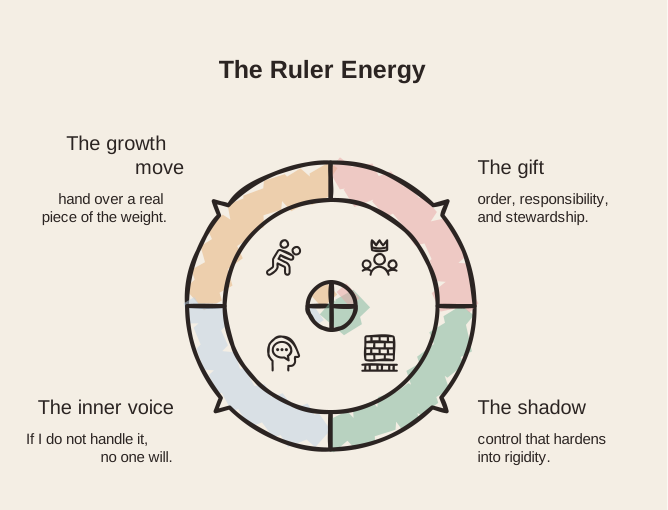
You hold things together — and your inner voice insists, "If I don't handle it, no one will." Your growth lives between keeping everything standing and letting someone else hold a corner of it.
You create order out of chaos. At work, at home, in your group chat — when things wobble, people look at you, and you've stopped being surprised by that. You plan, you decide, you absorb the pressure, and the whole thing stays standing because you're under it.
Your inner voice runs on responsibility: "If I don't handle it, no one will." Often that's even true. But repeated long enough, the sentence rewires you — rest starts to feel like negligence, delegating feels like risk, and being needed quietly replaces being known.
Your shadow is control that hardens into rigidity. Under pressure you don't fall apart; you tighten — more structure, more oversight, less room for anyone (including you) to breathe. The cost isn't your competence. It's that a life that's fully managed stops being fully lived.
Growth edge: order is your gift, not your cage. You can stay the steady one and still say "I don't know," still hand over something that matters and let it be done differently. When the grip tightens, ask — "Am I holding this because it's mine, or because holding things is the only way I know to matter?"
here's one thing to try tonight: Hand over one real thing this week — not the scraps, something that matters — and let it be done differently than you'd do it. Control that can never rest isn't strength; it's fear with a schedule.
After the meeting, you write the follow-up email because otherwise nobody will, and you keep a quiet list of who still owes what.
At home you know where the passports are, when the car is due and which bill is late. When a partner offers help, you say it is faster if you do it.
Alone at 2am, you walk tomorrow through its chain of dependencies and find the one link nobody else is watching.
The blind spot
Rulers rarely notice how much of their calm is maintenance. When help is always declined, people stop offering it, and that silence gets read as proof that everything depends on you. The reliability is real. What tends to stay out of view is that you have built a role nobody is allowed to share, and that it can be lonelier inside than it looks from outside.
A thought you may know, and a kinder answer
The thought: "If I step back for a week, it will all fall apart and that will be on me."
A kinder answer: "Some of it might wobble, and most of it would hold. I can hand over one named task, say what a good result looks like, and check back once. Done differently is still done."
Often confused with
The Hero: The Hero also carries heavy things, but is energized by the crisis itself and tends to improvise. The Ruler is quietly stressed by a crisis and calmer once a structure is in place. If your strain comes from keeping systems running, you are closer to the Ruler.
The Caregiver: Both of you are relied on. The Caregiver tracks what people feel and need, and says yes. The Ruler tracks what has to happen by when, and says "I will handle it". The Ruler shows care through logistics.
Other results in this quizFrequently Asked Questions
Frequently Asked Questions
Is The Ruler the same as being controlling?
Not by default. Tight control is what this type can slide into when it feels responsible for outcomes it cannot guarantee. Many Rulers are generous with their competence and keep a whole team steady. A useful check is whether the grip helps the work or only calms you down.
Why is delegating so hard for The Ruler?
Handing something over means accepting it may be done differently, late or wrong, and the Ruler tends to feel that cost personally. Starting with a task where the downside is small, and agreeing on the result instead of the method, makes the first handover easier.
If you are in crisis or thinking about harming yourself, call or text 988 (US) or find a local line at findahelpline.com. MindLift is a self-help tool and not a replacement for professional care.
The questions and result descriptions in this quiz draw on the studies below. The quiz is a self-reflection tool, not a diagnosis, and none of these papers tested this quiz itself.
Jung CG (1959). The Archetypes and the Collective Unconscious (Collected Works, Vol. 9, Part 1). Princeton University Press (Bollingen Series XX).
Pearson CS (1991). Awakening the Heroes Within: Twelve Archetypes to Help Us Find Ourselves and Transform Our World. HarperSanFrancisco.
Mark M, Pearson CS (2001). The Hero and the Outlaw: Building Extraordinary Brands Through the Power of Archetypes. McGraw-Hill.