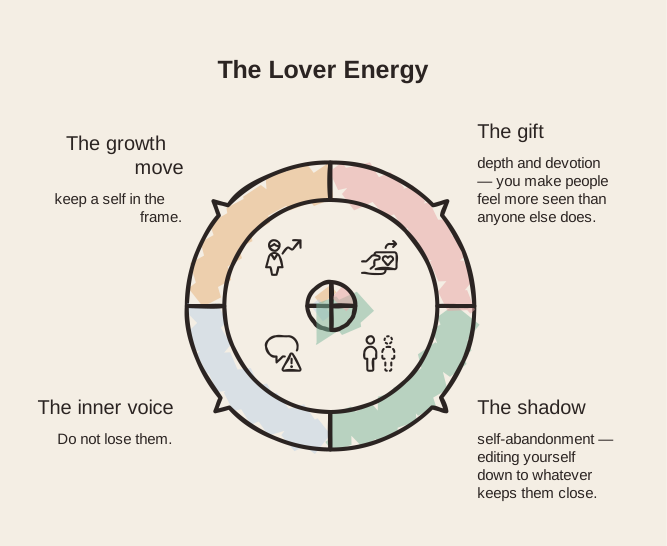
You feel everything at full volume — and your inner voice whispers, "Don't lose them." Your growth lives between loving deeply and remembering you exist when no one is looking at you.
You experience life at a depth most people only visit. When you care about someone — a partner, a friend, a project — you care completely, and the people you love feel more seen by you than by anyone else in their lives.
Your inner voice runs on connection: "Don't lose them." It's what makes you devoted, loyal, unforgettable. But the same voice can turn closeness into surveillance — rereading messages, replaying tones of voice, scanning for the first sign of someone pulling away.
Your shadow is self-abandonment. In the name of keeping people close, you edit yourself — swallowing needs, forgiving too fast, shape-shifting into whoever the room wants. The love stays real; the person offering it slowly disappears from inside it.
Growth edge: your depth is not too much — it's your signal strength. The work isn't to feel less; it's to keep a self in the frame. When the scanning starts, ask: "Am I reading them, or am I abandoning me?"
here's one thing to try tonight: Next time you catch yourself rereading a message for tone, put the phone down and name one thing you need tonight that has nothing to do with them. Connection counts double when you're still in it.
A friend takes four hours to reply. You reread the last message for tone, then reread your own, and nothing in the day sits quite right until they answer.
In a conversation you catch the second someone's attention drifts, and you feel it in your chest.
At 2am you think of everyone you love and run a quiet count of whether they know it.
The blind spot
Lovers read closeness as the safest place and distance as danger, so small changes in tone can feel like verdicts. You get very good at sensing what others need and less practiced at asking for what you do. The risk is editing yourself to keep people near, until they love a slightly smaller version of you.
A thought you may know, and a kinder answer
The thought: "They have gone quiet because I did something wrong, and I will lose them."
A kinder answer: "People go quiet for many reasons, most of which have nothing to do with me. I can wait until tomorrow, or ask once, openly, instead of building the answer myself."
Often confused with
The Caregiver: Both are devoted. The Caregiver tends to everyone and fears being useless. The Lover goes deep with a few and fears losing them. The Lover wants to be known, and the Caregiver wants to be needed.
The Everyman: Both want to belong. The Everyman wants a place in the group and blends in to keep it. The Lover wants one-to-one intensity and may stand out in order to be seen.
Same name, different quiz
The Lover: In the Male Archetypes quiz the Lover checks the bond with "Stay close" and the focus is presence. Here the voice is "Don't lose them", and growth means keeping a self in the frame.
The Lover: The Female Archetypes Lover listens to "Do they still care?" and centers on passion. Here the Lover heads its own family, with the Everyman and the Jester.
Other results in this quizFrequently Asked Questions
Frequently Asked Questions
Does being The Lover mean I am clingy?
No. The result describes depth and attention, and the scanning that comes with it is a stress response, not a flaw. It becomes a problem when it replaces trust or when you drop your own needs to keep closeness. Both can be worked on.
Is The Lover only about romantic relationships?
No. The type shows up with friends, family, work and projects, anywhere you invest fully. Romance is one place it is easy to see because the stakes feel high, but the pattern is about depth in general.
If you are in crisis or thinking about harming yourself, call or text 988 (US) or find a local line at findahelpline.com. MindLift is a self-help tool and not a replacement for professional care.
The questions and result descriptions in this quiz draw on the studies below. The quiz is a self-reflection tool, not a diagnosis, and none of these papers tested this quiz itself.
Jung CG (1959). The Archetypes and the Collective Unconscious (Collected Works, Vol. 9, Part 1). Princeton University Press (Bollingen Series XX).
Pearson CS (1991). Awakening the Heroes Within: Twelve Archetypes to Help Us Find Ourselves and Transform Our World. HarperSanFrancisco.
Mark M, Pearson CS (2001). The Hero and the Outlaw: Building Extraordinary Brands Through the Power of Archetypes. McGraw-Hill.