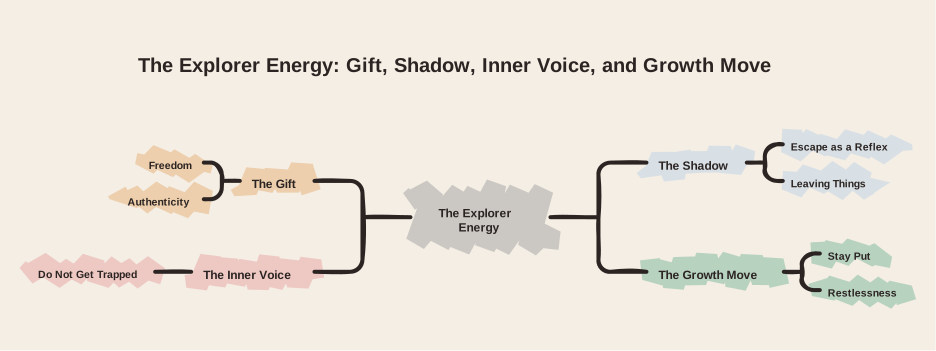
You need room to move — and your inner voice warns, "Don't get trapped." Your growth lives between staying free and letting something (or someone) actually hold you.
You're built for the open road — new places, new ideas, new versions of yourself. Routine reads as slow suffocation, and you can feel a cage forming in situations other people call stability. Your life is a collection of experiences most people only bookmark.
Your inner voice runs on freedom: "Don't get trapped." It's kept you authentic in a world that rewards conformity. But the same voice can't always tell the difference between a cage and a commitment — so it sometimes has you walking away from things that were actually holding you, not holding you back.
Your shadow is escape as a reflex. When things get heavy — a relationship deepening, a job getting real, a feeling settling in — the exit starts glowing. Movement becomes a way to outrun whatever was about to catch up.
Growth edge: freedom you have to protect this hard isn't freedom yet. The test isn't whether you can leave — you've proven that. It's whether you can stay put long enough to find out what's on the other side of the restlessness. When the exit glows, ask: "Am I moving toward something, or just away?"
here's one thing to try tonight: Next time the exit starts glowing, wait 48 hours before you move. If it's a real cage, it'll still be a cage on Thursday. If it was a feeling, you just saved something worth keeping.
A lease renewal arrives and you open flight listings before you open the email.
A relationship becomes more serious and you start noticing how many weekends you have left to yourself.
At 2am you think about everyone you could have been in another city, and the options feel lighter than the life in front of you.
The blind spot
Explorers can confuse a cage with a commitment because both feel like loss of air at first. The exit is always visible, so staying can feel like a decision you keep making and leaving can feel like relief. What gets missed is that some of the things you leave were not holding you back, and that the restlessness tends to travel with you.
A thought you may know, and a kinder answer
The thought: "If I settle here, I will wake up in ten years and realize I never lived."
A kinder answer: "Staying for now does not mean staying for ever. I can commit for six months, keep my curiosity alive inside the commitment, and choose again with more information."
Often confused with
The Rebel: The Rebel pushes against rules and stays to change them. The Explorer leaves them behind and moves on. The Rebel needs something to oppose. The Explorer needs somewhere to go.
The Sage: Both are curious. The Sage digs deeper into one subject, often from a chair. The Explorer wants first-hand contact with new places and people, and gets restless when held in one spot.
Same name, different quiz
The Explorer: In the Male Archetypes quiz the Explorer sits in the Rebel family, driven by momentum and "What's out there?" Here the Explorer heads its own family and the voice is "Don't get trapped", with the growth question about staying long enough to find out what lies past the restlessness.
Other results in this quizFrequently Asked Questions
Frequently Asked Questions
Is The Explorer afraid of commitment?
The result points to a fear of disappearing inside a commitment more than of the commitment itself. Explorers can commit well when it leaves room to grow. It helps to say aloud what freedom you need within the commitment.
How can The Explorer tell restlessness from a real need to leave?
Give the feeling some time before acting, a couple of days at least, and ask what exactly you want to move toward. A real need tends to name a destination. Restlessness mostly names what you are leaving.
If you are in crisis or thinking about harming yourself, call or text 988 (US) or find a local line at findahelpline.com. MindLift is a self-help tool and not a replacement for professional care.
The questions and result descriptions in this quiz draw on the studies below. The quiz is a self-reflection tool, not a diagnosis, and none of these papers tested this quiz itself.
Jung CG (1959). The Archetypes and the Collective Unconscious (Collected Works, Vol. 9, Part 1). Princeton University Press (Bollingen Series XX).
Pearson CS (1991). Awakening the Heroes Within: Twelve Archetypes to Help Us Find Ourselves and Transform Our World. HarperSanFrancisco.
Mark M, Pearson CS (2001). The Hero and the Outlaw: Building Extraordinary Brands Through the Power of Archetypes. McGraw-Hill.