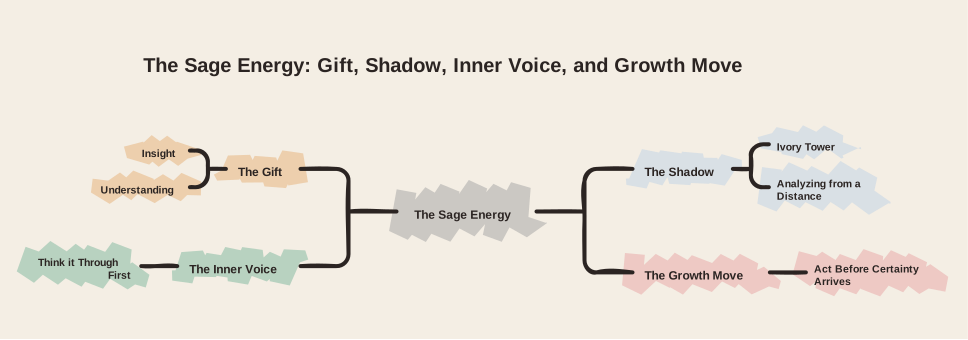
You need to understand things — and your inner voice keeps saying, "Think it through first." Your growth lives between knowing enough and letting yourself act before certainty arrives.
You live a step back from the noise, watching, connecting dots other people don't see. Friends bring you their tangled situations because you untangle them. You'd rather be right slowly than wrong fast, and your judgment has earned that patience.
Your inner voice runs on analysis: "Think it through first." It's why your advice lands and your mistakes are rare. But the same voice can quietly turn thinking into a hiding place — one more angle to consider, one more source to check, while the decision waits and the life around it moves on.
Your shadow is the ivory tower. Under stress you retreat into your head, where everything can be examined and nothing can touch you. Understanding a feeling becomes a substitute for feeling it; analyzing a risk becomes a substitute for taking it.
Growth edge: your mind is the gift — the moat around it is the problem. Insight that never becomes action is just decoration. When you catch yourself researching a decision you've already made, ask: "What am I actually waiting for — information, or permission?"
here's one thing to try tonight: Pick one decision you've been researching for weeks and make it with the information you already have. You knew the answer before the third spreadsheet — the rest was anesthesia.
A friend brings you a tangled situation and you ask three questions before saying anything. Two days later you are still turning it over.
You have a decision half made, yet you open one more tab, one more review, one more article before you commit.
Alone at 2am you hold a conversation in your head, arguing both sides until it feels settled and then unsettles itself again.
The blind spot
Sages can mistake understanding a feeling for having dealt with it. Thinking carefully feels productive, so hesitation hides inside it and rarely looks like avoidance. Others may see you as calmer than you are, because the analysis happens out of sight. Much of the research can be a request for certainty that no amount of reading will supply.
A thought you may know, and a kinder answer
The thought: "If I decide before I fully understand this, I will make a mistake I cannot undo."
A kinder answer: "Few decisions are as permanent as they feel at 2am. I know enough to take one small step, and I can learn the rest by taking it. If it goes badly, I can adjust."
Often confused with
The Magician: The Magician acts on partial understanding and changes things as it goes. The Sage waits until the picture is clear. If your habit is to research first, you lean Sage. If you jump in to fix, you lean Magician.
The Explorer: Both are curious. The Explorer wants to go out and meet new things, and gets restless when held in place. The Sage wants to go deeper into one thing and gets restless when forced to act before it is understood.
Same name, different quiz
The Sage: The Male Archetypes Sage focuses on patterns, incentives and perspective. Here the Sage heads a family with the Magician and Creator, and the voice is "Think it through first."
The Sage: The Female Archetypes Sage is built around truth seeking and the voice "Think more". This quiz keeps the idea of understanding as a hiding place, but sets the Sage beside two other insight-driven types.
Other results in this quizFrequently Asked Questions
Frequently Asked Questions
Does The Sage overthink everything?
Not everything. Sages are often decisive about things they know well. The overthinking tends to show up where the stakes feel personal or the information will never be complete. Naming the decision you are waiting on helps separate research from delay.
How does a Sage make decisions faster?
Set a stopping rule before you start looking, such as a date or the number of sources you will read. Then decide with what you have, and write down what would change your mind so the decision can be revisited.
If you are in crisis or thinking about harming yourself, call or text 988 (US) or find a local line at findahelpline.com. MindLift is a self-help tool and not a replacement for professional care.
The questions and result descriptions in this quiz draw on the studies below. The quiz is a self-reflection tool, not a diagnosis, and none of these papers tested this quiz itself.
Jung CG (1959). The Archetypes and the Collective Unconscious (Collected Works, Vol. 9, Part 1). Princeton University Press (Bollingen Series XX).
Pearson CS (1991). Awakening the Heroes Within: Twelve Archetypes to Help Us Find Ourselves and Transform Our World. HarperSanFrancisco.
Mark M, Pearson CS (2001). The Hero and the Outlaw: Building Extraordinary Brands Through the Power of Archetypes. McGraw-Hill.