The signs most men — and people who love them — never notice Low self-esteem in men rarely looks like low self-esteem. It looks like anger, avoidance, the need to win, the inability to ask for help. It looks, most of the time, like something else entirely.
~3 min12 questionsClinically-informed
You’ll get: whether the signs of low self-esteem are present, where they show up, and the first step up.
About this quiz
Do You Have Low Self-Esteem?
The signs most men — and people who love them — never notice
Low self-esteem in men rarely looks like low self-esteem. It looks like anger, avoidance, the need to win, the inability to ask for help. It looks, most of the time, like something else entirely.
This quiz uses 12 statements drawn from the behavioral patterns most commonly linked to low self-worth. Rate each one honestly — not how you think you should feel, but how it actually lands.
The four levels the screen reports — patterns, not verdicts.How does this quiz work?
How does this quiz work?
Answer 12 questions about how you usually react, not how you would like to. ~3 min is the usual time to finish, there are no right answers, and Do You Have Low Self-Esteem? scores your result on your device — free, no email, no signup.
When someone criticizes me — even gently — my first instinct is to defend myself or explain why they're wrong, rather than actually consider what they said.
Not me
Occasionally
Sometimes
Often
This is me
Compliments feel awkward or hard to believe. I tend to deflect them or immediately find a reason they don't quite apply to me.
Not me
Occasionally
Sometimes
Often
This is me
I find it genuinely difficult to ask for help. Getting through something alone feels important in a way that's hard to explain.
Not me
Occasionally
Sometimes
Often
This is me
I feel a strong need to be seen as competent, successful, or put-together — and I work hard to make sure that's what people see, even when things aren't going well.
Not me
Occasionally
Sometimes
Often
This is me
I'm very uncomfortable being wrong in front of other people. Losing an argument, even about something small, can stay with me for a while.
Not me
Occasionally
Sometimes
Often
This is me
In close relationships, I sometimes feel like the other person will eventually realize I'm not as good as they think I am.
Not me
Occasionally
Sometimes
Often
This is me
I have trouble fully trusting that people genuinely like or love me for who I am — rather than for what I do, achieve, or provide.
Not me
Occasionally
Sometimes
Often
This is me
When someone I care about seems distant or off, my first assumption is that I've done something wrong.
Not me
Occasionally
Sometimes
Often
This is me
I tend to keep difficult feelings to myself. Talking about what's bothering me emotionally feels uncomfortable or unnecessary.
Not me
Occasionally
Sometimes
Often
This is me
I'm better at taking care of other people's needs than I am at acknowledging my own. Needing things feels like a weakness.
Not me
Occasionally
Sometimes
Often
This is me
I have a tendency to replay mistakes or embarrassing moments long after they've passed — sometimes bringing them back up out of nowhere.
Not me
Occasionally
Sometimes
Often
This is me
Even when things are going well, there's often a quiet sense that I haven't really earned it, or that it could be taken away. Fully relaxing into good things is hard.
Not me
Occasionally
Sometimes
Often
This is me
What results can you get?
What results can you get?
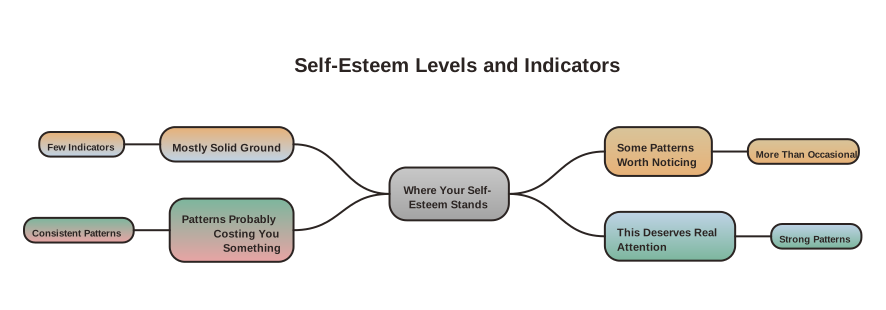
Your answers sort you into one of 4 results — Mostly Solid Ground, Some Patterns Worth Noticing, These Patterns Are Probably Costing You Something, This Deserves Real Attention. Each result comes with a description of its thinking pattern and one growth move you can practise this week, plus the answer mix that produced it.
Result
Who gets it
What it looks like
Mostly Solid Ground
12–24
Relatively few low self-esteem indicators
Some Patterns Worth Noticing
25–36
Moderate low self-esteem indicators
These Patterns Are Probably Costing You Something
37–48
Significant low self-esteem indicators
This Deserves Real Attention
49–60
Strong low self-esteem indicators
Mostly Solid Ground
Relatively few low self-esteem indicators
The patterns most associated with low self-worth don't seem to be running the show for you right now.
That doesn't mean everything's perfect — a few of these statements may have landed. But overall, the behaviors and thought patterns most linked to low self-esteem aren't dominant in your daily experience.
Pay attention to any statement you rated a 4 or 5. Those specific areas are worth sitting with — even small self-worth wounds have a way of surfacing under pressure, in relationships, or when things don't go as planned.
Staying curious about the thoughts that arrive when you're most stressed or criticized tends to reveal more than the calm moments do.
Notice the thoughts that arrive when you're criticized or when things go wrong. That's usually when the real picture shows up, even for people who are generally secure.
Mostly Solid Ground
The pattern
Pay attention to any statement you rated a 4 or 5.
A kinder next step
Notice the thoughts that arrive when you're criticized or when things go wrong.
Staying curious about the thoughts that arrive when you're most stressed or criticized tends to reveal more than the calm moments do.
Some Patterns Worth Noticing
Moderate low self-esteem indicators
Some low self-esteem patterns are showing up — more than occasional, less than defining.
This is probably the most common range, and also the trickiest — because moderate patterns are easy to rationalize. That's just how I am. Everyone's like that. It's not that bad.
But the statements you rated highest are worth taking seriously. The tendency to deflect compliments, to need to be right, to find it hard to ask for help — these aren't character flaws. They're adaptations. Things that made sense at some point and are now costing more than they're protecting.
Patterns at this level respond well to relatively small, consistent shifts: catching the thought underneath the behavior, noticing when the defense goes up and asking what it's protecting.
Start with the statement you rated highest — that's the thread worth pulling first. The underlying belief is usually 'I'm not enough in this specific way.'
Some Patterns Worth Noticing
The pattern
Some low self-esteem patterns are showing up — more than occasional, less than defining.
They're adaptations. Things that made sense at some point and are now costing more than they're protecting.
A kinder next step
Start with the statement you rated highest — that's the thread worth pulling first.
Patterns at this level respond well to relatively small, consistent shifts: catching the thought underneath the behavior, noticing when the defense goes up and asking what it's protecting.
These Patterns Are Probably Costing You Something
Significant low self-esteem indicators
Low self-esteem patterns are showing up consistently — and likely affecting your relationships, work, or sense of ease.
At this level, the patterns aren't occasional. They're structural. The internal voice that says not enough has been running long enough that it feels like facts rather than thoughts. The defenses built around it feel like personality.
That's not a judgment. It's just what happens when a wound goes unnamed and unaddressed for long enough. The patterns that protected you at some point — the self-sufficiency, the need to win, the difficulty receiving love — are now the thing in the way.
The shift that matters most isn't behavioral. It's learning to see the thought underneath the behavior — not suppressing it, but developing enough distance to ask: is this actually true?
Name the internal voice as a pattern, not as you. 'There's the not-enough thought again' is a different relationship to it than 'I'm not enough.' That distance is where choice lives.
These Patterns Are Probably Costing You Something
The pattern
The internal voice that says not enough has been running long enough that it feels like facts rather than thoughts.
A kinder next step
Name the internal voice as a pattern, not as you.
'There's the not-enough thought again' is a different relationship to it than 'I'm not enough.'
That distance is where choice lives.
This Deserves Real Attention
Strong low self-esteem indicators
These patterns are showing up strongly — and they're worth taking seriously.
A score in this range suggests that low self-esteem isn't just an occasional visitor. It's a consistent presence — shaping how you interpret situations, how you respond to people you care about, and the quality of your relationship with yourself.
Here's what's true: this is not who you are. It's what happened to you, or what you learned, or what you needed to build to survive something. The beliefs underneath these patterns — I'm not enough, I'm not worthy of this, I'll be found out eventually — were conclusions you drew. They can be redrawn.
That work is real. It takes time. It benefits enormously from professional support — a therapist who works with self-worth and self-concept, ideally trained in CBT or schema therapy. The process has a beginning that's available today.
Not fixing everything at once — just starting. One conversation, one honest acknowledgment, one moment of not performing. The process has a beginning that's available today.
This Deserves Real Attention
The pattern
The beliefs underneath these patterns — I'm not enough, I'm not worthy of this, I'll be found out eventually — were conclusions you drew.
A kinder next step
They can be redrawn.
Not fixing everything at once — just starting.
Here's what's true: this is not who you are.Frequently Asked Questions
Frequently Asked Questions
What does low self-esteem look like in men?
In men, low self-esteem typically routes through behaviors that look like confidence or personality rather than visible sadness: needing to win arguments, inability to ask for help, dismissiveness toward others' feelings, compulsive achievement-seeking, jealousy, and difficulty receiving love or care. The underlying experience is a persistent sense of not being enough.
Can low self-esteem be changed?
Low self-esteem is not a fixed personality trait — it's a set of thought patterns and behaviors that developed for reasons and can change with deliberate work. CBT and schema therapy have strong evidence bases for self-worth patterns. The process involves learning to identify the beliefs underneath the behaviors, examining their accuracy, and gradually building tolerance for being known and imperfect.
What is the difference between low self-esteem and low confidence?
Confidence is situational — it refers to belief in your ability to perform specific tasks. Self-esteem is more fundamental: it's your baseline sense of worth as a person, independent of performance. Low self-esteem shows up most clearly in how you handle criticism, vulnerability, and connection.
Is this low self-esteem quiz accurate?
This quiz is an educational self-reflection tool based on behavioral patterns associated with low self-worth in CBT research. It is not a clinical diagnosis. The 12 statements cover the most common indicators — criticism sensitivity, control patterns, relationship behaviors, emotional avoidance, and the internal voice. Use the results as a starting point for reflection, not a definitive assessment.
Can low self-esteem be fixed?
Low self-esteem is not a fixed personality trait — it's a set of thought patterns and behaviors that developed for reasons and can change with deliberate work. CBT and schema therapy have strong evidence bases for self-worth patterns. The process involves learning to identify the beliefs underneath the behaviors, examining their accuracy, and gradually building tolerance for being known and imperfect.
Keep exploring
If you are in crisis or thinking about harming yourself, call or text 988 (US) or find a local line at findahelpline.com. MindLift is a self-help tool and not a replacement for professional care.