
Turn this into a daily habit — free to start in the MindLift app:
Low self-esteem doesn't always look the way you'd expect.
You might expect someone who's visibly sad. Withdrawn. Apologetic. Someone who says "I'm not good enough" out loud, who shrinks in rooms, who can't take a compliment.
Sometimes it looks like that. But in men, more often, it doesn't.
More often it looks like someone who can't stop working. Someone who needs to win every argument. Someone who goes cold when they feel criticized, or gets angry when they feel vulnerable, or makes everything a competition without quite knowing why.
It looks, from the outside, a lot like confidence. Sometimes it looks like arrogance. Sometimes it looks like a personality trait — "he's just like that." It gets misread, by the men themselves and by everyone around them, for years.
This article is about the signs that actually matter — not the obvious ones, but the ones underneath behavior that looks completely normal or even successful. Whether you're reading this about yourself, about someone you love, or both: the goal is clarity, not judgment.
Why Low Self-Esteem Looks So Different in Men
Before the signs, it's worth understanding why male low self-esteem is so consistently misread.
From a very young age, most men receive a clear and consistent message: emotional vulnerability is weakness. Don't cry. Figure it out. Don't need too much. Be strong.
That message doesn't eliminate emotional pain. It just reroutes it. The feelings — inadequacy, fear, shame, the sense of not being enough — don't disappear. They get expressed sideways. Through behavior that's socially acceptable for men: ambition, anger, stoicism, control, dominance in conversation.
A man with deep self-worth wounds often doesn't know he has them. He's never had language for the feeling underneath. He just knows he needs to win. Needs to be right. Needs to not need anything from anyone. Needs to keep moving so he doesn't have to feel what's there when he stops.
This is why the clinical picture of low self-esteem — tearful, passive, self-critical out loud — so rarely matches the reality. The reality is adaptive. It's defended. It's been built over decades to look like something else entirely.
The Signs That Look Like Confidence (But Aren't)
Dominance that needs an audience
There's a difference between someone who is genuinely confident and someone who needs to be perceived as the most capable person in every room. The genuinely confident man can sit quietly while someone else leads. He can acknowledge someone else's expertise. He can be wrong without it meaning something about him.
The man whose confidence is compensating for something needs the room to register him. He talks over people. He steers conversations back to himself. He has a point of view on everything, delivered with more certainty than the evidence warrants.
This isn't arrogance as a character flaw. It's a performance of worth that's been running so long it feels like personality.
Not asking for help — ever
Independence is generally considered a positive trait. But there's a version of it that isn't really independence — it's an inability to be seen as someone who needs something.
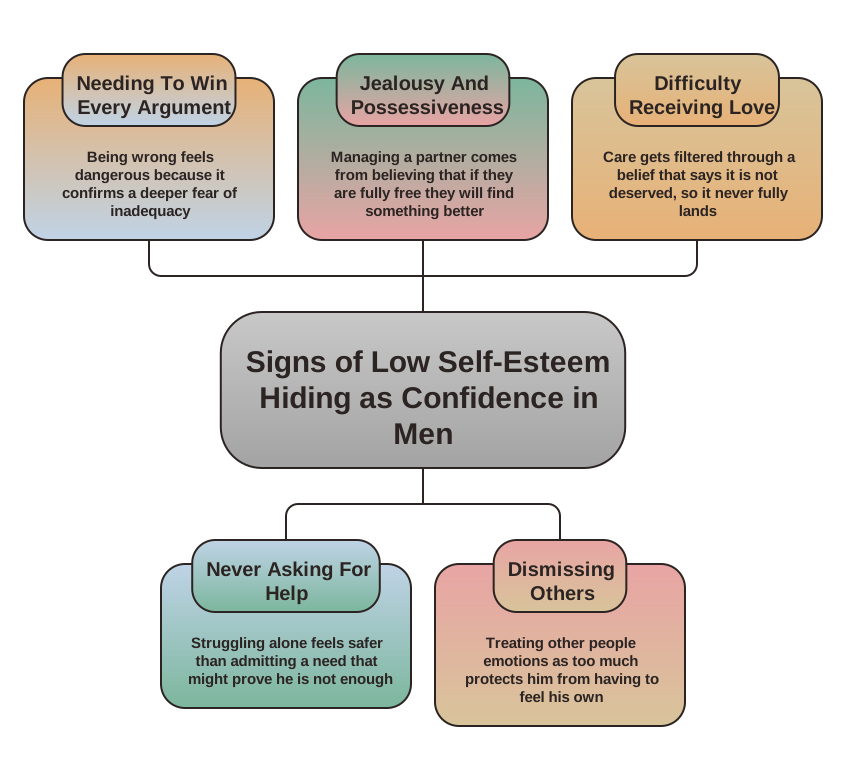
Asking for help requires admitting you can't do something alone. For a man with low self-esteem, that admission can feel existentially threatening. It confirms the fear he's been managing his whole life: that he's not enough. So he doesn't ask. He struggles alone. He fails quietly rather than risk being seen struggling.
Seeking validation through sex or achievement
There's nothing wrong with wanting to be desired or accomplished. The question is what it's doing. When sex or achievement becomes the primary way a man confirms his worth to himself — when he needs the conquest, the promotion, the recognition, the number — it's usually filling a hole that external validation can't permanently fill.
The compulsive quality of the pursuit — the way no achievement ever quite lands, the way approval needs to keep coming — is the tell.
Dismissiveness toward others' feelings
A man who is genuinely secure in himself can sit with someone else's emotional experience without being threatened by it. A man managing low self-esteem often can't. Others' emotional needs feel overwhelming, demanding, or contemptible. He dismisses them — "you're being too sensitive," "why are you making this into a big deal" — not because he doesn't care, but because emotional intensity triggers feelings he hasn't learned to process. Dismissing yours protects him from having to access his own.
The Signs That Look Like Personality
Inability to apologize genuinely
What's revealing is the ability to apologize when the wrongness is ambiguous — when it comes down to "you hurt me" rather than "you broke a rule."
Men with low self-esteem often find genuine apology almost impossible. Not because they're selfish, but because admitting fault touches the part of them that already believes they're fundamentally inadequate. A real apology means agreeing — at least for a moment — with the voice that says you're not good enough.The defenses go up. The apology becomes a non-apology. The conversation becomes an argument about who was more wrong.
Needing to win arguments
When your sense of worth is fragile, being wrong feels dangerous in a way that goes beyond the content of the disagreement. It confirms the fear. So the argument isn't really about what it appears to be about. It's about not losing — because losing means something much larger than this particular exchange.
Jealousy and possessiveness
Possessiveness — the need to know where a partner is, discomfort when they succeed or are admired, the subtle undermining of their confidence — is low self-esteem acting on a relationship.
The underlying logic: I'm not enough, so I need to manage the environment to prevent them from discovering that. It's not about trust in the other person. It's about the deep-seated belief that if they're fully free, they'll find something better.
Never celebrating wins
This one looks like humility. He deflects compliments. Doesn't acknowledge achievements. Moves immediately to the next goal without pausing on the current one.
But often it's an inability to let evidence of worth actually land. The good thing happened, but something in the system rejects it as insufficient, a fluke, or already irrelevant. The voice that says not enoughis louder than the evidence that contradicts it.
The Quieter Signs
People-pleasing and chronic agreeableness
Not all men with low self-esteem are dominant and defended. Some go the other way: agreeable to a fault, conflict-avoidant, accommodating to the point of disappearing.
This is the version that gets missed most often because it looks like niceness. But underneath the agreeableness is the same fear: if I express what I actually want or think, I'll be rejected, and I can't survive that. The needs don't disappear. They go underground. Resentment builds quietly. Connection becomes performance.
Difficulty receiving love or care
This is the sign that breaks relationships. A man with low self-esteem often can't receive love cleanly. When someone expresses care, he deflects it, reframes it, or becomes suspicious of it. They don't really know me. If they did, they wouldn't feel this way. They'll figure it out eventually.
The care that's offered is filtered through a belief system that says he doesn't deserve it. So it doesn't reach him. He might push people away precisely when they get close. He might self-sabotage relationships that are actually working. Not because he doesn't want them, but because he doesn't believe them.
The Voice Underneath All of It
Every behavior on this list is an adaptation. A way of managing a specific quality of internal voice — one that runs quietly in the background of most waking hours, providing a running commentary that returns, regardless of evidence, to some variation of: you're not enough.
That voice doesn't announce itself clearly. It tends to arrive as a feeling — a low-level anxiety, a sudden flash of shame, a tightness when someone criticizes you, a need to check your phone for reassurance. Most men have never named it as a voice, as a thought pattern, as something separate from themselves that can be examined and questioned.
That naming is where the work begins.
What Changing It Actually Looks Like
Low self-esteem isn't a personality type. It's a set of thought patterns and behaviors that developed for reasons — usually early experiences of conditional love, criticism, shame, or environments where vulnerability wasn't safe — and that can be changed with deliberate work.
That work looks more like:
Learning to catch the thought underneath the behavior. Noticing when the need to win an argument is really a fear of inadequacy. When the inability to ask for help is really terror of being seen as insufficient. When the defensiveness after criticism is really a core belief that being wrong means being worthless.
Learning to examine those beliefs rather than act on them. Using techniques like cognitive restructuring to ask: is this actually true? What would I tell someone I loved who thought this about themselves?
Building a tolerance for being seen. Gradually, in safe contexts, practising the thing that low self-esteem makes feel impossible: being known, being imperfect, being honest about need, and surviving it.
For the step-by-step version, see how to build self-esteem. If the loudest part is the inner verdict after a mistake, self-compassion vs self-esteem explains why answering it kindly works better than chasing a higher score.
A Note on Professional Support
If what's described in this article resonates — either about yourself or someone you love — therapy is worth mentioning not as a last resort but as a first one. CBT and schema therapy have strong evidence bases for the kind of deep-seated self-worth patterns described here.
For men specifically: the barrier to accessing therapy is often not willingness but the same self-esteem pattern that needs treating. I should be able to handle this myself. Needing help means something's wrong with me. That barrier is worth naming and pushing through, because the cost of not doing so shows up in relationships, in work, and in the quality of daily life.
Starting Smaller
Therapy is the deepest tool. But for the daily moments — the thought that spirals after a criticism, the voice that surfaces at 2am, the automatic belief that gets triggered by a look or a silence — having something that meets you in real time matters.
Most men with low self-esteem have never had their actual internal voice reflected back to them without judgment, and without being told what they should feel instead. That's what MindLift does. You put in the exact thought — the raw one, not the polished version — and get back a CBT-based reframe that challenges the assumption underneath it, in about sixty seconds.
Not you're great and everything is fine. Something more honest than that. Something that actually reaches the belief doing the damage.
Frequently asked questions
Why does low self-esteem in men look so different from low self-esteem in women?
From an early age, most men receive a consistent cultural message that emotional vulnerability is weakness. This doesn't eliminate the underlying pain — it reroutes it. Feelings of inadequacy, shame, and fear of not being enough get expressed through socially acceptable behaviors for men: ambition, anger, stoicism, and control. The clinical picture of low self-esteem (tearful, passive, self-critical out loud) rarely matches the male experience because that experience has been adaptive and defended for decades.
Is needing to win arguments a sign of low self-esteem?
It can be. When your sense of worth is fragile, being wrong feels dangerous in a way that goes beyond the content of the disagreement — it confirms the underlying fear of inadequacy. The argument isn't really about what it appears to be about. It's about not losing, because losing means something much larger than this particular exchange. Genuinely secure people can be wrong without it feeling existentially threatening.
Can low self-esteem in men be changed?
Yes. Low self-esteem is not a personality type — it's a set of thought patterns and behaviors that developed for reasons and can be changed with deliberate work. That work involves learning to name the internal voice rather than just act on it, examining the beliefs underneath the behaviors, and gradually building tolerance for being known and imperfect. CBT and schema therapy have strong evidence bases for this kind of self-worth work.
Is jealousy in men a sign of low self-esteem?
In its controlling form, yes. Mild jealousy is common. Persistent jealousy and possessiveness — the need to monitor a partner, subtle undermining of their confidence, discomfort when they're admired — typically come from a deep belief that 'I'm not enough, so they'll eventually find something better.' It's not fundamentally about trust in the other person. It's about self-worth.
Like what you're reading?
Continue your wellness journey
Reframe negative thoughts in 60 seconds — free to start in the MindLift app.


Free to start · premium optional