When you think about 2026, your first reaction is:
About this quiz
What Kind of Year Do You Need in 2026?
A 60-second check-in, not a personality test
This isn't about predicting your future. It's about naming what your nervous system actually needs next.
Answer honestly. There are no "best" results.
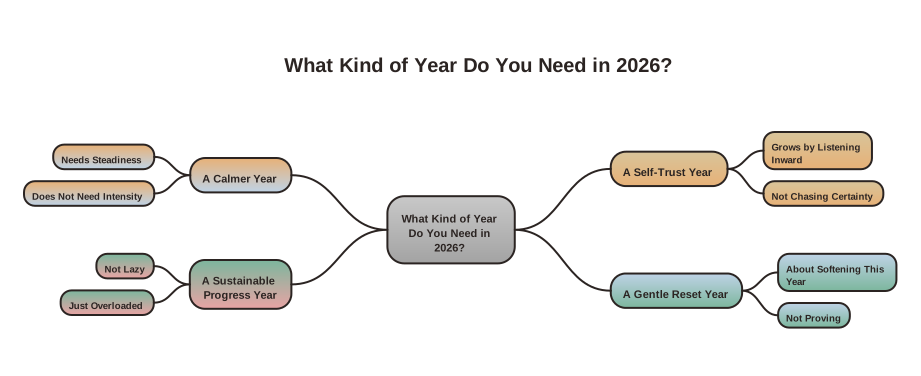
The four year types — the quiz names what your nervous system actually needs.How does this quiz work?
How does this quiz work?
Answer 5 questions about how you usually react, not how you would like to. About 1 minute is the usual time to finish, there are no right answers, and What Kind of Year Do You Need in 2026? scores your result on your device — free, no email, no signup.
When you think about 2026, your first reaction is:
Relief. I just want things to feel calmer.
Pressure. I feel behind and need to catch up.
Curiosity. I want space to explore without a plan.
Exhaustion. I need rest more than goals.
Right now, the hardest part of your day is:
Quiet moments. My thoughts get loud.
Decision-making. Everything feels heavy.
Motivation. I know what to do but can't start.
Boundaries. I give more than I have.
If 2026 felt "successful," it would mean:
I felt more at ease in my body and mind.
I trusted myself more, even when unsure.
I made progress without burning out.
I stopped being so hard on myself.
Which sentence feels most true lately?
"I'm tired of rushing."
"I don't trust my choices."
"I'm capable, but stretched thin."
"I feel like I should be further by now."
This year, you want permission to:
Slow down without guilt.
Take small steps without overthinking.
Rest without needing a reason.
Change your mind without explaining.
What results can you get?
What results can you get?
Your answers sort you into one of 4 results — A Calmer Year, A Self-Trust Year, A Sustainable Progress Year, A Gentle Reset Year. Each result comes with a description of its thinking pattern and one growth move you can practise this week, plus the answer mix that produced it.
Result
Who gets it
What it looks like
A Calmer Year
Majority A answers
You don't need intensity. You need steadiness.
A Self-Trust Year
Majority B answers
Your growth comes from listening inward, not chasing certainty.
A Sustainable Progress Year
Majority C answers
You're not lazy. You're overloaded.
A Gentle Reset Year
Majority D answers
This year is about softening, not proving.
A Calmer Year
You don't need intensity. You need steadiness.
You don't need intensity. You need steadiness.
What it means: your answers lean toward wanting less noise, not more achievement. That usually shows up as racing thoughts in quiet moments and a tiredness with being rushed. A year built around steadiness is not a smaller year; it is a year in which your mind has fewer emergencies to react to.
I don't need to rush to be okay.
Calm is a valid goal.
I can move at a pace that feels safe.
A worked example. Sunday evening, nothing urgent, and the thought arrives: "Everyone else has their life together and I'm just treading water." Realist reframe: "I'm comparing my Sunday-night head to other people's highlight posts. That isn't a fair test." Growth reframe: "Treading water this week means I kept everything afloat. Next week I pick one thing to move forward." Compassionate reframe: "Of course quiet feels loud after months of rushing. I can let it be quiet without filling it."
Where to start: choose one daily anchor that has nothing to prove, such as the same ten-minute walk, a phone-free first coffee or a fixed lights-out time, and keep it for a month. Steadiness grows from repetition, not from intensity.
here's one thing to try tonight: Focus on steadiness over intensity. One calm moment at a time.
A Calmer Year
Where you are
You don't need intensity. You need steadiness.
What to tell yourself
I don't need to rush to be okay.
Calm is a valid goal.
Focus on steadiness over intensity. One calm moment at a time.
Your growth comes from listening inward, not chasing certainty.
Your growth comes from listening inward, not chasing certainty.
What it means: your answers point to decisions that feel heavier than they should, and a habit of checking with other people before you check with yourself. A self-trust year is not about never feeling unsure. It is about acting on small, good-enough choices and letting the results teach you.
I can trust myself without having all the answers.
Small decisions still count.
I'm allowed to learn as I go.
A worked example. After picking a restaurant that turns out to be mediocre: "See, this is why I shouldn't decide things." Realist reframe: "One average dinner is not evidence that my judgment is broken. Most of my choices this week were fine." Growth reframe: "I learned I prefer somewhere quieter. That's useful for next time." Compassionate reframe: "I made a call and it was ordinary. That's allowed. Nobody needs me to be right every time."
Where to start: keep a short decision log for two weeks. Write down one small choice a day, what you expected and what actually happened. Most people find their record is better than their inner voice claims, and the log gives you something concrete to point to when the doubt comes back.
here's one thing to try tonight: Practice one small trust-building decision each day.
A Self-Trust Year
Where you are
Your growth comes from listening inward, not chasing certainty.
What to tell yourself
I can trust myself without having all the answers.
I'm allowed to learn as I go.
Practice one small trust-building decision each day.
What it means: you know what to do and you can do it, but your answers describe a load that leaves nothing in reserve. Starting is hard not because motivation is missing but because every task lands on an already full plate. Sustainable progress means deciding in advance what enough looks like.
Consistency doesn't require exhaustion.
I can move forward without pushing myself too hard.
Progress can be quiet and real.
A worked example. At 4pm with half the list undone: "I wasted the whole day. I'm so behind." Realist reframe: "I finished three of seven things, and two of the rest weren't due today." Growth reframe: "Tomorrow's list gets three items, written before I open my inbox." Compassionate reframe: "I've been carrying too much for too long. Feeling tired at 4pm isn't laziness; it's information."
Where to start: before each day begins, write down the three things that would make it enough, and stop counting after those. If the list is always longer than the day, the problem is the list, not you.
here's one thing to try tonight: Define "enough" for each day before you begin.
What it means: your answers carry the sense that you should be further along by now, plus a habit of giving more than you have. A gentle reset year swaps proving for repairing: less effort spent showing you are doing enough, more room to recover from the stretches when you did too much.
I don't need to earn rest.
I can release what no longer fits.
Beginning again can be quiet.
A worked example. Seeing an old classmate's promotion: "I should be further along by now." Realist reframe: "There is no official timeline. I'm comparing my whole life to one announcement." Growth reframe: "What would I actually want to be further along in? That's worth knowing, and it might not be a job title." Compassionate reframe: "I've been through a lot to get here. Being here is not a failure."
Where to start: pick one thing to stop this year instead of one thing to start, such as a commitment you keep out of guilt or a weekly call that leaves you drained. Saying no once, out loud, is the most concrete version of a gentle reset.
here's one thing to try tonight: Give yourself explicit permission to rest — out loud.
A Gentle Reset Year
Where you are
This year is about softening, not proving.
What to tell yourself
I don't need to earn rest.
Beginning again can be quiet.
Give yourself explicit permission to rest — out loud.
This quiz identifies what your nervous system actually needs heading into 2026 — whether that's calm, self-trust, sustainable progress, or a gentle reset. It's a check-in, not a personality test.
Why do I feel pressure at the start of a new year?
New year pressure often comes from comparison, unfinished goals, and the cultural expectation to "hustle." Your nervous system may need safety and regulation before it can handle expansion — and that's completely normal.
What are the four result types?
The four results are: A Calmer Year (you need steadiness over intensity), A Self-Trust Year (growth through listening inward), A Sustainable Progress Year (moving forward without burnout), and A Gentle Reset Year (softening instead of proving).
Can I take this quiz more than once?
Absolutely. Your needs can shift over time. Retaking the quiz every few months can help you check in with where your nervous system is right now versus where it was before.
Is this quiz scientific?
No. It is a five-question reflection, scored by whichever answer letter you chose most often. It is meant to start an honest conversation with yourself about the months ahead, not to measure a trait. If two letters tie, read both results; most people recognize themselves in more than one.
Do I have to wait for January to use my result?
No. The year type describes what you need now, so it works just as well in the middle of the year. If you are reading this in the autumn, treat your result as a plan for the next twelve weeks rather than the next twelve months.
Why does this quiz focus on self-talk instead of goals?
Because the way you talk to yourself decides how a goal feels to pursue. The same goal, running twice a week, lands very differently with a voice that says "you always quit" and one that says "twice is a good week." That is why each result includes a harsh thought and three kinder answers to it.
What if my result feels wrong?
Read the result for your second most common letter. Five questions can only sketch a pattern, and one hard week can pull your answers toward rest or reset. Go with the result whose worked example sounds most like your own inner voice.
How can MindLift help with my year type?
MindLift is a CBT-based app for the moment a harsh thought shows up. You type the thought, for example "I should be further along by now," and get a kinder response in about 60 seconds, in a Realist, Growth or Compassionate tone. It is free to start on iOS and Android.
Keep exploring
If you are in crisis or thinking about harming yourself, call or text 988 (US) or find a local line at findahelpline.com. MindLift is a self-help tool and not a replacement for professional care.