The 4 Attachment Styles
Your attachment style isn't a personality label — it's the strategy your nervous system learned for staying safe in closeness. Each of the four has a gift, a shadow, and an inner voice: the sentence it repeats when someone goes quiet. Find yours, then learn where it grows.
What are the attachment styles?
Attachment styles come out of attachment theory — John Bowlby's work on the bond between a child and a caregiver, extended by Mary Ainsworth's observations of how infants respond to separation and reunion, and later applied to adult romantic relationships by Cindy Hazan and Phillip Shaver. The idea is simple and uncomfortable: the way closeness worked for you early on becomes the template for how closeness feels now. Four patterns recur — secure, anxious, dismissive avoidant, and fearful avoidant (also called disorganized).
It helps to see them as two dials rather than four boxes: how much anxiety you carry about the relationship, and how much you avoid closeness to manage it. Low on both is secure. High anxiety with low avoidance is anxious. Low anxiety with high avoidance is dismissive avoidant. High on both — wanting closeness and needing to escape it at the same time — is fearful avoidant.
None of these is a diagnosis, and none of them is fixed. Attachment styles are a self-reflection framework, not a clinically validated measure — treat yours as a mirror, not a diagnosis. What makes them worth knowing is that each one generates a specific thought in the moment things get uncertain, and a thought you can catch is a thought you can reframe.
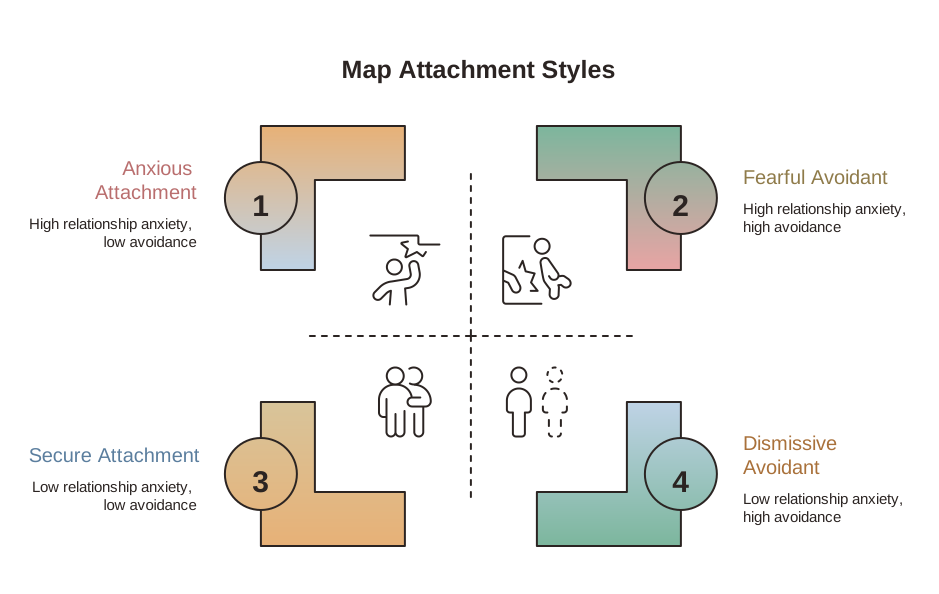
The four styles
Read the one whose shadow stings a little — that's usually yours.
The Secure Attachment
You know love doesn't have to cost you your peace
The Anxious Attachment
You love deeply — your nervous system just hasn't gotten the memo that you're safe
The Dismissive Avoidant
You built self-sufficiency into a fortress — from the inside, it feels like strength
The Fearful Avoidant
You want exactly what terrifies you most
| Attachment style | What it looks like | The inner voice |
|---|---|---|
| The Secure Attachment | You know love doesn't have to cost you your peace | “I'm the stable one — I should be able to handle this.” |
| The Anxious Attachment | You love deeply — your nervous system just hasn't gotten the memo that you're safe | “They're pulling away — I did something wrong.” |
| The Dismissive Avoidant | You built self-sufficiency into a fortress — from the inside, it feels like strength | “I'm fine. I don't need this conversation.” |
| The Fearful Avoidant | You want exactly what terrifies you most | “If I let them in, I'll lose either way.” |
How to find your attachment style
Don't pick the style you'd like to have — look for the one whose shadow you recognise. The strengths are easy to claim; the shadow is the tell. If "I'm the stable one, I should be able to handle this" or "they're pulling away, I did something wrong" makes you wince, you've found your candidate. The clearest evidence isn't how you behave when things are good; it's what you do in the first hour after someone goes quiet.
Two things make self-assessment harder than it looks. First, most people are a blend, and the styles that neighbour each other behave similarly for different reasons — a dismissive avoidant and a fearful avoidant both withdraw, but only one of them finds peace in the distance. Second, your style can look different depending on who you're with; anxious patterns get louder next to an avoidant partner, and vice versa.
That's what the quizzes are for — they separate the neighbouring patterns by asking about specific moments rather than about how you'd describe yourself.
- Attachment Style Quiz — the main one. 10 scenario questions, about 2 minutes, no email, and it returns all four styles ranked with the thought pattern underneath your leading one.
- How you react under stress — a companion quiz for the version of you that shows up mid-argument, after bad news, or three days into silence, when the strategy is running unedited.
- Do I have anxious attachment? — a focused self-check if the reassurance loop is the part you already recognise.
- Do I have avoidant attachment? — a focused self-check if going cold, not clingy, is how conflict tends to end for you.
Whichever you take, the result is a starting point for reflection rather than a verdict. MindLift is free to start, with premium features available.
Common questions
What are the 4 attachment styles?
The four attachment styles are secure, anxious (also called anxious-preoccupied), dismissive avoidant, and fearful avoidant (also called disorganized). Each one describes a strategy your nervous system learned for staying safe in closeness — whether connection generally felt reliable, inconsistent, dismissed, or frightening.
How do I know what my attachment style is?
Read the four styles and notice which shadow section stings rather than which strengths sound flattering — the shadow is the reliable tell. If you want a faster read, the free attachment style quiz is 10 questions, takes about 2 minutes, and needs no email; it names the pattern that leads for you and the thought it generates.
Am I anxious or avoidant?
Watch what you do when a relationship goes quiet. Anxious attachment moves toward: you scan for subtext, re-read messages, and reach out to close the gap. Avoidant attachment moves away: distance brings relief and emotional conversations land as demands. If both are true at once — you want closeness and need to escape it — that combination points to fearful avoidant rather than to either one alone.
What's the difference between dismissive avoidant and fearful avoidant?
Dismissive avoidance largely resolves the conflict by turning the wanting down: independence feels genuinely preferable and distance brings calm. Fearful avoidance never resolves it — the longing stays at full volume alongside the fear, so pulling away brings its own distress rather than peace. Both produce withdrawal; only one of them feels like relief afterwards.
Can your attachment style change?
Yes. Attachment patterns are learned strategies rather than fixed traits, and they shift through repeated experiences of being reliably met plus the practice of catching and reframing the thoughts an older pattern generates — the ordinary machinery of CBT. Moving toward security later in life is common enough to have a name: earned security.
Is an attachment style a diagnosis?
No. Attachment styles are a self-reflection framework, not a clinically validated measure — treat yours as a mirror, not a diagnosis. The value is in recognising the thought patterns the framework names, which you can then work with directly. If a pattern is causing real distress, that is worth taking to a professional rather than to a quiz.
Take the free attachment style test
Which pattern is deciding what you do when someone goes quiet? The free attachment style test takes about 2 minutes — 10 questions, no email, instant results with your leading style, the thought it generates, and a reframe built for it.
Attachment describes how you behave when closeness is at stake; the 12 female archetypes and the 6 style archetypes map other layers of the same self-perception — each with its own gift, shadow, and inner voice. If the anxious pages felt familiar, relationship anxiety usually isn't about your relationship goes further into where that alarm actually comes from.